


Have you ever found a company creating value in so many fields that you can’t really label them? That’s what I felt when I discovered Nagami’s work in 2018 through these 3D printed chairs, and a few years later the Ecolab’s 3D printed store.
At that time, to our community, Nagami was a design studio and an architectural firm. But when I realized the company also develops the manufacturing technologies it is using across its projects, it became a technology and manufacturing company to me.
Today, Manuel Jiménez García, one of the founders of the company, describes Nagami as a digital brand with 3D printing and sustainability at its core:
“We come from architecture, so design and spatial thinking are part of our DNA, but over the last ten years we have had to develop almost every layer required to turn digital designs into physical products: software, robotic processes, extrusion technology, material knowledge, engineering and, ultimately, the manufacturing infrastructure itself.
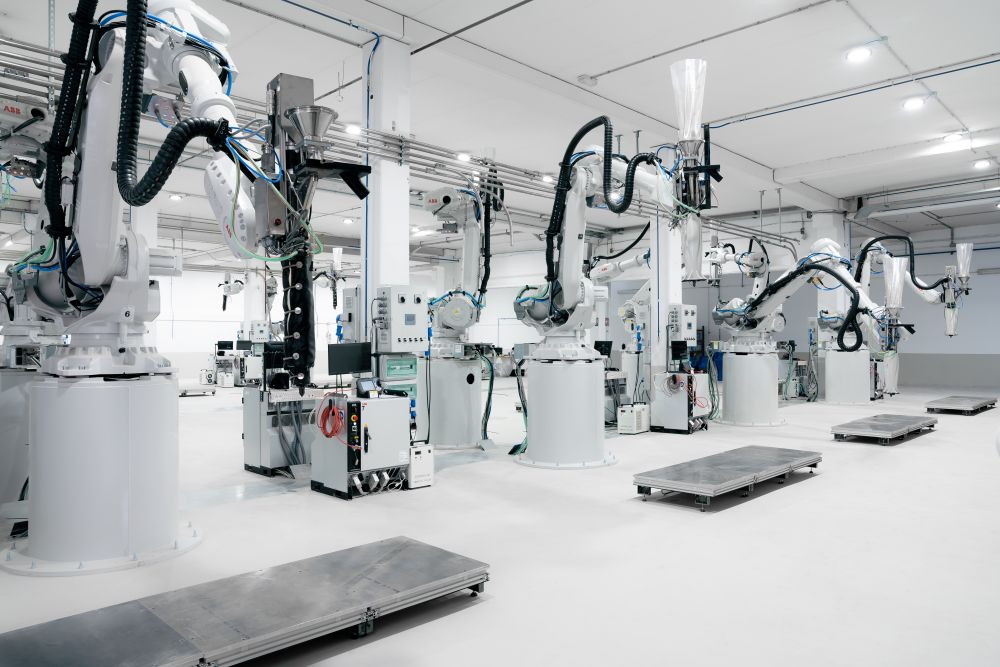
So, I don’t think the real asset is either the software or the robot farm independently. The real asset is the integration of all of these elements into one manufacturing system that can help bring unprecedented design to life.
Today, when we start conceiving a design from the digital – either from our design studio or in collaboration with others – we understand how to optimize it for manufacturing, how to generate the robotic toolpaths, how the material will behave and how to manufacture it reliably at scale. That accumulated knowledge is probably more valuable than any individual robot.”

Jiménez García founded the company in 2016 in Spain along with two other architects, Miguel Ángel Jiménez García and Ignacio Viguera Ochoa. Born around 3D printing, the company’s ambition has always been to transform the way products, interiors, and architecture are made by using digital design and robotic 3D printing to go directly from data to full‑scale, finished objects, eliminating tooling and unlocking new geometric freedom.
The current state of manufacturing in large-scale 3D printed architecture and how Nagami stands out
Nagami’s founders started their journey with limited resources and relied on a second-hand industrial robot and a prototype extruder as sole equipment. This modest equipment underscores how different their manufacturing approach was from those building a conventional manufacturing company for the architecture sector.
At the time, large-scale AM in architecture, as we have covered it over the years, had revealed that three broad families of technology matter for this field:
- Cementitious extrusion at construction scale. In this setup, the machine (gantry or arm) exists to place structural material at or near the site as seen in for example, ICON’s printed homes in Texas, or the film studio realized in Austria with Incremental3D
- Clay and ceramic deposition as seen in several examples shared by WASP: the Dropcity concept or the pendant lamps developed with Paolo Castelli
- And polymer pellet extrusion for architectural and interior components as seen in Aectual’s façade for the BOSS store in Istanbul and more recently ceilings and storefronts for lululemon, Model No.’s furniture, or the twenty benches installed in Minneapolis’s Crystal Court.
Nagami’s technology, robotic arms with pellet extrusion, belongs to that third family. According to Jiménez García, using the robot was finding a way out of the Cartesian structure:
“An industrial robotic arm gives you six axes of movement and therefore the possibility of thinking beyond conventional horizontal layer-by-layer printing.
In practice, much of what we manufacture today still uses layered deposition, because it is efficient and reliable, but the robotic platform gives us a much larger field of possibilities: different orientations, non-planar deposition, multiple tools and hybrid manufacturing processes.
Pellet extrusion was equally important. Filament is excellent at smaller scales, but once you start thinking about furniture, interiors or architectural components, pellets become much more logical economically and materially. You can achieve much higher deposition rates and work much closer to the raw material itself.
That becomes particularly important when working with recycled materials.”
The focus on recycled materials
Remember when we said that recycling has become a central focus in advancing sustainability within Additive Manufacturing (AM)? Well, the architecture and construction sectors are filled with examples of projects that demonstrate how recycled and waste-derived feedstock has been leveraged over the years across projects.
As a matter of fact, the Ecolab’s 3D printed store was one of the projects that drew further our attention to Nagami as it revealed a move from the widely used PLA to recycled PETG. Furthermore, across the many projects 3D ADEPT Media covered over time, the concern I often see most companies face is consistency in the use of these materials for their projects. Biodegradable and recycled filaments often carry variable ingredients and irregular physical properties that shift with their source and even the season.
“In the early years, PLA was an accessible material that allowed us to understand the process and demonstrate what large-scale robotic printing could achieve. But very quickly we realized that if we wanted this technology to become a real industrial manufacturing process, material circularity had to be part of the equation. But if the material itself is virgin and the product has no strategy for its next life, you are only solving part of the problem.
That is why we progressively moved toward recycled thermoplastics, particularly recycled PETG. It gives us the mechanical performance, visual quality and recyclability we need for many of our applications.
The Ecoalf store in Madrid was an important demonstration of this philosophy at architectural scale. We transformed recycled plastic into almost the entire interior landscape of the store through robotic 3D printing”, Nagami’s founder explains.
That said, with robotic 3D printing at the center of their production strategy, Nagami is well positioned to make the move towards recycled materials a key part of its technological evolution and conviction.
The reason is recycled plastic works because of 3D printing. “Traditional manufacturing processes often require extremely standardized material properties because the material has to behave within very narrow tolerances inside molds, dies or other fixed tooling.
Of course, recycled plastics introduce variability, and you still need control over contamination, moisture, viscosity and mechanical properties. But because the manufacturing process is digitally controlled, many parameters can be adjusted.
More importantly, there is no mold defining the final geometry. That gives us much greater flexibility both geometrically and materially.
For me, this is one of the most interesting aspects of the technology: the imperfections and variability of recycled material don’t necessarily have to be hidden. They can become part of the identity of the product,” Jiménez García told 3D ADEPT Media.
Beyond large-scale 3D printed structures: rethinking what a factory can be

Ask Jiménez García which early decision everything has depended on, and it was the one to build the technology they needed themselves. That single decision has helped Nagami expand its expertise and become the technology and manufacturing company I described earlier.
But building a great product is not enough to guarantee success. The AM industry is full of examples of great technologies that disappeared along the way which is why an equally important decision for this Spanish design brand was how it would introduce itself to the world.
According to Jiménez García, that was through collaborations with the likes of Zaha Hadid Architects, Ross Lovegrove and Daniel Widrig. “Their design ambitions demanded that we advance the technology and develop entirely new processes to realize objects that could not have been made in any other way”, he adds.
What he concedes they got wrong is probably a lesson much of the AM industry has learned over the same decade: In 2016, the revolution looked like the ability to print large objects. Ten years later, industry experts have realized that producing one extraordinary piece and producing it hundreds of times are different disciplines.
This has somehow helped Nagami define distributed manufacturing as its long-term goal: the same digital file manufactured in Ávila, Dubai or New York, close to where the product is needed, from locally available recycled material, without molds, without shipping finished goods across continents, without large inventories.
Achieving that requires to address existing concerns technology providers are facing: certification across jurisdictions, quality constraints and in this specific case, consistent recycled feedstock at every site.
This long‑term ambition also clarifies the studio’s position on technology adoption. Jiménez García wouldn’t rule out licensing the company’s technology, and he isn’t looking to fill Ávila with more robots. Instead, he wants to deepen the capabilities already in place, pairing robotic deposition with milling, finishing, assembly and other materials. And while software will be essential to making that integration possible, the ultimate goal is to bring these processes together in a way that rethinks what a factory can be.
THE 3D ADEPT WEEKLY NEWSLETTER Every week, the latest additive manufacturing news, in-depth features and real-world applications, straight to your inbox. Plus, be the first to know when a new issue of 3D ADEPT Mag is out. Free · One email a week · Unsubscribe anytime Clicking loads our email provider’s sign-up form, including its analytics and Google’s anti-bot protection. You’re only subscribed if you complete the sign-up. Read our privacy policy.The industry moves fast. Stay ahead.