There is a particular frustration that intensifies in hospital corridors, point-of-care labs, and boardrooms across Europe; the one of people who know clinically, technically, intuitively that a 3D-printed patient-specific device delivers better care and who cannot yet get the system to agree.
We have been following this conversation for some time. In a previous dossier, we explored the current state of public policies that help patients benefit from 3D-printed implants, mapping a landscape of national fragmentation, regulatory uncertainty, and missed connections between innovators and payers.
What we found, above all, was a technology maturing faster than the frameworks designed to absorb it but also, countries working in silos to get 3D printing approved by healthcare systems.
This dossier picks up where that conversation left off and goes deeper.
We spoke with three experts who each hold a piece of this puzzle:
- Kinga Meszaros brings the health economics lens, grounding the reimbursement debate in how European payers actually make decisions.
- Laura Cercenelli speaks from inside a university hospital point-of-care 3D printing lab in Emilia-Romagna, Italy, where the gap between what clinicians ask for daily and what the system is willing to fund is felt in very concrete terms.
- And Naomi Nathan, as a convener through Medical Goes Additive (MGA), has made it her work to ensure that – all relevant stakeholders; hospitals, manufacturers, researchers, and policymakers stop talking past each other and start building something together.
We understood the list of barriers that need to be addressed. Through this dossier, we explain these barriers and the main stakeholders involved, and map what needs to happen next, and who needs to show up to make it possible.
Who should read this dossier, and what they will take away:
- Additive manufacturing companies and technology providers will find a clear articulation of why evidence generation is mandatory in this journey and what a well-structured economic argumentation for payers requires. Most importantly, this dossier emphasizes that the reimbursement conversation is not happening without you, but it cannot be led by you alone.
- Hospital administrators, clinicians, and point-of-care lab managers will recognize the structural challenges described here and hopefully, find frameworks that can help them make the case for funding, from DRG logic to coding strategies to multi-center evidence design.
- Health economists, HTA bodies, and payers will understand how the 3D printing field is working to speak their language and where the evidentiary gaps remain that their decisions depend on.
- Policymakers and European institutions will see both the fragmentation that needs addressing at a systemic level, and the collaborative project models, including the Innovative Health Initiative – Public-Private Partnership (PPP) funding mechanisms, already working to bridge it.
The system is not ready yet. But the people determined to change are organized, rigorous, and increasingly aligned. This is their conversation.
Part I | The health economics perspective: Speaking the language payers understand
Based on the expertise of Kinga Meszaros, Health economics and policy professional with focus on European health and social systems.
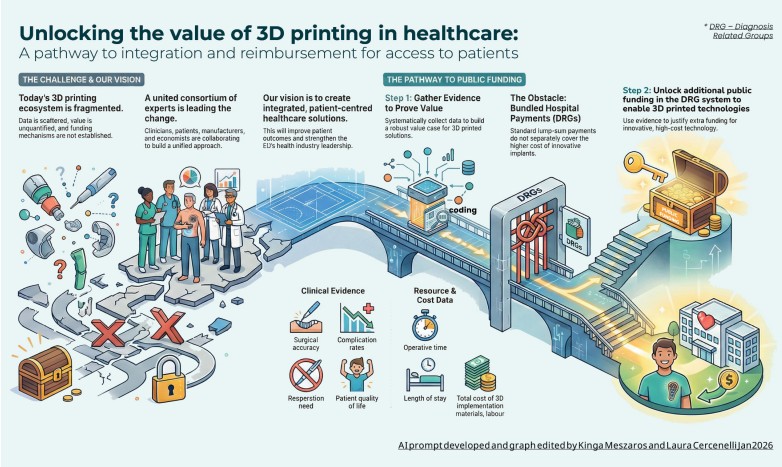
The journey from innovation to access is a two-step process most AM companies misunderstand.
Any health technology (a drug, a vaccine, a medical device) has to clear two distinct gates before a patient can access it within a healthcare system: market authorization and public funding (often referred as reimbursement).
Market authorization: the regulatory green light confirming that a product is safe and fit for human use. In Europe, this is handled at the centralized level by the European Medicines Agency (EMA) for medicines, and through the CE marking framework for devices.

But clearing that first gate does not open the door to patients. As Kinga Meszaros explains: “Once a product is available on the market, the next question is: is it something that can be widely used in the setting of healthcare? And that is driven by two aspects. One is that the clinical community includes it in their practice, for example in their clinical guidelines. The other is that there is public funding to cover the costs, so that patients can actually access the intervention and afford in case of any need for co-payment.”
Public funding: Complexity begins here, and the additive manufacturing community is still learning the rules.
In Europe, unlike the centralized approach to market authorization, decisions on public reimbursement are made at the national level. Each member state manages its own healthcare budget, its own coverage logic, and most of the countries have their own HTA (Health Technology Assessment) body. The result, as Meszaros puts it plainly, is a system that is “very heterogeneous within the different countries.”
For medicines, the reimbursement pathway, while variable, follows a relatively established logic in most of the countries: a manufacturer submits a dossier, an HTA body evaluates clinical and economic evidence, a decision is made.
For medical devices, the picture is considerably less transparent. Devices tend to be reimbursed not as standalone products but as components absorbed into what are called Diagnostic Related Groups (DRGs), funding decisions move to regional or hospital level, and that distinction matters enormously.
The DRG problem: Why 3D printing doesn’t show up in healthcare budgets

The Diagnostic Related Group (DRG) system is the dominant funding mechanism for hospital procedures across Europe. Rather than reimbursing each element of a surgical intervention separately, the DRG assigns a fixed lump sum to an entire procedure; one global payment that is supposed to cover everything from bed sheets and anaesthesia to the implant itself.
Meszaros offers a vivid illustration: “That DRG code for, say, a spinal surgery includes the cost of cleaning, the electricity bill of the operating room, the payments for the healthcare professionals and it includes the surgical guide, or the implant itself as needed.”
This is precisely where the problem emerges for medical 3D-printed devices. When a patient-specific implant costs significantly more than the standard version it replaces, that additional cost has to come from somewhere within the same fixed payment envelope. Hospitals face a structural disincentive, even if they can use the 3D enabled solutions reimbursed at the same level as the standard solutions: absorbing a higher-cost technology into a DRG designed for the standard of care means they either operate at a loss or forget the innovation altogether.
This is fundamentally different from how drugs are handled. A pharmaceutical product can be priced and reimbursed as a distinct line item. The cost is identifiable and traceable. A 3D-printed surgical guide used in a spinal procedure? It disappears into the bundle, invisible to the payer.
Medicine vs. medical device vs. 3D print-enabled personalized care: why these distinctions matter

Meszaros insists on a clarification that may seem technical but has real consequences.
A medicine or vaccine has an identifiable cost, a predictable dosage, and an established reimbursement logic. A standard medical device is often bundled into a DRG but follows a relatively defined pathway for market access. A personalized, 3D-printed enabled device introduces a third layer of complexity: it is not a product in the traditional sense. It is a technology applied within a surgical flow, customized to an individual, and often co-produced by a combination of hospital staff, external software, and manufacturing infrastructure.
“3D enabling or personalization itself is a technology,” Meszaros notes. “It’s not a product itself, it’s not a service itself – it is a potentially value-adding feature of them. This technology can be used across several disease areas and phases of the surgical flow, and is seen still as part of the same flow in the respective solution, including the service and product, under an existing DRG..”
This cross-cutting nature of AM as a technology platform (not a single product for a single indication) creates a market access challenge unlike anything payers have typically dealt with. Building a reimbursement pathway requires thinking at the level of surgical flows and value frameworks.
What “value” actually means to a payer and why AM companies do not speak that language

When a European payer looks at a 3D print-enabled surgical intervention and asks whether it justifies additional funding, they are running a specific mental calculation. What is the measurable health outcome improvement or cost saving compared to the standard solution that justifies that premium?
As Meszaros explains, payers are accustomed to comparing technologies in a structured way: “The payer thinks: what is the better health outcome that can justify that amount of money? How many days less does hospitalization take? How much faster is the surgical intervention taking place, freeing up resources for other interventions? How much less rehospitalization occurs one year after the surgery?”
The data answering these questions are inputs to cost-effectiveness models, the tools that allow payers to compare investment in a 3D print-enabled spine procedure against investment in, say, an oncology treatment or a cardiovascular drug, with showing the results in the common denominator of cost of one unit of health gain (incremental cost-effectiveness ratio).
What would a well-structured economic case for a 3D-printed orthopedic implant actually look like? According to Meszaros, it would need to map and quantify the full costs and health outcomes of the entire surgical flow, from pre-operative planning (anatomical models, surgical guides) through the procedure itself to recovery and follow-up.
It would require data collection and modelling studies to help establish those cost-effectiveness ratios and budget impact results. And it would need to demonstrate value in a language payers already use: quality-adjusted life years, complication rates, re-hospitalization rates, surgical accuracy metrics and budget impact.
The challenge is that most studies in the AM field, while increasingly robust on the clinical side, does not (always) have a solid economic dimension. “Most of these scientific papers are more focused on clinical evidence,” Laura Cercenelli confirms. “The lack is, in part, probably the economic evidence.”
The IHI framework, described in more detail below, is specifically designed to close that gap.
A word for AM companies: your role in building the evidence base
One of the most direct messages to emerge from this conversation was addressed implicitly to AM technology providers. The reimbursement pathway will not be built on clinical enthusiasm alone. Manufacturers who believe their solutions deliver better outcomes but cannot demonstrate it in the language the system requires are, in practical terms, not yet ready for the healthcare system.
“Manufacturers must align on their perception of value,” the background materials from Meszaros state, “and provide shared data comparing their technology to the standard of care.” That means participating in the evidence-building process, including multi-stakeholder consortia, data collection aligned with registry frameworks, and economic evaluations conducted in collaboration with health economists and hospital finance experts.
The good news: there is a structural parallel that offers encouragement. Robotic surgery navigates this pathway. The stakeholders got together, and shared relevant case studies to be discussed with broad stakeholders in this white paper.
With that example, I trust AM technology providers can do their homework.
Part II | Clinical Evidence: Proving what surgeons already know
Based on the expertise of Laura Cercenelli, biomedical engineer and senior staff at eDIMES Lab, a university hospital 3D point-of-care lab led by Prof. Emanuela Marcelli, in Bologna, Emilia-Romagna, Italy

Ask a clinician when the question of reimbursement first enters the room, and the answer reveals a great deal about the current state of 3D printing in healthcare.
For Laura Cercenelli, whose point-of-care lab produces anatomical models and patient-specific surgical aids for surgeons across multiple specialties, the answer is clear: reimbursement becomes an urgent conversation at the moment of scaling.
“The topic of reimbursement usually emerges when there is a need to move from a single case or pilot use toward broader implementation,” she explains. “The question comes mainly from the hospital administration, in close collaboration with clinicians and 3D PoC lab staff since they perceive the clinical value and workflow impact.”
It is worth pausing on that dynamic: The clinician perceives the value and asks for the technology. The 3D lab delivers it. The administration looks at the accumulating costs and asks: how do we pay for this? That sequence (value first, cost conversation second) is both understandable and structurally problematic. By the time the reimbursement question enters the room, the technology is already being used, the costs are already accumulating, and the evidence base may not yet be in place to justify formal funding.
From anatomical models to surgical guides to implants: the spectrum that doesn’t yet have a single solution
One of Cercenelli’s most important contributions to this conversation is a clarification between anatomical models, surgical guides, implants and their rapport with reimbursement.
She draws a clear progression: at one end, anatomical models used for preoperative planning; in the middle, 3D-printed cutting guides and surgical aids that help the surgeon during the intervention; at the far end, patient-specific implants; the full surgical flow from design through manufacturing to implantation.
Each level represents a different degree of complexity, a different regulatory status, and, interestingly, a different relationship to the current reimbursement landscape. “Reimbursement models should be structured across different categories of 3D print-enabled personalized treatments,” Cercenelli argues, “ranging from 3D anatomical models for preoperative planning, to 3D-printed surgical aids, and ultimately to implants. These represent increasing levels of complexity, and should correspond to distinct billing codes and, likely, different reimbursement categories.”
The situation today is uneven. At the implant end of the spectrum, particularly for complex orthopedic cases, some reimbursement pathways exist, although fragmented and local. Anatomical models and cutting guides, despite being produced and delivered daily in labs like Cercenelli’s, “are generally not reimbursed.” Surgeons request them because they trust them. The lab delivers them because the clinical value is evident. And the cost sits in a grey zone that the healthcare system has not yet decided how to address.
A concrete example: the megaprosthesis case from Emilia-Romagna
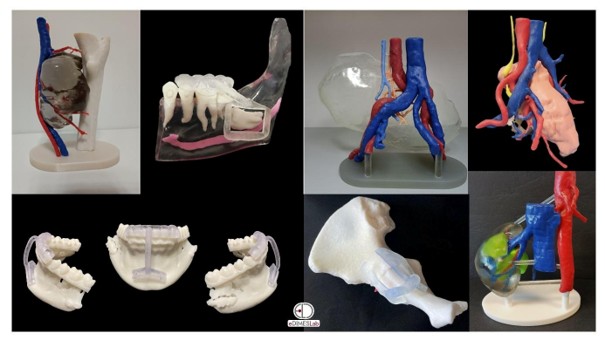
Cercenelli offers a specific, instructive example from her own region. In the orthopedic field in Emilia-Romagna, a specific category has been identified for custom-made prosthetics, the so-called “megaprostheses.”
For eligible cases, the regional healthcare system provides an additional DRG payment above the standard implant reimbursement. The hospital receives a capped annual budget covering a predefined number of such cases, and clinicians decide, based on clinical indication, which patients benefit.
“In some sporadic examples, we have already established a sort of reimbursement,” Cercenelli notes, “but it is not a common practice in Italy and I think Europe is also fragmented in terms of recognizing the value of 3D personalization.”
This example reveals how local and contingent current solutions remain. A regional healthcare authority in one Italian region may have recognized the value of 3D printing here but, the hospital across the border operates under a different framework entirely. This is the fragmentation that any European-level solution has to overcome.
What “clinical evidence” actually means in a reimbursement dossier
The phrase “clinical evidence” is used frequently in discussions about AM in healthcare. Cercenelli is careful to define exactly what it needs to mean in the context of a reimbursement dossier, because the bar is higher, and the requirements more specific, than many in the AM field can tell.
“Clinical evidence needed for a reimbursement dossier goes well beyond safety and technical performance of the 3D-printed device. It’s really about demonstrating its value in real clinical practice.”
That means comparative outcomes versus the current standard of care, measured across multiple dimensions:
- Clinical outcomes (complication rates, revision rates, device durability),
- Patient-reported outcomes (quality of life, pain scores),
- Time and efficiency metrics (surgical time, procedural accuracy), and
- Resource utilization metrics (length of hospital stay, follow-up visits, direct costs of 3D implementation).
The last category, cost data, is where the literature is most thin. “Currently, the literature offers limited insight into these costs, as most studies focus primarily on clinical outcomes. This creates a significant gap in building robust economic evaluations.”
For payers specifically, single-center studies can establish proof of concept, but they rarely suffice for coverage decisions. The variability introduced by personalization (each patient, each device, each clinical setting slightly different) makes it harder to generalize from one center’s experience to a population-level recommendation.
Multi-center, comparative studies are needed. And those studies require something that is still underdeveloped across Europe: standardized frameworks for data collection, uniform coding systems, and coordinated protocols across institutions.
The orthopedic implant lifecycle: where the pathway breaks down

Walking through the lifecycle of a 3D-printed orthopedic implant reveals exactly where the system strains. The clinical and technical sequence is, by now, relatively well-defined: medical imaging and patient-specific design, design validation by clinician and engineer, additive manufacturing and post-processing, regulatory conformity assessment, implantation, and post-market follow-up.
“Technically, the pathway is quite well defined,” Cercenelli acknowledges. “Where things start to break down is on the regulatory and evidence side.”
From a regulatory standpoint, the classification questions — patient-matched versus custom-made device, in-house production versus outsourced manufacturing — remain inconsistently interpreted across EU member states. The MDR (Medical Device Regulation) introduced clearer frameworks, including Article 5.5 for in-house production, but their application varies.
From an evidence standpoint, the challenges are different for industry-driven implants than for point-of-care applications:
- For industry: data tends to be fragmented across centers, patient populations are small and heterogeneous, and controlled comparative studies are difficult to design.
- For PoC: the regulatory ambiguity compounds the evidence challenge, because variability in design, manufacturing, and clinical workflow across sites makes it harder to aggregate data in a standardized way.
Point-of-care manufacturing: the grey zone that needs a framework
The grey zone between “medical device” and “hospital-produced product” is perhaps the most structurally complex challenge in the field. A hospital lab that designs and manufactures a cutting guide for a specific patient’s surgery is doing something that does not map neatly into traditional regulatory categories.
“Point-of-care production can introduce variability in design, manufacturing, and clinical workflows,” Cercenelli explains. “This reduces reproducibility and makes it more challenging to aggregate data in a standardized, comparable way that is meaningful for health economists.”
The consequence is circular: PoC labs cannot produce the kind of standardized evidence HTA bodies need, partly because they lack the frameworks to collect it, and partly because the regulatory uncertainty shapes what they can and cannot share across borders.
The solution Cercenelli points toward is twofold:
- First, shared frameworks and coding systems need to be developed: standardized identifiers for different types of 3D printing applications within electronic health record systems.
- Second, adoption itself needs to be traced systematically.
Whether we talk about point of care manufacturing or implants or surgical guides, the US provides a useful reference: Category III CPT codes for 3D-printed anatomical models and guides, and New Technology APC codes proposed by the American College of Radiology for 3D printing services, have created a mechanism to track usage, not yet tied to reimbursement, but building the dataset that could eventually justify it.
“We should work together to set up registries to collect data, to trace the adoption of this technology, following the example from the United States,” Cercenelli urges. “Trying to identify some preliminary codes more related to tracing the usage of this technology; not yet directly related to reimbursement, but a starting point.”
The IHI Funding: enabling the evidence Europe needs

Imagine the practical obstacles to running multi-center randomized controlled studies for 3D-printed devices are real: standardization challenges across sites, small patient populations, workflow variability, regulatory differences between national frameworks, and the sheer coordination and funding required. Such undertakings require large multi-stakeholder consortia that bring together industry, hospitals, and academia to provide outcomes that payers and policymakers can act on.
What the IHI (Innovative Health Initiative) funding is designed to do, is enable both private and public stakeholders work together to bring innovative interventions to European Health systems. This year MGA worked with various partners to convene 40+ stakeholders to build a consortium for the IHI project to enable the pathway to reimbursement. Unfortunately the consortium has to dissolve as we realized that we still need a lot of work in the 3D Printing community to align on such efforts, and in the meantime we need to keep the dialogue ongoing and keep building towards the goal to enable patients to access the care that they need– this is what, Nathan, as Head of Medical remains committed to.
Part III | Building the ecosystem: Convening the people who need to find each other
 Based on the expertise of Naomi Nathan, Head of Medical, Medical Goes Additive (MgA)
“All our stakeholders romanticize reimbursement.“
Naomi Nathan’s framing of the challenge is characteristically direct. As she put it from the outset: “All our stakeholders romanticize reimbursement, yet they are unaware of the proper steps to take to enable it.”
It’s a point that deserves a moment of reflection: There is this common belief across the AM healthcare ecosystem, that demonstrating clinical value is sufficient to unlock funding. That if the technology works, the system will recognize it. Or that the evidence, once gathered, will speak for itself.
It does not. Healthcare systems are complex, politically administered, budget-constrained, and deeply conservative when it comes to adopting new funding categories. At the end of the day, 3D printing remains one among an array of health technology solutions. That’s why, the community has to go to the health economist, with evidence, with economic models, with coordinated advocacy.
What MgA actually does when it convenes stakeholders
Medical Goes Additive positions itself as a convener and it’s crucial to understand what the stakes actually require.
The stakeholders around the table in this field have different incentive structures, different timelines, and different definitions of success:
- Hospitals are focused on patient outcomes and operational sustainability.
- Device manufacturers are focused on market access and commercial viability.
- Health economists are focused on the frameworks that will allow payers to act.
- Regulators are focused on safety frameworks that may not yet fully account for personalized manufacturing at the point of care.
- And patients, who are, as Nathan emphasizes, “not really engaged” in these conversations to the degree they should be, are at the center of the entire exercise.

“If stakeholders are not aligned,” Nathan says, “we will continue having this fragmentation problem. Because everyone will be doing their own thing. And at the end of the day, health systems do not respond to that. We have to come together.”
In Nathan’s analysis, fragmentation is the core structural problem. Individual hospitals run their own registries. Individual manufacturers conduct their own studies. Individual countries fund pilot programs that never connect to broader evidence pools.
The 3D printing community’s is very fragemented for its size and it’s tendency to do things alone. As Nathan states, “everyone wants to do their own thing” and this, in terms of the goal we want to achieve, is counterproductive.
“Even Big Pharma comes together to make sure that they have a collective effort. If the message is we want to really tackle this problem, we have to collaborate and make it work and not have siloed approaches,” she adds.
The language gap is closing slowly
The language gap, Nathan believes, has begun to close. The presence of economists like Kinga Meszaros, the work of PoC labs like Cercenelli’s on evidence generation, the IHI framework’s structured approach to multi-center studies…all of this represents the AM community investing in the translation work the system requires.
But the closing is not yet complete. “Payers still see us as people who are just printing toys,” Nathan says, frankly. “There is no credible evidence, and we all know that the healthcare system is quite complex. We have to do ourselves the duty of showing this to the healthcare system decision-makers, because they are already inundated with so much innovation.”
The patient gap: the most urgent frontier

If the language gap is beginning to close, the patient gap remains wide open.
“We don’t really engage with patients,” Nathan acknowledges. “And yes, that’s a big gap.”
This matters for reimbursement in ways that go beyond optics. Payers and HTA bodies are increasingly required to incorporate patient perspectives into coverage decisions. The EU MDR has added explicit provisions requiring demonstration of end-user benefit. Patient-Reported Outcome Measures (PROMs) are a standard input to health technology assessments. And the EU AI Act’s provisions on high-risk medical AI systems further reinforce the centrality of patient safety and benefit documentation.
Without patient engagement, without data on benefits to patients, on quality of life, on satisfaction, on expectations, on the lived experience of receiving a personalized device versus a standard one, the economic case for 3D print-enabled care is missing its most human dimension.
You cannot lobby without the patients. “You cannot go to the next stage, which is advocacy, without them,” Nathan insists. “This is really key.”
Standardization: necessary but not sufficient
I believe MGA’s role may sometimes extend to the standardization debate, which is where the structural work of ecosystem building meets the operational reality of diverse institutions.
Although standardization is necessary for several reasons, Nathan is careful not to overstate what standardization alone can achieve.
The funding dimension: two angles worth keeping in mind
When Nathan speaks about funding, she highlights two specific types of funding:
The first is public research and infrastructure funding, primarily from the European Commission. This is the funding that enables researchers like Cercenelli to generate the clinical and economic evidence the field needs, that supports the multi-center studies the IHI framework is designed to produce, and that develops the coding and registry infrastructure on which real-world evidence depends.
“If you Google ‘funding for additive manufacturing in healthcare,’ you don’t see it,” Nathan observes. “We need this kind of specialized funding to show that, if we go forward, this technology will be able to enter into health systems.”
The second is industry funding and co-investment, the commitment from manufacturers and technology providers to participate in joint evidence-building projects, to share data across competitive lines, and to accept that market access requires collective infrastructure investment. The IHI framework exemplifies this model: co-funded by the European Commission and co-supported by industry, it is neither purely public nor purely commercial.
Both funding streams are necessary. And both require the kind of aligned stakeholder ecosystem that MGA is working to build.
Europe has therefore a genuine interest in developing a robust, locally-grounded and competitive 3D-print-enabled healthcare manufacturing capability, both for patient benefit, and for industrial competitiveness.
Part IV: Key takeaways, and what we are watching next

Three perspectives, one shared diagnosis: the challenge of reimbursement for 3D-printed devices in Europe is not primarily a technical problem. Additive manufacturing is mature enough to be considered. We have covered thousands of applications that demonstrate it.
The challenge, in my view, remains a set of fragmented, underdeveloped, and sometimes misaligned systems that were not designed with personalized, technology-enabled care in mind.
From Kinga Meszaros, we learned that payers speak a specific language, and that the AM community needs to develop fluency in it. The DRG system, designed for standardized procedures, structurally disadvantages technologies that increase upfront cost while delivering value downstream. Bridging that gap requires economic models, not just clinical data.
From Laura Cercenelli, we learned that the reimbursement challenge corresponds to different categories of 3D printing implementation. Anatomical models, surgical guides, and full patient-specific implants require differentiated approaches. The evidence architecture that will support reimbursement for these different categories has to be built with the same care as the devices themselves: systematically, collaboratively, and with a clear sense of what the payer will ultimately need to see.
From Naomi Nathan, we learned that collective action, with all relevant stakeholders is not a strategy of last resort; it is the only strategy. Healthcare systems respond to organized communities who have done the homework, built the evidence, and arrived at the table with a coherent ask.
Structural changes that would move this forward
Based on this conversation, three structural shifts would meaningfully accelerate the path to reimbursement for 3D print-enabled care in Europe.
First, a European coding and registry framework for 3D printing applications in healthcare. The US has begun this work with CPT Category III codes and APC codes for 3D printing services. Europe needs a comparable initiative, fit for its healthcare architecture, that allows adoption to be tracked systematically and evidence to be gathered at scale.
Second, explicit recognition of 3D print-enabled surgical flows as a distinct value category in HTA frameworks. The current tendency to absorb personalized devices into standard DRG codes makes the value of personalization structurally invisible. Dedicated assessment frameworks, or at minimum dedicated add-on payment mechanisms modeled on what exists in some regions for complex orthopedic cases, would create the financial signal that incentivizes adoption.
Third, patient engagement as a formal requirement of AM healthcare programs.
What we are watching
Several developments warrant close attention in the months ahead:
The IHI framework remains the most significant structured initiative in this space. Its ability to deliver harmonized clinical and economic evidence across multiple European centers and clinical applications will be a defining test of whether collaborative evidence generation at scale is possible in this field.
The evolution of EU MDR implementation, particularly the interpretation of Article 5.5 for in-house production and the guidance being developed for custom-made devices, will shape what PoC labs can and cannot do, and how their output will be regulated and evidenced.
The US parallel, particularly around Medicare/Medicaid reimbursement for 3D-printed prosthetics and the coding frameworks the American College of Radiology has proposed, offers a useful reference point.
And perhaps most importantly: the conversations happening inside the ecosystem, between manufacturers and hospital finance teams, between PoC labs and health economists, between advocacy organizations and European Commission officials; in a nutshell, conversations where the real work of alignment are taking place.
This dossier is, in part, a record of some of those conversations. We intend to keep following them.
Responses from experts have been edited for brevity and clarity. This dossier has first been published in the healthcare 3D printing edition of 3D ADEPT Mag.
References
- Baghbanian, A., Carter, D., & Merlin, T. (2025). Methods for the health technology assessment of complex interventions: A scoping review. PLOS One, 20. https://doi.org/10.1371/journal.pone.0315381
- Blüher, M., Saunders, S., Mittard, V., Torres, R., Davis, J., & Saunders, R. (2019). Critical Review of European Health-Economic Guidelines for the Health Technology Assessment of Medical Devices. Frontiers in Medicine, 6. https://doi.org/10.3389/fmed.2019.00278
- Cangelosi, M., Chahar, A., & Eggington, S. (2023). Evolving use of Health Technology Assessment in Medical Device Procurement – a Global Systematic Review. Value in Health. https://doi.org/10.1016/j.jval.2023.06.005
- Conrads-Frank, A. et al. (2022). Decision-analytic modeling for early health technology assessment of medical devices – a scoping review. GMS German Medical Science, 20. https://doi.org/10.3205/000313
- Dettori, J., Henrikson, N., & Ecker, E. (2009). Health technology assessment. International Journal of Technology Assessment in Health Care, 25. https://doi.org/10.1017/s0266462309090345
- Fernandez, J., De Boissieu, P., & Galbraith, M. (2025). Health Technology Assessment in Europe: a comparison of organizations and introduction to the European regulation. Presse médicale, 104282. https://doi.org/10.1016/j.lpm.2025.104282
- Hunter, A. et al. (2018). EUPATI Guidance for Patient Involvement in Medicines Research and Development: Health Technology Assessment. Frontiers in Medicine, 5. https://doi.org/10.3389/fmed.2018.00231
- Kirwin, E., Round, J., Bond, K., & McCabe, C. (2022). A Conceptual Framework for Life-Cycle Health Technology Assessment. Value in Health, 25(7). https://doi.org/10.1016/j.jval.2021.11.1373
- KCE Belgium (2022). Responsible use of high-risk medical devices: the example of 3D-printed medical devices. https://kce.fgov.be/en/publications/all-reports/responsible-use-of-high-risk-medical-devices-the-example-of-3d-printed-medical-devices
- Llorian, E. et al. (2023). Frameworks for Health Technology Assessment at an Early Stage of Product Development. Value in Health. https://doi.org/10.1016/j.jval.2023.03.009
- Ming, J. et al. (2022). Health technology assessment of medical devices: current landscape, challenges, and a way forward. Cost Effectiveness and Resource Allocation, 20. https://doi.org/10.1186/s12962-022-00389-6
- Pimenta, J., & Vieira, A. (2025). Selection and Prioritization of Medical Devices for HTA Evaluation: A Systematic Review. Applied Health Economics and Health Policy, 23. https://doi.org/10.1007/s40258-025-00981-w
- Polisena, J., Williams, D., & Ciani, O. (2019). Health technology assessment of medical devices. Clinical Engineering Handbook. https://doi.org/10.1016/b978-0-12-813467-2.00112-7
- Wale, J. et al. (2022). Can We Afford to Exclude Patients Throughout Health Technology Assessment? Frontiers in Medical Technology, 3. https://doi.org/10.3389/fmedt.2021.796344
- Other background materials and HTA reference framework: Kinga Meszaros, assisted with AI-based literature synthesis via Consensus (consensus.app). Research synthesis: Consensus NLP, Inc., 2026.