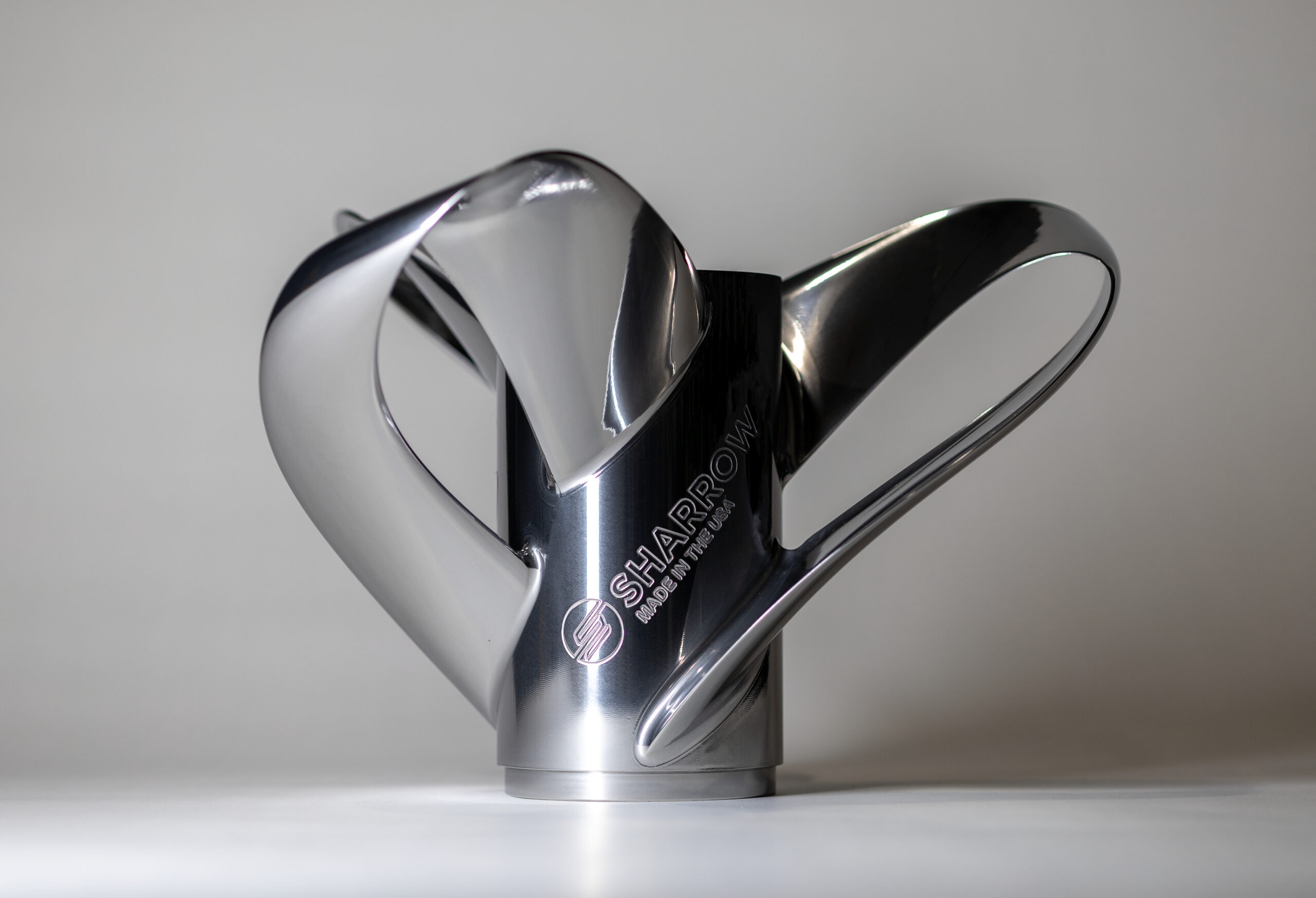
When scaling a complex, precision part hits a wall, the answer sometimes comes from an unexpected neighbour. That is precisely what happened when Sharrow Engineering, maker of the patented Sharrow™ Propeller, turned to Ford Motor Company’s Advanced Industrial Technology & Platforms (ATP) team for help.
The collaboration, brokered through the Michigan Central innovation ecosystem in Detroit, centers on advanced 3D sand-casting techniques that have cut production timelines from as long as 130 days with traditional investment casting down to approximately two weeks, while maintaining the precision Sharrow’s complex geometry demands.
As a reminder, 3D sand casting is an indirect additive manufacturing process. Unlike direct AM processes where the final part is built layer by layer (think metal laser powder bed fusion or binder jetting of metals), 3D sand casting uses additive manufacturing to print the mold itself, typically from sand and a binder.
That mold is then used in a conventional foundry casting operation. The result is a metal part with the design freedom of AM, but produced at volumes and costs that direct AM often cannot match for large, complex geometries. It is one of the oldest applications of 3D printing in industry, and as we have covered extensively, one that continues to prove its industrial relevance.
The specific case of Ford
Dan Michalski, additive manufacturing operations supervisor at Ford, noted that the company has been at the leading edge of 3D sand casting for more than 20 years, perfecting its expertise with a process that enables scalability, material compatibility with foundry workflows, and the production of geometrically complex metal parts without retooling.
This stands in contrast to the broader AM conversation, where metal powder bed fusion often captures the spotlight.
The collaboration also opens a broader roadmap for Sharrow, whose core propeller technology has potential applications in drones, advanced air mobility, industrial fans, pumps, and renewable energy systems.
*We curate insights that matter to help you grow in your AM journey. Receive them once a week, straight to your inbox. Subscribe to our weekly newsletter