The paradox of innovation and exclusivity
According to a McKinsey report, over the past five years, the luxury industry experienced a period of exceptional value creation. Unprecedented demand for personal luxury goods—fashion, leather goods, watches, and jewelry among them—combined with a deep well of supply, allowed the sector to achieve a 5% compound annual growth rate. Interestingly, all of the aforementioned categories and more are areas where Additive Manufacturing delivers value. With luxury brands outperforming global markets and achieving new profitability records, is it fair to link a tiny part of this performance to the value AM brings into products?
Luxury is often defined by a combination of high price, perceived quality, exclusivity, and brand prestige. While there’s no universal price threshold, luxury products typically command a premium over comparable items in their category. What truly distinguishes them, however, are elements like scarcity, craftsmanship, and heritage. Yet, as luxury brands seek to innovate, they face a dilemma: embracing digital manufacturing technologies that are, by nature, geared toward efficiency and broader accessibility—qualities that seem to contradict the exclusivity luxury is built upon.
According to the McKinsey report, “the luxury client base is becoming more diverse, and clients have a more complex relationship with luxury goods than ever. Having a differentiated value proposition that is appealing to this diverse client base is essential, given the anticipated low-growth environment.”
As luxury brands embrace advanced manufacturing technologies like additive manufacturing, does that mean a product — whether it’s a necklace or a car component, critical or not — automatically gains value simply because it’s 3D printed?
Those who have cracked the code of luxury with Additive Manufacturing
From bikes, watches, to fashion accessories, and luxurious cars, AM has proven a natural ability to highlight bespoke designs and innovation.
A few examples worth mentioning in 2025 include products from Bentley, Apiar, HERMES, and J.Laverack Bicycles.
Bentley’s EXP 15 design concept features 3D printed titanium finishes
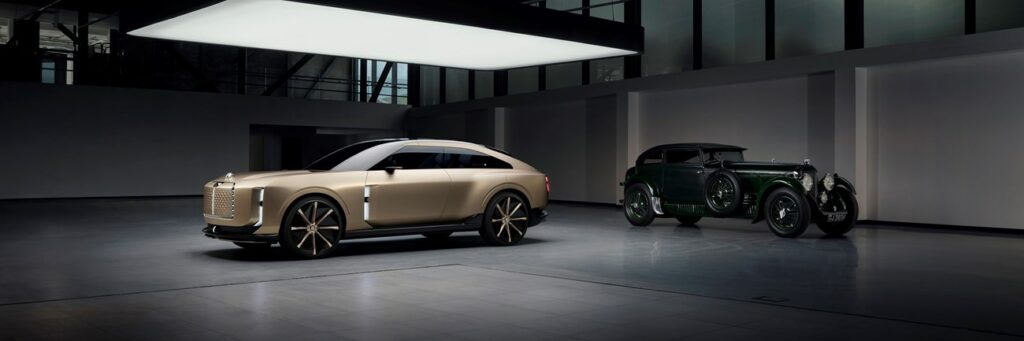
It’s just a design concept, but we already look forward to seeing the final version. Car manufacturer Bentley recently unveiled its latest luxury vision concept, and we are not disappointed.
Just like the Bentley Batur Convertible and the Batur Coupé, the company combines here a long-standing experience in sports and supercars with modernization.
Created using virtual reality (VR) software to enable customers to see and experience a wider variety of possible configurations, it mixes familiar contemporary physical car interior features like luxury seating, wing-shaped dashboard, steering wheel, dials and switches with spellbindingly futuristic digital elements that can be brought to the fore or melt away into the background as driver mood or functional need requires.
Although customers won’t be interested in all aspects of manufacturing, one of the selling points of the car is the executive trim theme interior alongside real 3D-printed titanium finishes.
The car manufacturer confirms the advantages of AM are still met in this application: “due to the material choice and its precise 3D-printed creation these metal details reduce both weight on the car and waste in production.”
Lastly, EXP 15 is conceived as having a fully-electric, all-wheel drive powertrain with a long range and recharging speeds commensurate with the convenience customers have come to expect of a Bentley.
Apiar’s collection of metal 3D printed watches
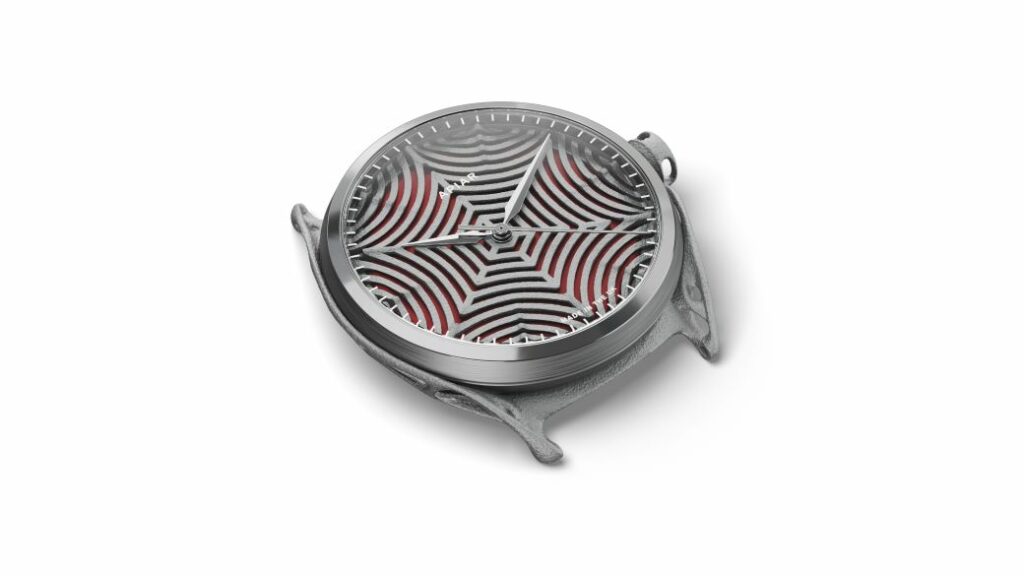
We’re not yet in the realm of ultra-luxury watches like Rolex, Audemars Piguet, or Patek Philippe, but with an entry price of £2,000, the Apiar collection comfortably sits in the mid-tier luxury range.
Apiar London Ltd, the startup behind Gen1.0. collection imagined a watch that we would want to wear in extreme environments – like the Moon. This ideal watch “would need to be robust and resilient, versatile enough to work in any situation. All with a design that feels fitting for the bold, inventive and unconventional people who will be wearing it.”
The new watch owes its name to generative design (GD), a design technique that founders Matt Oosthuizen and Sam White master as designers and engineers.
Ideal to optimize the part design, particularly for an exceptional strength-to-weight ratio, GD often leads to unconventional structures and geometries that only Additive Manufacturing can create. In this specific case, the team relies on Laser Powder Bed Fusion. White shared with 3D ADEPT Media that they partnered with metal AM service provider Apex Additive in Ebbw Vale, Wales to print with Grade-23 Titanium using their RenAM 500Q machines.
“The final design for the Gen1.0 – a completely organic form, with skeletonized lugs and seemingly impossible geometry. They also developed a deep, undulating dial that Apiar describes as “the guilloché of the future”.
Diverse examples from the fashion industry
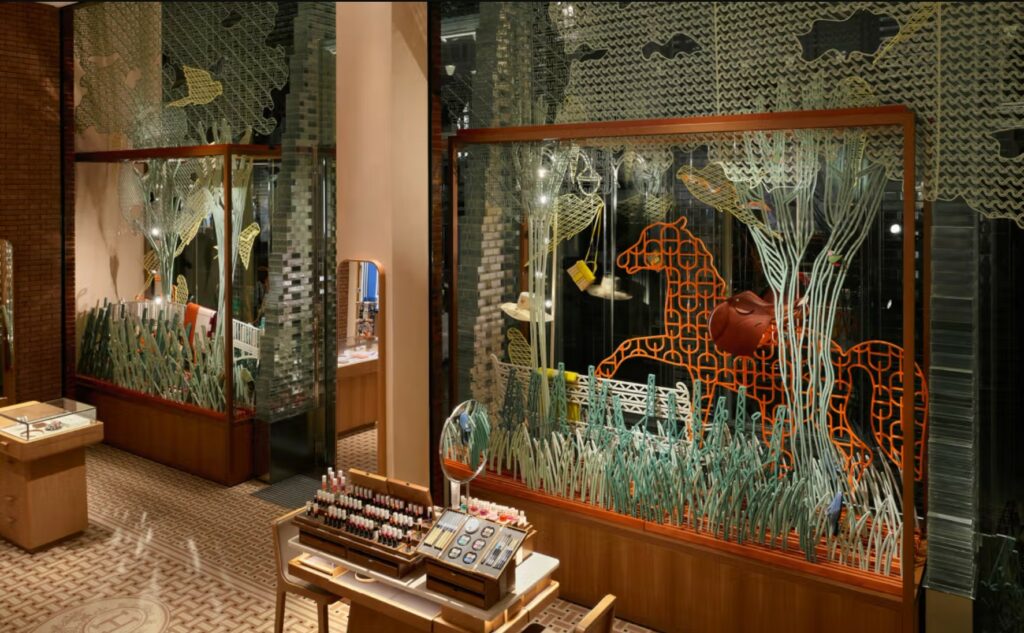
Since the beginning of the year, a range of luxury fashion houses have introduced new projects that integrate AM technologies. From Dior3D’s 3D printed eyewear frames to Gucci’s Cub3d 3D printed sneaker, along with ongoing initiatives from Aectual and Hermès, these brands continue to push boundaries in design and innovation. While 3D printed eyewear and footwear are becoming familiar territory, Aectual and Hermès stand out with initiatives that warrant a closer look:
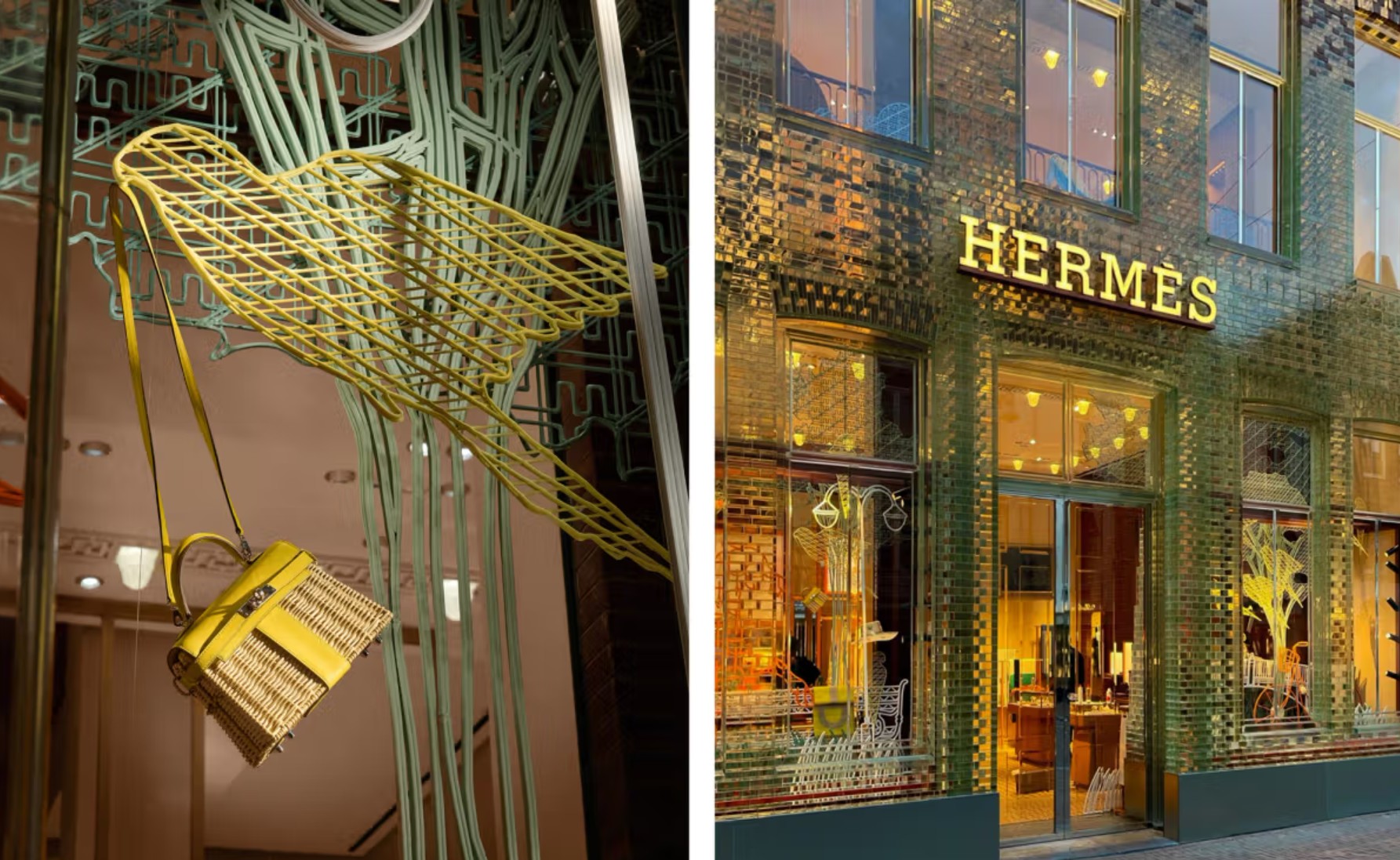
After a first collaboration on the Monde d’Hermès Kiosk—an elegant reinterpretation of the classic Parisian newsstand, architecture and construction 3D printing firm Aectual helped Hermès realize the fashion brand’s Crystal Houses façade in Amsterdam.
Spanning two levels of transparent glass, the installation features colourful, sculptural elements—digitally designed and precisely printed—combining movement, nature, and narrative in a vibrant celebration of the Hermès world.
J.Laverack Bicycles’ 3D printed bespoke bike
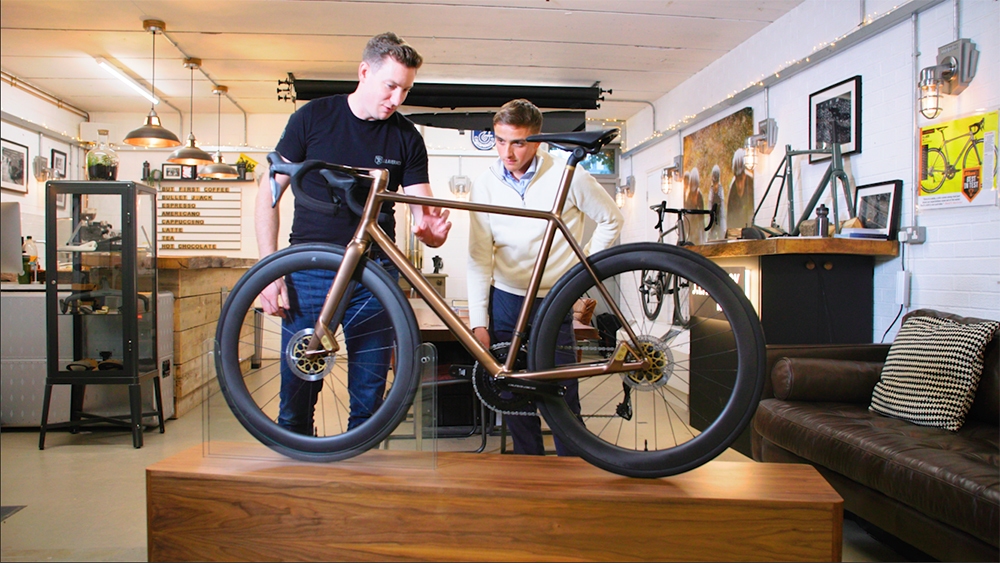
UK-based J.Laverack Bicycles is one of the rare exceptions—leveraging AM to produce titanium lugs and components that elevate both performance and design.
In a luxury bespoke bike, aesthetics are highly important. The aim was to make a visually ‘boltless’ bicycle from a combination of titanium lugs and carbon fibre tubes, where nearly every element can be tailored to the exact measurements of the rider, from made-to-measure handlebars to unique frame sizes. This defies traditional bike design, allowing for components to be adjusted for different rider shapes, sizes and physical attributes.
Once the design and support strategy was optimized, machine manufacturer Renishaw began to print the components in aerospace-grade 6AI/4V titanium in 30 micron layers, then heat treated and post-processed them so they can be sent for Finite Element Analysis (FEA). The parts are produced on Renishaw’s flagship RenAM 500Q system, which features an industry leading gas flow system, precision dynamic control and software for connected digital workflows.
For performance, keeping the weight of the bike as low as possible is important. Using AM, as opposed to more traditional frame-building approaches, meant we could remove materials from certain areas of the frame where it is not needed, helping to reduce weight from the bike. As a result, the J.Laverack Aston Martin .1R starts from just 7.5 kg.
Described as “the world’s first ‘boltless’ bicycle”, the .1R has no visible bolts, screws or attachments at the headset, seat clamp, calipers or bottle cage. Brake hoses are concealed within the handlebars, which is a complex part that uses the same design and manufacturing technique applied to the front splitter of a Formula One car. Each bike takes over 1,000 hours to create, including over 500 hours of CNC machine time. Every detail is meticulously engineered and designed to meet the specific needs of each individual.
When exclusivity drives value in luxury vs when it does not
The examples listed above highlight one-of-a-kind pieces, tailored to each project’s requirements, dimensions, or even digital signature. The common thread that reflects AM value across these applications is design innovation: the ability to enable shapes that would have been impossible to manufacture using conventional manufacturing processes, ultra-lightweight structures, and intricate geometries.
With AM, brands can iterate faster and bring limited drops to market more quickly – as agility becomes a key component of the luxury experience.
That said, I want to remain cautious.
I’m not convinced AM materials are advanced enough for luxury brands’ needs. While AM with metals and ceramics is advancing, there are still limits in finish and texture compared to traditional methods. If a product feels “light” or “incomplete,” it risks losing its luxury feel.
From a commercial standpoint, I can already hear fashion purists reading these lines and warning about the risk of commodification. If additive manufacturing makes certain luxury designs easier to replicate, brands must guard against dilution. After all, luxury depends on scarcity — and mass customization, if not tightly controlled, could blur that distinction.
*This opinion piece has first been produced in the July/August edition of 3D ADEPT Mag. Access the full issue here. Featured image: Credit: Aectual – HERMES