

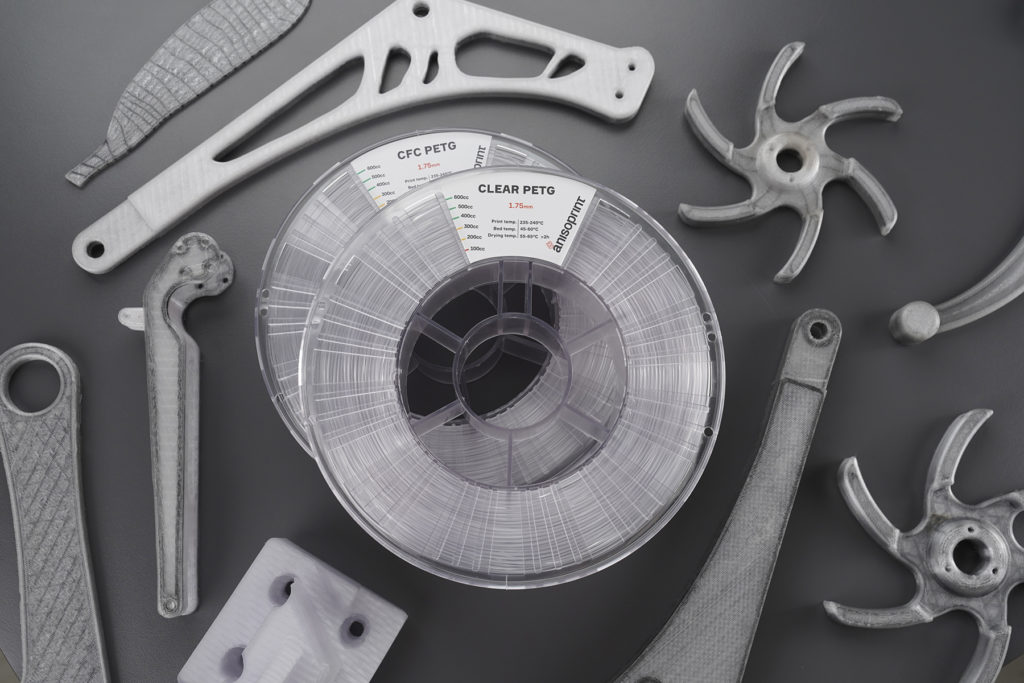
The complexity of composites 3D printing often leads some OEMs to develop proprietary materials in order to guarantee consistency and repeatability of parts. With this goal in mind, continuous fiber 3D printing systems and software OEM Anisoprint has developed two variations of PETG, one of the most widely-used materials for composite fiber co-extrusion (CFC).
Named Clear PETG and CFC PETG, the new filaments are meant for desktop Anisoprinting. Their combination with a proprietary profile in Aura slicer library ensures high standard quality and exactly predictable properties of parts.
As a reminder, Aura is the software tool that makes Anisoprint’s continuous fiber 3D printing systems deliver customized 3D printed components. The machine manufacturer continuously updates its library with new materials and profiles in order to provide users with a wide range of options.
“A lot of our customers use different PETG variations with our dedicated profiles, with sometimes unpredictable results in terms of mechanical characteristics and quality” Artem Naumov, Anisoprint Head of Materials states. “We decided to launch our own plastic with characteristics perfectly suitable for the profiles. The new material has been intensively tested and will ensure that our customers get the desired result and quality.”
The new materials are odorless during the printing process and easy to process – even for beginners in the field. Since they are transparent, it’s easy to appreciate their internal structure. The manufacturing process would reveal a natural good adhesion to reinforcing fibers, not to mention that due to their low absorption rate, there is no need to use the drybox if the humidity of the storage facility is low enough. In addition to their good flowing properties, Anisoprint said they can withstand wide working temperature range (-40 °C to +70 °C) and deliver good durability, resistance to fats and mineral acids, etc. to parts.
Despite the capabilities of these materials, the OEM recalls that diversity of materials often comes before standardization – especially in plastic 3D printing. With no set boundaries, resulting products oftentimes have unpredictable and unstable quality. Anisoprint strives to provide its users with solutions that produce stable and reliable quality results, so the combination of the new formulation material and fine-tuned parameters is specifically designed to achieve that goal, the company states in a press release.
Remember, you can post job opportunities in the AM Industry on 3D ADEPT Media free of charge or look for a job via our job board. Make sure to follow us on our social networks and subscribe to our weekly newsletter : Facebook, Twitter, LinkedIn & Instagram ! If you want to be featured in the next issue of our digital magazine or if you hear a story that needs to be heard, make sure to send it to contact@3dadept.com
THE 3D ADEPT WEEKLY NEWSLETTER
The industry moves fast. Stay ahead.
Every week, the latest additive manufacturing news, in-depth features and real-world applications, straight to your inbox. Plus, be the first to know when a new issue of 3D ADEPT Mag is out.
Free · One email a week · Unsubscribe anytime
Clicking loads our email provider’s sign-up form, including its analytics and Google’s anti-bot protection. You’re only subscribed if you complete the sign-up. Read our privacy policy.