From a UK-based additive manufacturing SME proving that polymer 3D printing can scale into serial production, to a European metal AM player expanding its commercial footprint in Southern Europe, and Carbon reinforcing its position in the cycling market with a dedicated Tier 1 manufacturing partner, this edition of news round-up reflects how companies are investing efforts to expand their business.
RYSE 3D: Serial production of high-performance parts from the UK’s midlands
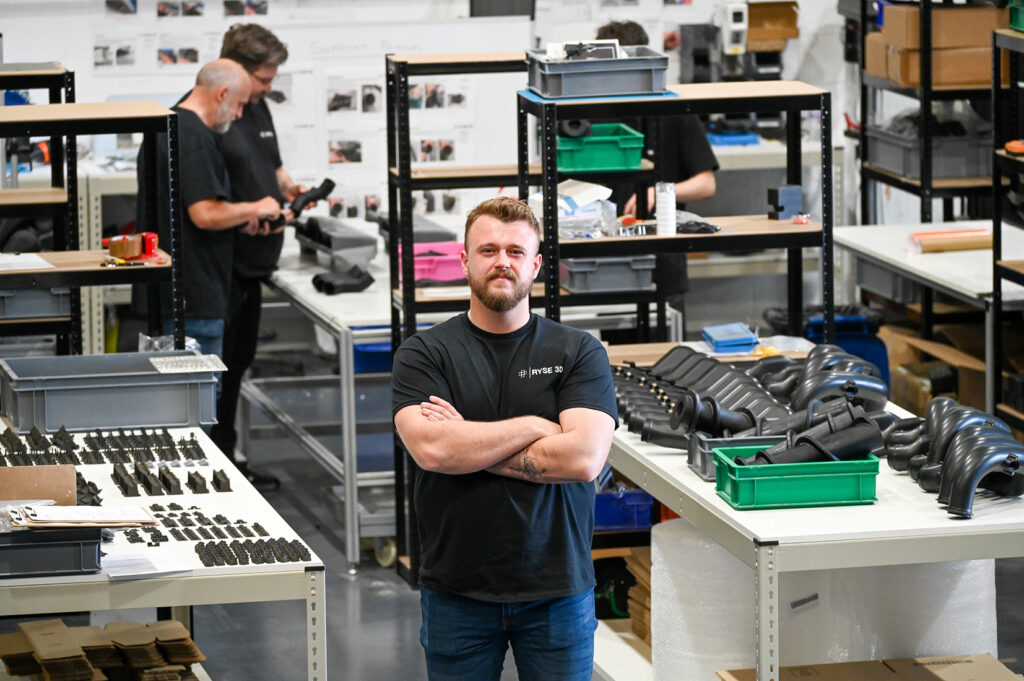
Founded in 2017 by Mitchell Barnes, RYSE 3D provides polymer parts in series production, for demanding end applications. The Shipston-on-Stour company, run by Mitchell and his brother Cameron, supplies high-performance components to 23 hypercar projects worldwide, as well as to programmes in aerospace, defence, and energy.
The company’s production process is built around large-format polymer 3D printing using widely available engineering-grade materials, with no tooling investment required. With a production of up to four million components per year, and exports now account for nearly half of its revenues, the company reaches clients in the US, Denmark, France, and Latvia.
With several team members being trained internally from non-technical backgrounds, illustrating a pragmatic approach to skills development in a sector often challenged by talent shortages, the business recently exceeded £5 million in annual turnover and invested over £1 million in new equipment, R&D, and the development of its own ‘LANDR’ large-format printer. RYSE 3D has now been recognised with two King’s Awards for Enterprise: one for Innovation (2024) and one for International Trade (2026).
ATLIX enters Spain with Excelencia Tech Group as Its distributor
 ATLIX, the European industrial LPBF manufacturer, has announced the appointment of Excelencia Tech Group as its official distributor for the Spanish market. The agreement gives Spanish industrial manufacturers direct access to ATLIX’s full LPBF portfolio, supported by local sales, application consulting, maintenance, and field service.
Excelencia Tech Group is headquartered at DFactory Barcelona and operates three offices across Spain (Barcelona, Madrid, and Bizkaia’s Automotive Intelligence Center). With over 20 years of cumulative experience in additive manufacturing and a team of five application engineers and five field service technicians, the company is one of Spain’s most established AM partners. Its subsidiary, Windforce 3D, also offers on-demand printing services, giving customers access to production capacity alongside equipment.
Spain’s industrial base (notably in automotive, aerospace, and general manufacturing) is precisely the environment where LPBF metal AM is gaining traction. The ATLIX platform brings together German engineering heritage from TRUMPF with Italian operational flexibility under its current structure.
Distribution partnerships often receive less attention than product launches, yet they are frequently more consequential for actual market development. For ATLIX, securing a distributor of Excelencia Tech’s caliber, with deep vertical expertise and proven service infrastructure is a sign that we may expect lot of more traction at the applications level.
Carbon and DDK establish the first tier 1 contract manufacturer for 3D-printed saddles in Asia
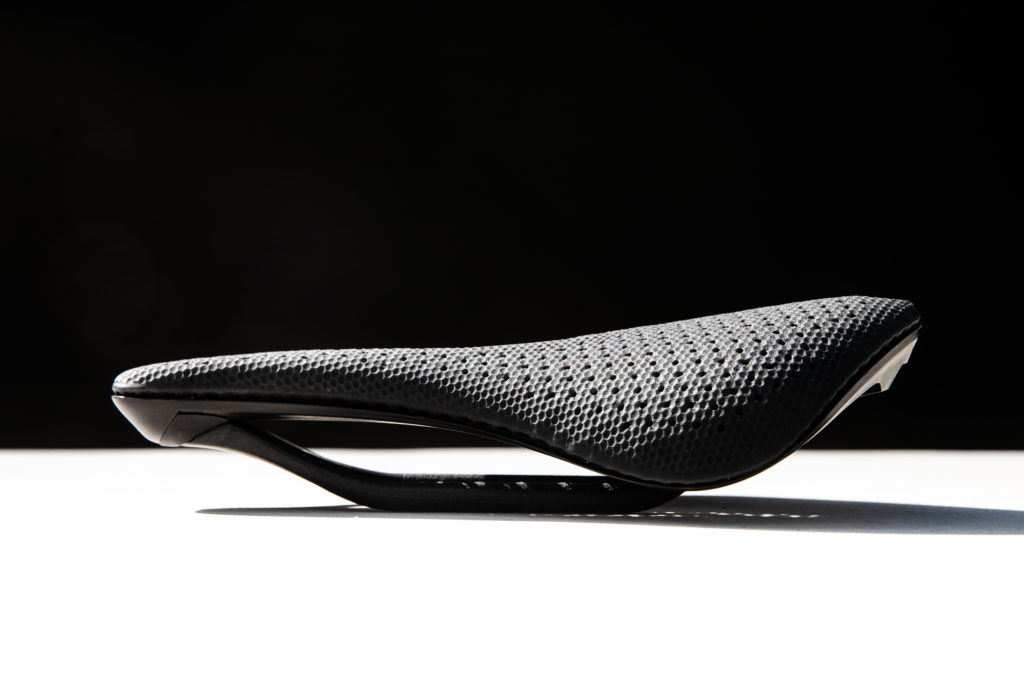 Carbon has announced a partnership with DDK, a Taiwan-based manufacturer with over 50 years of experience in bicycle saddle production, to establish the first dedicated, vertically integrated Tier 1 supplier of 3D-printed saddles on Carbon’s platform in Asia. The agreement is designed to consolidate the entire saddle supply chain, from additive manufacturing of latticed structures to final assembly, under one roof.
The move comes as Carbon reports having enabled the production of nearly one million 3D-printed saddles to date, with demand now outpacing existing capacity. DDK’s vertical integration capabilities, spanning foam manufacturing, cover processing, plastic injection, and metalwork, provide a level of supply chain control that is rare in the 3D printing ecosystem. By centralising production in Asia, the partnership also aims to reduce time-to-market and lower the cost threshold for brands looking to incorporate 3D-printed saddles into their product lines, including entry-level SKUs.
Beyond the cycling market, the model has broader implications: it is one of the more mature examples of a 3D printing OEM embedding itself within a traditional manufacturing supply chain at the Tier 1 level, rather than operating as a parallel or experimental track.
*We curate insights that matter to help you grow in your AM journey. Receive them once a week, straight to your inbox. Subscribe to our weekly newsletter