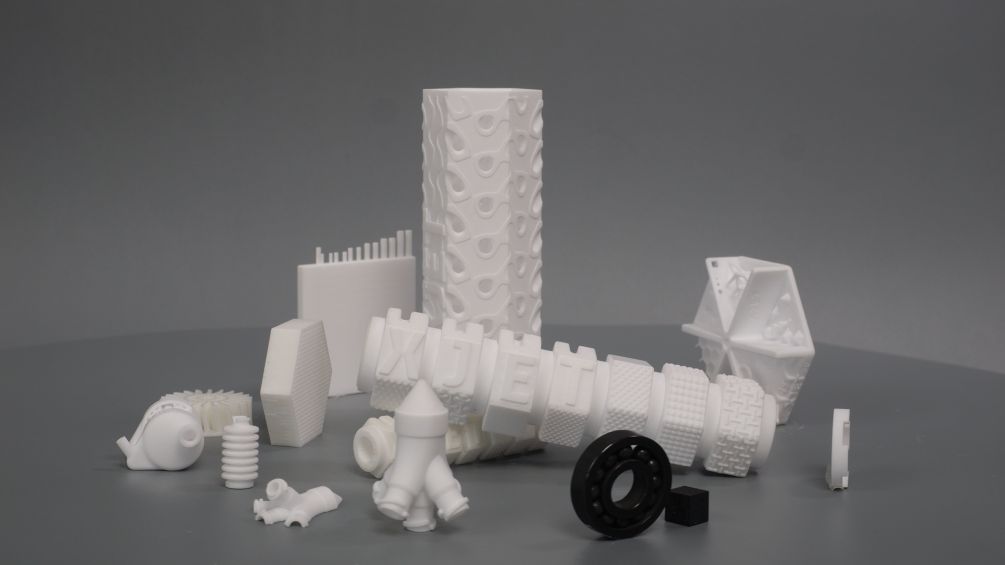
Somewhere in a cleanroom in Ohio, USA, spinal implants are being 3D printed in technical ceramics. Elsewhere in Switzerland, watch components are being printed in batches. And in another facility, a 3-in-1 fluid management part is being produced with a precision that traditional manufacturing could not achieve. The common thread across these applications? Not only can they be produced with technical ceramics but the technology behind them can deliver these parts in a consistent and repeatable way. Yet technical ceramics are still as unforgiving as they’ve always been. What changed today is the production logic behind them. XJet is now showing us what this production logic looks like, and how it can be applied vertically, one industry at a time.
For decades, ceramics have sat at the intersection of impossibility and indispensability. Not only were they positioned as a niche technology, but their manufacturing was also defined by two compromises, forcing AM users to choose between design freedom without serial production volume, or good resolution at the expense of consistent surface quality.
The fact is, whether we look at aerospace, MedTech or consumer goods technologies, operators on the factory floor now eye repeatability, workflow integration and scalability.
With technical ceramics, meeting these criteria is a tough challenge.
Ceramics are thermally stable, chemically inert, mechanically hard, and electrically insulating; properties that make them irreplaceable in demanding applications. Their problem has always been manufacturability given the fact that they are hard-to-process, and there are complex post-processing workflows, geometric constraints, and long qualification cycles.
Additive manufacturing solution provider for advanced ceramic and metal production XJet has well understood these challenges and it addresses them through a reliable production ecosystem.
A production ecosystem built around technical ceramics
In case you’re not familiar with it, XJet’s proprietary NanoParticle Jetting™ (NPJ) technology delivers precise, scalable, and sustainable manufacturing of high-resolution ceramic and metal components with complex geometries and fine feature details.
Interestingly, what brings NPJ to production-grade relevance is the way the full workflow (material, process, post-processing) has been designed to work as one.
A key strength of XJet’s platform is that sub-micron particle size enables fine feature resolution below 200 microns and smooth surface finish straight from the printer, removing one of the most persistent sources of variability in ceramic production.
The ink materials, processed by the 3D printer, are developed in-house within a quality management system certified to ISO 9001 and ISO 13485. The portfolio spans high-purity alumina, zirconia, aluminum nitride, tungsten carbide and silicon nitride, as well as ceramic composites such as ZTA and ATZ, materials that map directly to the performance requirements of medtech, semiconductors, consumers, and precision engineering applications.
The more we reflect on it, the more we realize that what truly foster production is the simplicity and control of the company’s ceramic workflow: Print – Wash – Sinter. According to the company, file-to-part time can drop to as little as 72 hours, with no depowdering, no manual cleaning, and no debinding.
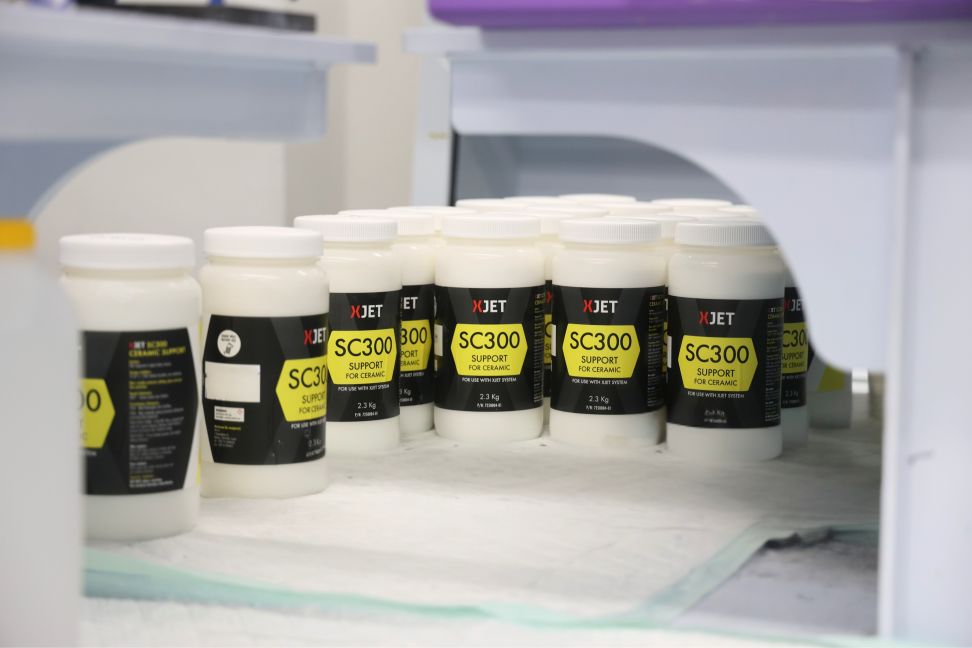
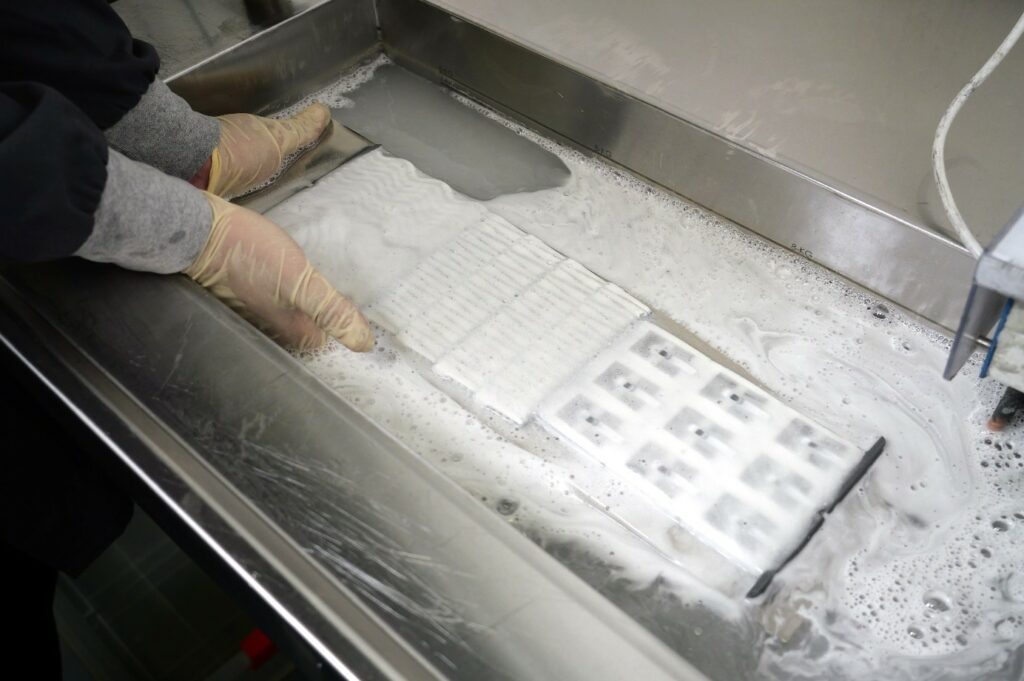
During printing, a soluble support material (X-Clear) is jetted alongside the build material, enabling complex geometries that would be difficult or unsafe to produce through conventional ceramic processes. Support removal then occurs through a one-touch washing step using a non-acidic, non-toxic solvent, eliminating manual intervention and reducing operator safety constraints.
At the end of the three-step process, sub-micron particle sizes allow sintering below 1,500°C, with predictable shrinkage under 15% and final densities above 99.5%. The result is consistent part quality across runs with minimal manual handling.
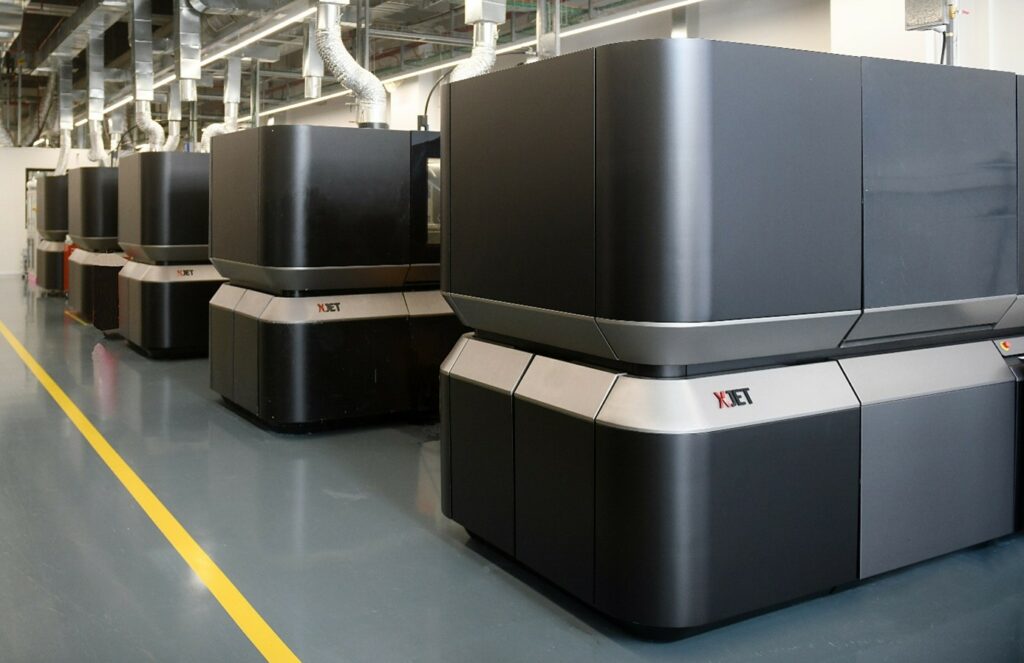
XJet presents various Carmel system models for various production volumes. With large build sizes up to 500*280mm, scalable software infrastructure, and a clean and powderless process that doesn’t require excessive manual labor in operating nor post-processing, XJet solution enables maximum digital manufacturing potential, with 1 system operator managing a multi-machine site.
Beyond labs and research hubs
During the past decade, XJet has enhanced its portfolio and developed a multi-material platform that can meet the needs of labs, research hubs and production teams on the shop floor.
Recent applications enabled by XJet’s NanoParticle Jetting™ (NPJ) illustrate how the company is expanding access to high-value ceramic production.
Remember the application examples mentioned at the beginning of this article.
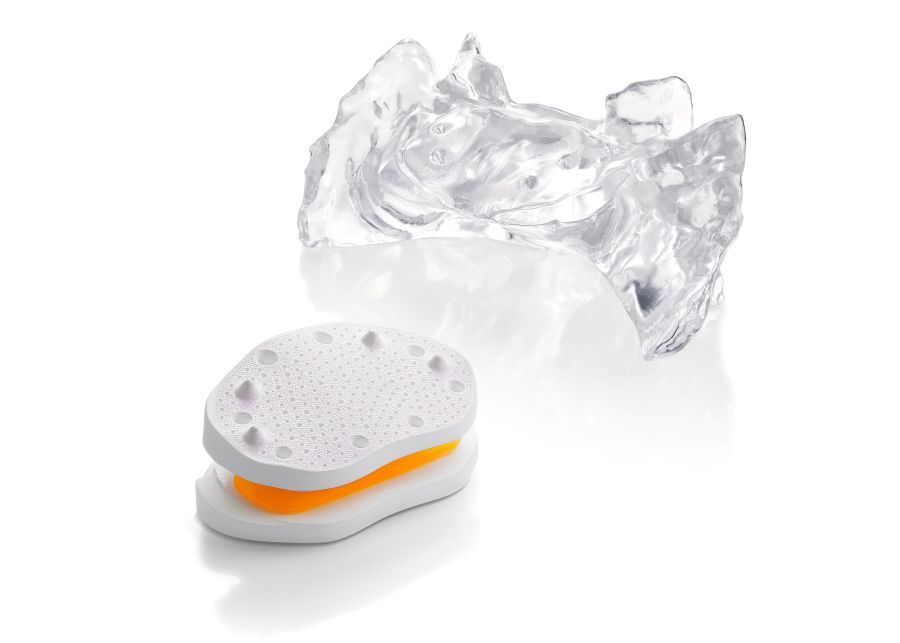
In Ohio, the patient-specific, metal-free spinal implant was produced by Nivalon Medical and the Youngstown Business Incubator, with a ZTA ceramic architecture designed to behave like bone, paired with a flexible core that mimics natural spinal motion. A part so geometrically specific to each patient that fixed-size metal implants were never going to solve the problem.
In Switzerland, Ceramaret, a precision ceramic specialist deeply embedded in watchmaking and industrial tooling, took a different path with the same platform. Where medtech demands biological compatibility and geometric exactness, luxury watchmaking demands something equally important: permanence of appearance.
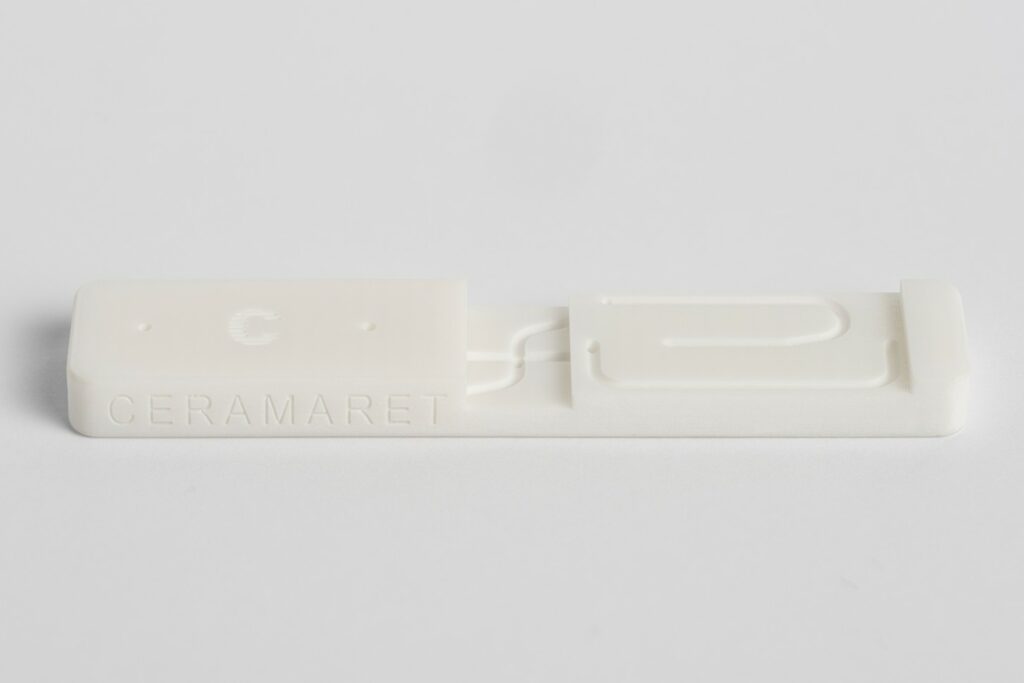
Technical ceramics deliver both, and with XJet, Ceramaret can now bring that level of finish and complexity to prestigious creations in serial production.
Two industries, two completely different production rationales (medtech precision and aesthetic performance) and a single platform capable of serving both at specification.
While the applications mentioned here are dedicated to medtech and consumer goods, this production logic travels across verticals without losing its rigor.
Editor’s notes
The strongest argument for any production claim is the people who staked their business on it. At ceramitec 2026, taking place from March 24 to 26, XJet’s booth 206, Hall A6 will make that case in the most direct way possible.
And they won’t be alone. Nivalon, YBI, Ceramaret, and CeramTec will all be present at the company’s booth; each bringing their own production experience with the platform, and their own vertical as proof. From patient-specific spinal implants to luxury watchmaking components, the applications will speak for themselves.
Among those joining as well is Ter Hoek, a precision manufacturing vendor with thirty years of production experience serving aerospace, medical, and semiconductor customers. Ter Hoek built that reputation in metal. They chose XJet to expand it into ceramics. That decision, made by a company that has seen every alternative the market has to offer, is its own kind of endorsement.
If the production logic described in this article raises questions you’d rather answer in person, ceramitec 2026 is where you go to find them, at the XJet booth.
This content has been produced in collaboration with XJet.