


Retrospective written for the November/December 2022 issue and posted online in January 2023. Assessments and expectations for 2023 express the editorial view at that time. Announced transactions are distinguished from completion.
From mergers & acquisitions to bankruptcies, expected & unexpected milestones, 2022 led us through an emotional rollercoaster.
As 2022 draws to a close, 3D ADEPT Media is looking back over a year difficult to characterize. To paraphrase a well-known book, we rejoiced with those who rejoiced, we felt empathy with those who were in some real uncomfortable situations, and most importantly, we analyzed, learned lessons and takeaways that hopefully, the industry will consider moving forward. Here is a wrap-up of what we will keep from business, the manufacturing value chain as well as vertical industries & standards.
1. “Fortune favors the brave”, the saying goes, but is it always enough?

The editorial tally cited for 2021 covered more than 53 transactions, including SPACs, compared with more than 21 acquisitions reported in 2022. It illustrates continued consolidation, not an exhaustive census or proof of an all-time record. Financing, technology and market access may combine in buyers’ motivations.
| Buyer | Target business or company | Notes |
|---|---|---|
| Stratasys | Covestro additive manufacturing materials business | Announced in 2022; completed April 3, 2023. |
| Nikon | SLM Solutions | Offer announced in 2022; consolidated subsidiary in January 2023. |
| Lithoz | CerAMing | First company |
| Materialise | Identify3D | |
| Carbon | ParaMatters | First company |
| Nano Dimension | Admatec, Formatec & Global Inkjet Systems Ltd. | |
| Bico | Allegro 3D | |
| Hyperganic | DirectFEM | First company |
| 3D Systems | Titan Robotics, Kumovis, dp polar | |
| CORE Industrial Partners | RE3DTECH | |
| Markforged | Digital Metal | |
| Quickparts | Xcentric Mold & Engineering | |
| Addman Group | Harbec, Castheon | |
| HP | Choose Packaging | |
| Prodways | Auditech Innovations | |
| Authentise | Elements Technology Platform | First company |
The table retains the original selection. Stratasys acquired Covestro’s AM materials business, not the whole group; completion was on April 3, 2023. SLM Solutions became a Nikon consolidated subsidiary on January 27, 2023. “First company” notes retain the original 2022 editorial observations.

When this review was written, Nikon’s offer for SLM Solutions was still in progress. Following Morf3D, it marked an expansion in metal AM alongside Nikon’s measurement capabilities. The comparison with GE’s acquisition strategy is an editorial interpretation, not a guarantee of industrial or financial outcomes.

Another interesting example might be the one of HP and Choose Packaging, a Scotland-based startup that fabricates paper containers that could be a wise alternative to packaging for drinks, laundry detergent, make-up or food. At first glance, the first thought might be: what does a company that makes paper containers, have to do with 3D printing? Well, at the heart of the manufacturing process, one finds HP’s Multi Jet Fusion (MJF) technology and a plant-based barrier material that can make molded fiber containers waterproof. The manufacturer presented this combination as a route to recyclable or compostable packaging. Although this purchase builds on top of HP’s existing molded fiber tooling service, can we not see the fact that 3D printed tools are used to quickly fabricate molds as a boost for a vertically integrated sustainable business enabled by additive manufacturing; the one of eco-friendly containers for the consumer goods industry?
Environmental benefits need assessment for the complete package, its use and end-of-life. Fiber or bio-based material alone does not establish recyclability or compostability in every waste system.
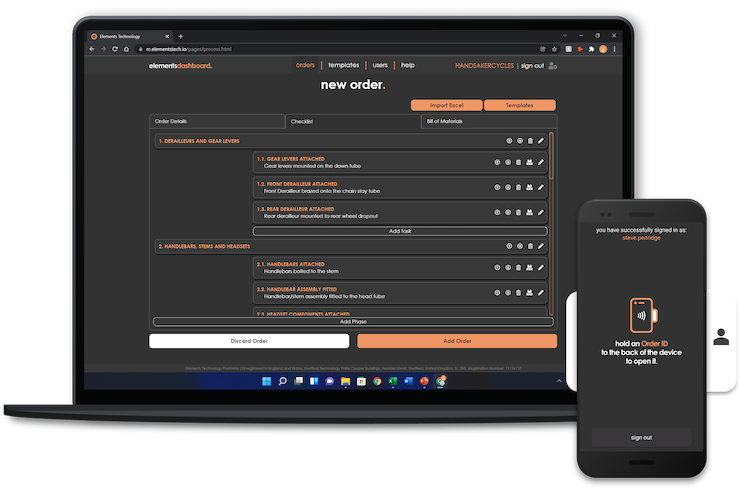
The last example I would like to mention here is the one of Authentise that goes beyond AM with its acquisition of Elements Technology Platform. As of today, the software company is now gaining some market shares outside of the AM as well, by providing a unique self-serve tool for all types of manufacturing operations, to quickly create, capture and access repeatable shop floor processes. It’s the rule of not putting all your eggs in one basket. It’s that simple.
While these mergers and acquisitions have brought a breath of fresh air to the acquired companies, others have been suffocating due to the lack of air.
Difficulties in 2022 did not all mean the same thing: insolvency proceedings, service shutdowns, reduced operations and company closures need distinction. Fast Radius and Xerox’s refocusing below illustrate that diversity; they do not justify counting every originally listed brand as a liquidated company.

Most of the time, financial resources are pointed out as the number one reason behind a disposal, but I truly believe another crucial aspect to thrive – and therefore generate profits – is often overlooked: a thoughtful marketing strategy. Please, bear with me as I do not find any kind of joy in writing these lines. I do understand that one of the most heart-breaking decisions a founder can take is to close their business, but tech founders need to realize that sometimes, the company that sells the most is not often the one that has the best product, but just the best marketing strategy.
This reflection on marketing is a general editorial opinion. It does not establish the cause of any particular company’s financial difficulties.
Fast Radius filed for Chapter 11 protection on November 7, 2022. That procedure does not itself mean immediate closure: the company stated that it intended to continue serving customers during the process.
Clarification to this retrospective: the agreement to sell substantially all Fast Radius assets to SyBridge Digital Solutions is dated December 8, 2022, with announced consideration of about US$15.85 million. This was an asset sale in the proceedings, not simply the purchase of an unchanged company.
For Xerox, the information reported in this 2022 review concerned a reduction in AM activities and a focus on supporting existing ElemX installations. It did not concern closure of the Xerox group and must not be read as its current status.
To end on a lighter note of this “Business” part, I will say that fortune may not have favored those who are shutting down their activities, but it might favor the next wave of new comers entering the market. This is good news as most of them are spin-offs from research institutes or well-established companies with a solid expertise in another manufacturing field. Being backed by a bigger company is always good music for any player trying to find its move on the dancing AM floor. Some of these new entrants include EPSON, Jeol, Grob, Krauss Maffei and AviaTOOLS.
2. The value chain: materials, software, processes and post-processing
Manufacturing has historically been the industry to carry the most weight when it comes to leading the overall economy out of downturns. This has never been truer than during this post-Covid era. Indeed, the spotlight placed on additive manufacturing (AM) during the pandemic as a tool to overcome supply chain hardships led to an increasing transition to AM for its flexibility and on-demand production capabilities, and toward the use of AM as a source of product development. This also led to key developments across specific fields of the manufacturing value chain and specific vertical industries that have also been observed in 2022.
Materials, first area of growth

In this vein, the first area where we’ve observed interesting developments for the industry is materials. 2022 was another year where copper shone, be it in applications or new forms of materials available – That’s something Olaf DIEGEL also highlighted in his retrospective for 2022. Companies that added copper to their portfolio include Infinite Flex, producer of smart materials, that has developed a pure copper powder for industrial SLM 3D printing; Kupros, a US-based company that develops an all-metal conductive copper filament; or 3D Systems that adds copper-nickel alloy for use with Metal 3D printing.
Applications that have demonstrated the potential of this material when combined with AM, include for instance induction hardeners (inductors) for gear wheels in the automotive sector and for chain wheels on chainsaws (developed by Schunk and AIM3D); a 3D printed copper cooling plate developed by JX Nippon Mining & Metals (JXNMM) and Alloyed, or this radio frequency quadrupole (RFQ), one of the most complex parts of any accelerator complex – developed by TRUMPF for CERN-coordinated I.FAST project.
On another note, I have been pleasantly surprised to see the development of materials that increasingly takes into account the environmental challenges and the need to fight climate change.

On the metals side, IperionX was among the companies I wanted to follow. In his 2022 interview, Taso Arima described scrap- and mineral-based titanium routes, targeting lower costs and impacts. Those aims and simulations need distinction from measurements at full industrial scale.
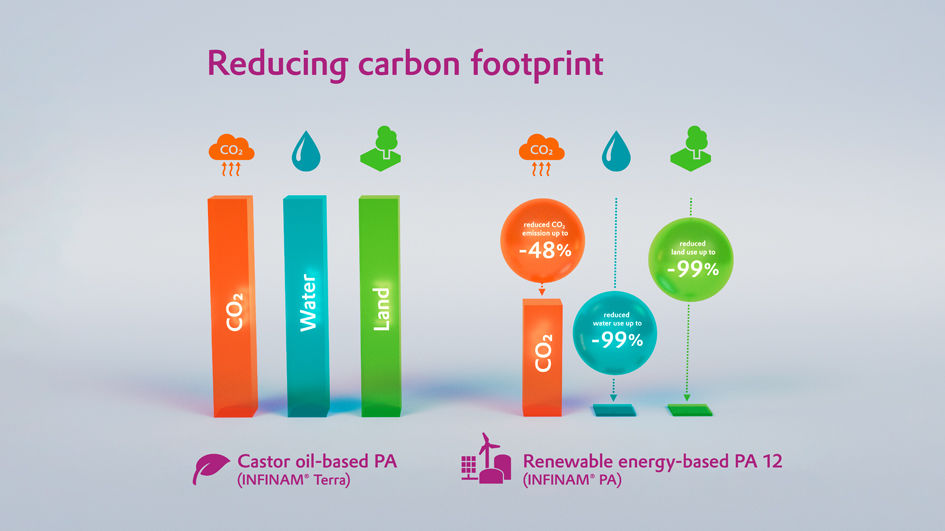
I wouldn’t stop looking at how companies take action in the polymer side, because as I always say, the challenge is higher for them due to the nature of their activity. Kudos to Evonik that is presenting developments in the AM industry, with the introduction of a new grade of PA12 powders with significantly reduced CO2 emissions and which plans to go one step further in 2023. WASP is also one to mention as it develops a recycled fishing net material. This does not include the number of one-time applications that have been achieved with recycled materials.
Moving forward, my hope for next year is that more and more companies realize that sustainability should not be seen as a selling point, but truly as a core issue, given the fact that manufacturing has long been one of the most significant contributors to environmental pollution.
Software: managing production and estimating impacts
It’s been a couple of years that AM users have been asking for more robust software solutions across the manufacturing workflow; software solutions that can streamline workflows and integrate with existing enterprise solutions, software that can make it easier for engineers to design a part directly for additive manufacturing rather than having to design that part twice. I am not saying that what was available so far was not interesting, I am saying that they have been improved and others have been developed with a couple of magic ingredients.
AI is one of the terms highlighted in these offerings. Beyond the label, the automated task, input data and results for a use case need examination.
One company that really knows what they are doing here is Hyperganic that develops an AI-powered Algorithmic Engineering software. The latter uses customisable building blocks and frameworks to create individual applications and automate repetitive tasks, which may lead to applications for mass customisation, or generating complex internal cooling channels, lattice structures, and thin-walled geometries.
Speaking of SaaS solutions that can streamline workflows and integrate with existing enterprise solutions, I like the AI driven factory operating system developed by Oqton. The team brings to the table some solid expertise and its platform covers several manufacturing workflow stages. I was given a tour of the cloud-based manufacturing operating system, so I have been able to understand how it automates the end-to-end workflow across & beyond the production floor.
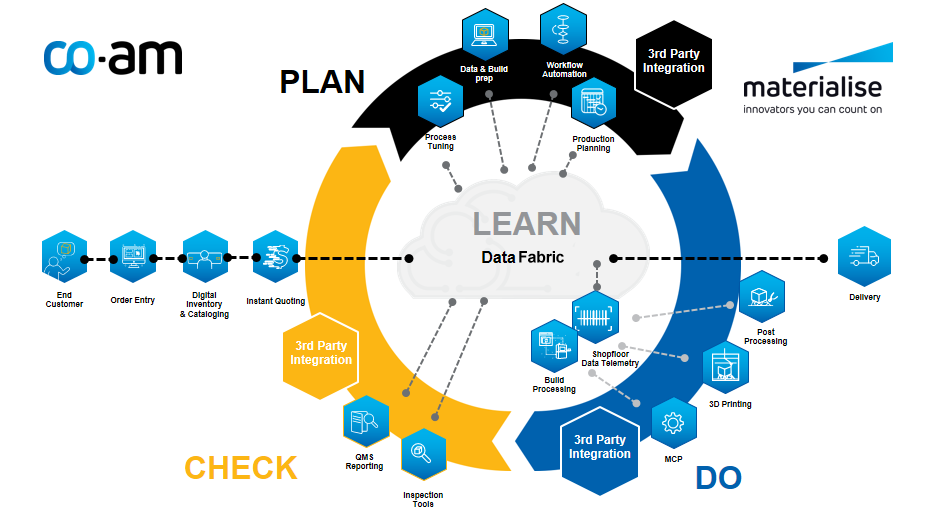
Materialise’s CO-AM platform, developed following the Link3D acquisition, aims to connect planning, optimization and monitoring tools. Openness to partners does not mean free or unrestricted access: licensing and integrations depend on the offering selected.
At the design and simulation level exclusively, I didn’t have the opportunity to approach them yet, but I have heard good things about 1000 Kelvin GmbH, a start-up that delivers an AI-powered all-in-one solution. We will probably keep them in our radar next year.
Simulation is another route, from Solukon depowdering to flow and process phenomena studied using Flow Science tools. It can compare scenarios before manufacturing. A simulation model is not automatically a digital twin linked to physical equipment; accuracy and speed depend on the model, data and validation.
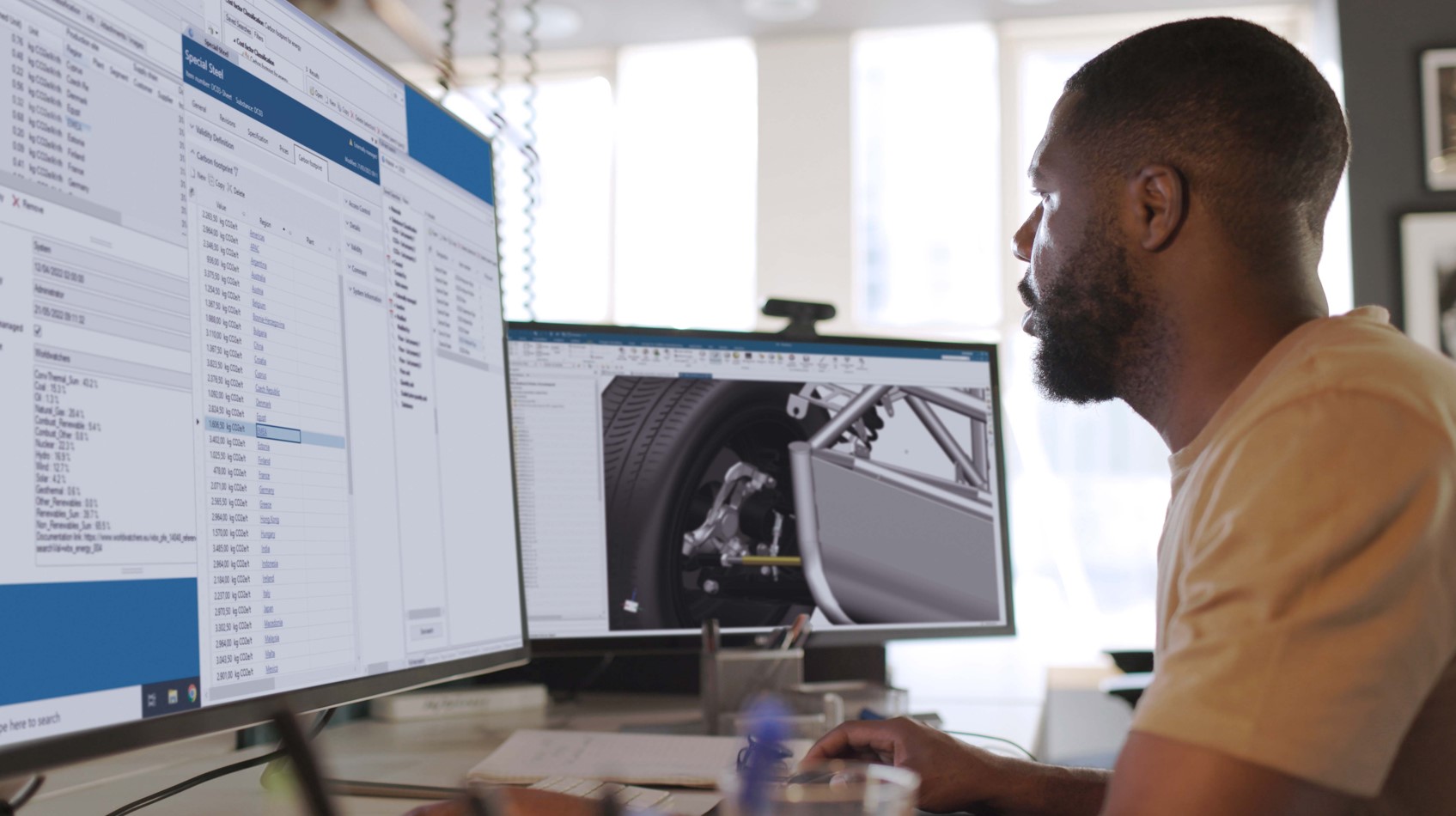
A major milestone in terms of sustainability has been achieved by software companies that have developed “Product Carbon Footprint Calculator” tools for 3D printed parts. Two companies that are ahead of the curve here, are Siemens Digital Industries Software & CASTOR.
A calculator estimates a footprint from data and assumptions. Using it does not automatically reduce emissions; it can inform choices whose effects need assessment on comparable boundaries.
That being said, software is a big world that remains very platform-dependent – whether we talk about manufacturing processes or post-processing processes.
Manufacturing processes: a need for dedicated processes
Speed has always been the number one technological challenge to address in the development of industrial 3D printers – especially for industries driven by mass serial production – followed by materials. This year, speed has remained one of the top challenges to address in the development of 3D printers but sometimes, the need to address it was driven by a bigger vision.
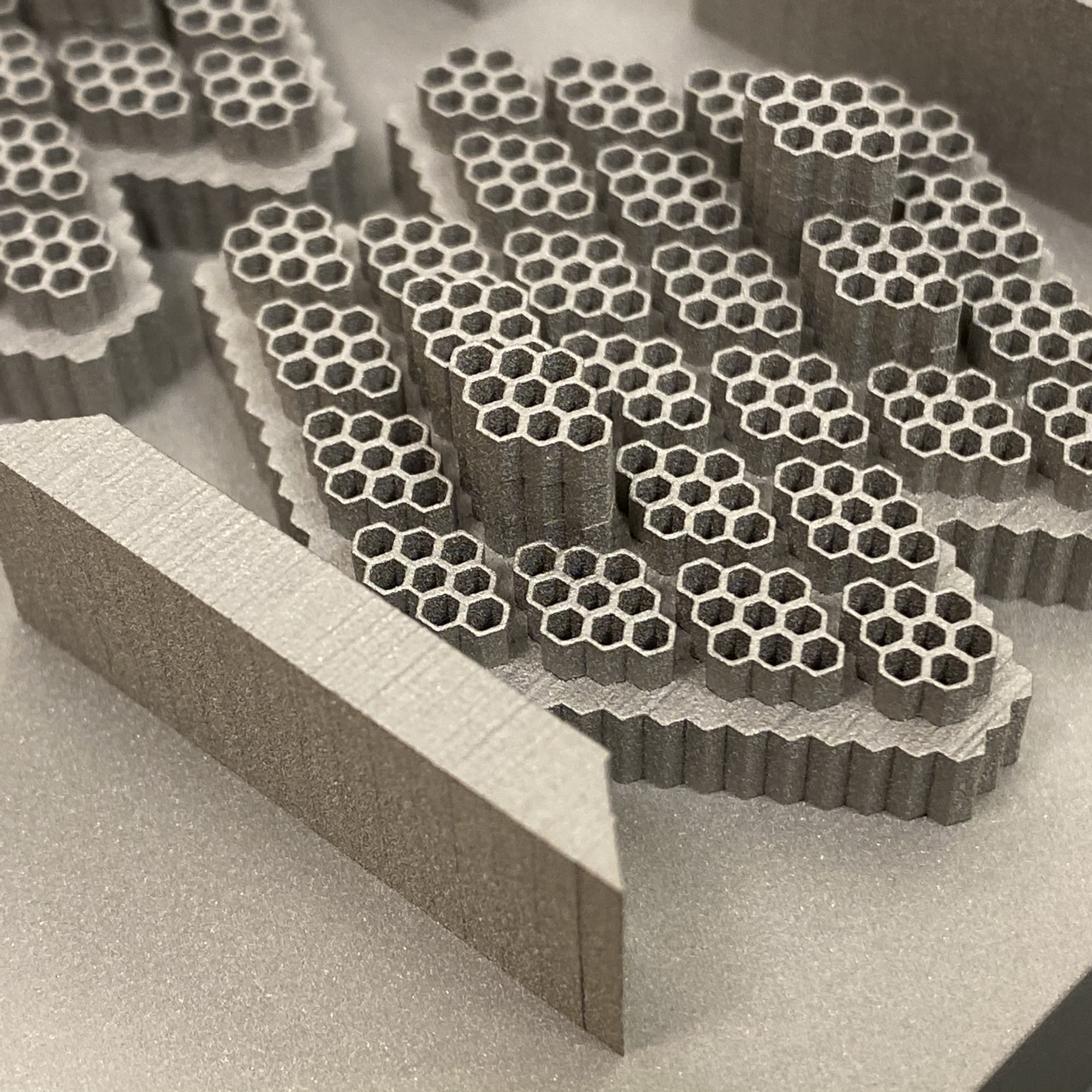
Seurat was among the companies followed for its Area Printing technology. It described a high-power laser and spatial modulation exposing many powder locations in parallel. The 30 kW and 2.3 million pixel figures in its presentations are reported characteristics, not a universal energy or throughput comparison with casting.
Lasers remain a cost factor and development route for several processes. Power, wavelength and material interaction require application-specific choices; no source is the most efficient across all additive manufacturing.
The announced Essentium–NUBURU collaboration explored blue lasers. A speed gain of up to ten times and elimination of certain downstream steps were aims or claims associated with that 2022 announcement, not generally demonstrated results in this review.
On another note, just as more materials (still) need to be qualified for use on AM machines, one should acknowledge the importance of new 3D printing processes that stand out from the crowd, and that are developed to process exotic, and sometimes more challenging materials. One of the first examples that come to my mind right now is “Goliath” a large-format 3D printer developed by Teu2tec GmbH and that enables printing of objects from compatible pellets using the paste extrusion modelling process (PEM). Other examples that are worth mentioning, include silicone 3D printers – a type of printer that I thought, was no longer of interest to the market – but Lynxter and Spectroplast proved otherwise. And before I forget, FDM 3D printing is still on fire, since companies like DUPLEX debuted on the market with multi-directional printing and RAISE3D introduced a toolkit which could be the much sought-after solution to that speed problem.
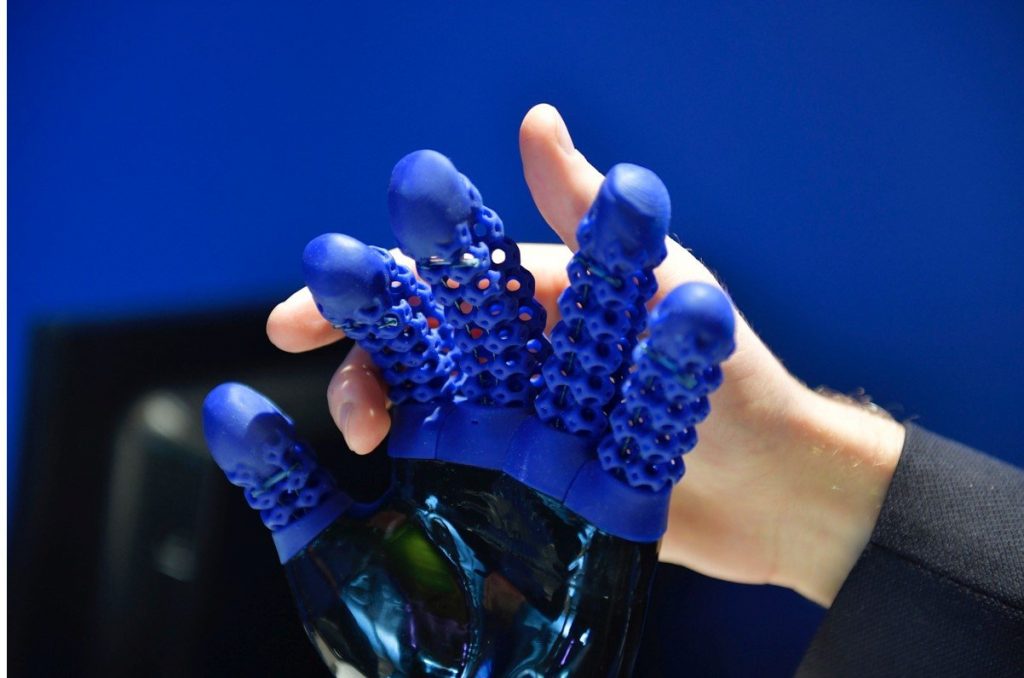
Post-processing: quality assurance and computed tomography
We have clearly passed the stage where we had to inform, educate about the fact that post-processing is the most complicated task to perform because it was not automated, resulting therefore in a price increase of the final part; and long lead times.
Whether we are talking about powder removal, support removal, machining or any other post-processing solution, we are at a stage where users want more options – fancy, useful, more sophisticated – and they want to know how they can add value to their process. In any case, this has clearly been one of the trends observed in solutions introduced to the market this year – all solutions combined.
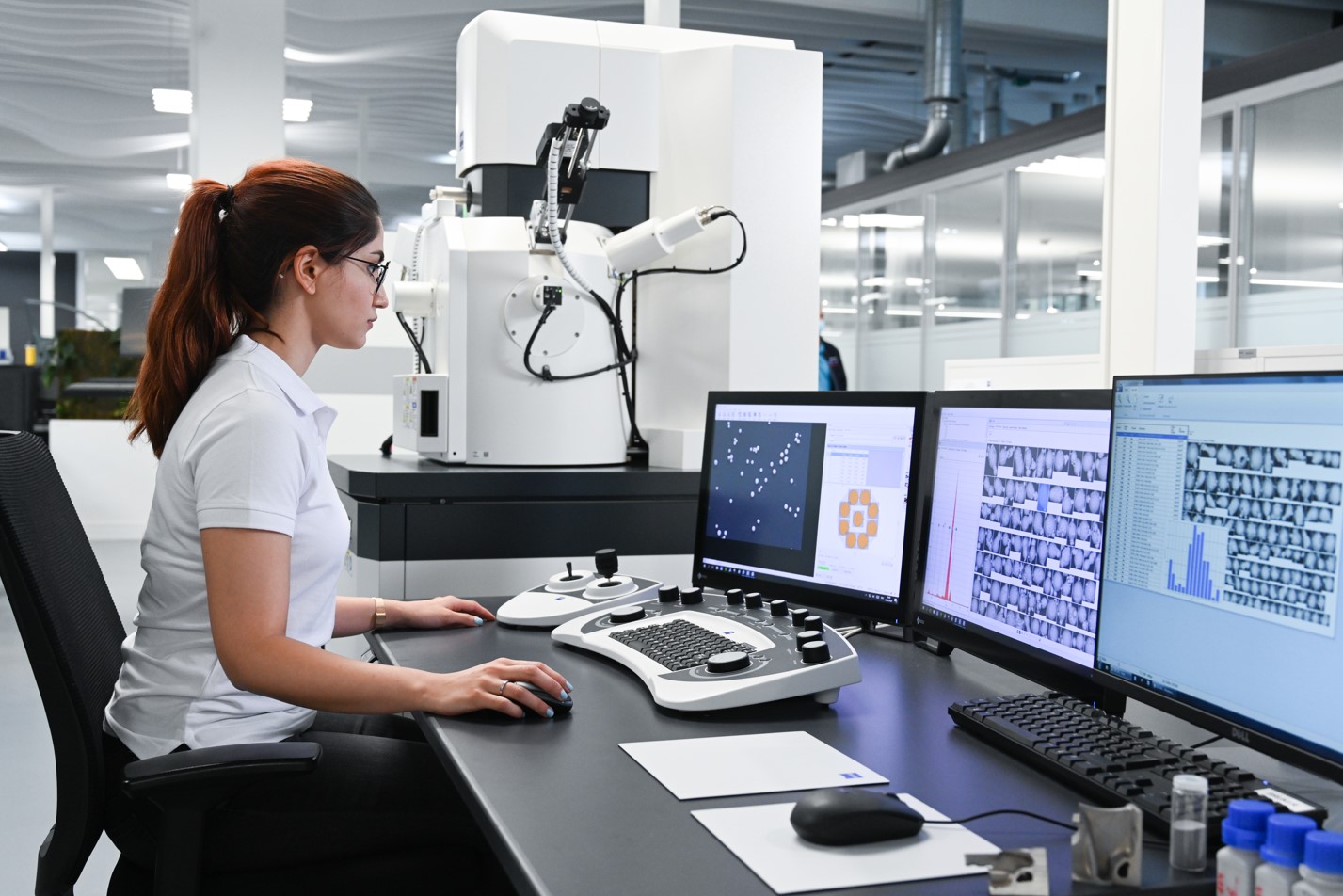
Amid the wide range of solutions developed and improved for the post-processing stage, I have to say that Quality Assurance (including CT Scanning) solutions stand out from the crowd and will probably continue to do so in 2023. The companies I would certainly be tracking here, include ZEISS, Sigma Additive Solutions and Lumafield.
On another note, the recent Formnext revealed that – whether they are used with post-processing solutions or manufacturing processes, the upcoming months or years will probably see a lot more of AM-dedicated developments compatible with robotic systems.
3. Standards and vertical industries adopting AM technologies
It is no secret that the growth of industries, technologies or processes emerge and grow along with the need for standardization – which helps ensure safety, reliability, and repeatability. Whether driven by regulators, standards bodies or the industry itself, this year saw an “emergence of an assurance culture in AM” that will definitely help build confidence across the value chain. This has been marked by the growing number of standards-developing organizations and classification bodies as well as the development of new standards for specific industries.
The first edition of API 20S for metallic components was published in October 2021. It was complemented in August 2022 by API 20T for polymer-based components. These historical references illustrate qualification frameworks, not necessarily the editions currently applicable.
Lastly, as I said before, whether we talk about technology advances at the machines level, at the software, materials or depowdering levels, enabling applications through all of these processes is the example that demonstrates they perfectly work together. It’s a virtuous circle. And amid the vertical industries adopting AM technologies, the aerospace & space industries remain the key verticals that have driven this market with new complex and fascinating applications and with the emergence of new companies that penetrate the market with AM as a key enabler of their operations. However, two other industries that leverage AM on their own way continue to expand: construction 3D printing and 3D bioprinting. While a lot of professionals remain cautious, those verticals saw a growing number of applications and developments – e.g. this 3D printed human lung scaffold in 3D bioprinting and new materials in construction 3D printing – , thus opening up a myriad of possibilities people are probably not ready to explore.
The lung scaffold mentioned here concerns bioprinting research. It is not a complete functional lung with established clinical use in this article.
So…
Coming from a year of recovery, I have to say that 2022 did not disappoint me. There was a lot to see and discover, a lot to learn and obviously a lot I didn’t mention, but that’s fine because I have come to realize that until AM gets more mature, this industry will always make you feel this way: sometimes bored, which is good as it shows there is a certain steadiness, but most of the time, hungry for more.
This article was first published in the 2022 November/December edition of 3D ADEPT Mag.
THE 3D ADEPT WEEKLY NEWSLETTER
The industry moves fast. Stay ahead.
Every week, the latest additive manufacturing news, in-depth features and real-world applications, straight to your inbox. Plus, be the first to know when a new issue of 3D ADEPT Mag is out.
Free · One email a week · Unsubscribe anytime
Clicking loads our email provider’s sign-up form, including its analytics and Google’s anti-bot protection. You’re only subscribed if you complete the sign-up. Read our privacy policy.