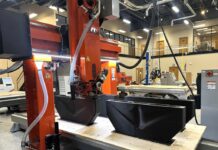
RAPID+TCT 2026 in Boston was, by most accounts, a serious show. The themes running through this year’s exhibitor announcements reflected an industry focused more on making AM work, consistently and at cost.
BigRep brought automated large-format production. 3D Systems introduced AddiTrak, an on-premises factory floor software platform tightly coupled to its hardware. HP celebrated a decade in AM with a dense, multi-front portfolio update. The signal across the show floor was clear: the industry is maturing, and it wants to prove it.
And then there was Snapmaker.
At their Boston booth, the Shenzhen-based 3D printing company unveiled the U1 x Cocoapress Edition, described, without apparent irony, as the world’s first 3D printer that also functions as a fully operational coffee maker.
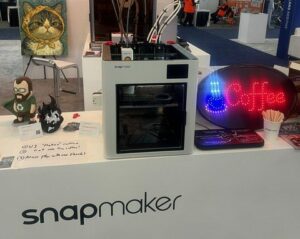
Built in collaboration with Cocoapress, maker of 3D chocolate printers, the machine repurposes the U1’s SnapSwap™ multi-toolhead system to deliver coffee and a custom non-dairy creamer alongside its usual printing capabilities. The toolheads normally dedicated to filament extrusion have been, in this edition, partially reassigned to your morning routine.
What makes this announcement genuinely interesting is what the coffee reveals about Snapmaker’s open-source software architecture. The U1’s SnapSwap™ system was designed with modularity and user modification in mind, and the Cocoapress collaboration is a live demonstration of that openness, proof that the platform can accommodate uses its engineers never anticipated. In an ecosystem where most manufacturers tightly control their toolchains, that kind of deliberate flexibility is a real differentiator.
The underlying U1 platform highlights print speeds up to 500 mm/s, up to 80% less filament waste compared to traditional multi-color printers, AI-based print monitoring, and a 270 × 270 × 270 mm build volume.
Against a backdrop of production-readiness messaging and industrial seriousness, Snapmaker chose to remind the room that 3D printing is also, still, a platform for imagination. That is a harder thing to communicate than a throughput metric, and arguably more valuable for the long-term health of the ecosystem.
*We curate insights that matter to help you grow in your AM journey. Receive them once a week, straight to your inbox. Subscribe to our weekly newsletter