What makes the Hammer Pro25 a production candidate for medical 3D printed brackets?
Around 6.66 million patients are in active treatment with members of the American Association of Orthodontists in the US and Canada alone (AAO, 2025). While it’s hard to give an accurate number in Europe, KZBV (the federal association of statutory health insurance dentists) reported 8.54 million orthodontic billing cases in Germany for 2024. Many of these patients are treated with fixed appliances, and the metal brackets bonded to their teeth are typically produced by metal injection molding (MIM). As patients increasingly need individualized treatment, it becomes hard to produce brackets at the economics of a mold. Incus GmbH aims to fill this gap with its Hammer Pro25, a 3D printer powered by lithography-based metal manufacturing (LMM).
In January 2021, when Incus GmbH shipped the first series of its Hammer Lab35 3D printer, CEO Dr. Gerald Mitteramskogler shared that there was still a long road ahead to scale up to mass production. Little did we know that four years later, the company would be ready to deliver on that promise.
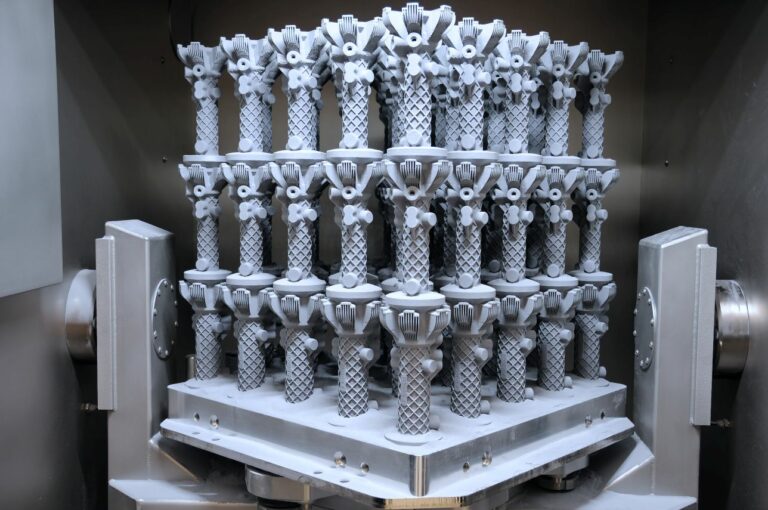
The company debuted the Hammer Pro25 last year at Formnext, a 3D printer designed with serial production in mind, with a material throughput of up to 980 cm³ per hour. Anyone knowing that the Lab35 offers a print speed of up to 100 cm³ per hour could already see that the new 3D printer delivers almost 10 times that throughput.
But mass production is more than just print speed. In the lines below, Mitteramskogler explains:
- How Incus defines mass production for LMM
- Which bottlenecks the Pro25 addresses
- How it fits into existing production lines and what a manufacturer needs to adopt it for series production.
- And how it supports the mass production of patient-specific brackets.
The framework of mass production with LMM

Ask 3 companies from different industries how they define mass production and there is a great chance you end up with three different concepts. We have come to realize that, in AM, it can mean a few thousand customized parts as much as millions of identical ones. And not only.
One thing we learned when defining AM candidacy for production applications is that the framework rarely accounts for the specificities of each AM technology. LMM illustrates why it still matters today.
LMM uses light and a special metal-filled paste to 3D print high-precision metal parts layer by layer. The photopolymerization process produces a “green part” that is then debound and sintered. When the binder is removed, the metal particles are fused at high temperature, as in MIM.
Based on Mitteramskogler’s point of view on mass production, Incus’ candidacy framework for mass production comes down to three items:
- The part itself. Incus’ LMM enables the production of small, geometrically complex components with fine features.
- Build density. The more parts can be nested on a build platform, the lower the machine-time contribution per part. For LMM, build density helps address part of the economics equation.
- Variation and tooling. Whether it’s individualized parts, multiple geometries produced in parallel, recurring design changes, or volumes too low to amortize a mold, tool‑free production becomes the more economical path.
For this reason, we understand why Incus refuses to put forward one universal parts-per-year figure. “Output depends on the component’s size, geometry, build density and production setup”, the CEO explains. Mass production should therefore be seen here as “the reliable, repeatable and economically competitive serial manufacture of parts rather than as a fixed volume threshold.” In practice, he adds, “the meaningful capacity figure should therefore be calculated for the customer’s specific component.”
Cost, the real bottleneck
The numbers shared at the very beginning highlight why we are increasingly gearing towards mass production of medical 3D printed brackets. A research on the orthodontic supplies market stated that roughly 65% of orthodontic patients worldwide choose metal.
The question is which metal process? For Mitteramskogler, answering this question depends a lot on the cost.
While MIM has long been the ultimate benchmark, the difficulty of mass customizing with it urges to consider other production processes.
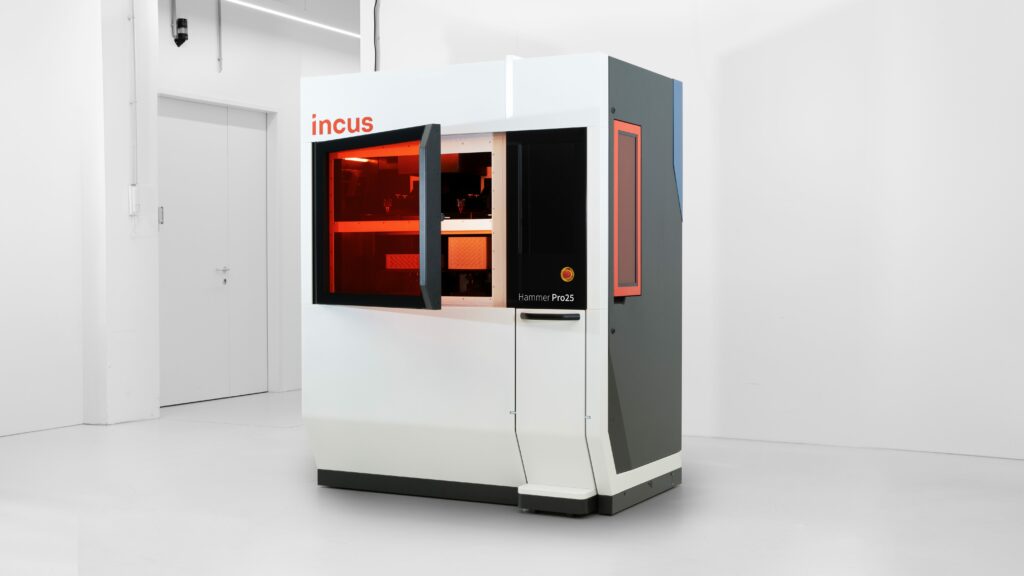
“The main barrier to broader adoption of metal additive manufacturing in series production is cost. The Hammer Pro25 addresses this through a larger build platform, high material throughput and a high degree of automation. Automatic feedstock reloading and print-job extraction reduce operator involvement, allowing more parts to be produced with less manual effort. Together, these capabilities bring the quality and economics of additive manufacturing as close as possible to MIM, while retaining the key advantages of AM: tool-free production, design freedom and the ability to manufacture different or individualized parts within the same build”, Incus’ CEO notes.
A closer look at the 3D printer’s specifications reveals that two overlapping scrolling projectors with a resolution of 25 μm work together to cover one large, continuous production platform of 200 × 204.55 mm, with layer thicknesses between 10 and 100 µm. A storage magazine for fresh feedstock and a “garage” for completed print jobs are both served by automatic manipulators, so that the machine can keep running over weekends without operators. Additionally, the company specifies a surface roughness of around Ra 2 µm after sintering.
Integration into existing workflows
It would be naïve to ignore other production processes when integrating the Pro25. In fact, its shared process logic with MIM is probably the technology’s greatest strength.
Like MIM, the Pro25 produces near-net-shape components that are debound and sintered before the finishing operations the application requires. This means that established MIM post-processes such as grinding, polishing, sizing or calibration can be applied to LMM parts as well.
Where particularly tight tolerances or specific functional surfaces are required, a final machining step may still be needed, and distortion introduced during sintering can be corrected through sizing or straightening. “This should not be seen as a limitation unique to sinter-based manufacturing methods, but as part of an optimized production chain”, Mitteramskogler notes.
So, is LMM more complementary than other AM technologies? Largely, yes.
A solid understanding of the complete sinter-based chain to adopt LMM is required and this includes design for LMM, feedstock handling, debinding and sintering, shrinkage compensation, and the control of distortion and dimensional variation.
Series production also requires appropriately sized debinding and sintering equipment, along with capabilities for material handling, cleaning, finishing, inspection and quality assurance, a setup that can be adapted to existing infrastructure and expanded as volumes grow.
MIM manufacturers start with “directly transferable process knowledge and quality-control methods”, while newcomers to sinter-based manufacturing can build that competence during a structured implementation and ramp-up phase, supported by Incus through application development, process transfer and hands-on training across the workflow.
The more we understand how AM works, the more we, as Mitteramskogler puts it, “recognize that the strongest production solutions combine additive manufacturing for geometric freedom and near-net-shape production with subtractive and conventional finishing methods for precision and surface quality.”
Mass producing patient-specific 3D printed metal brackets
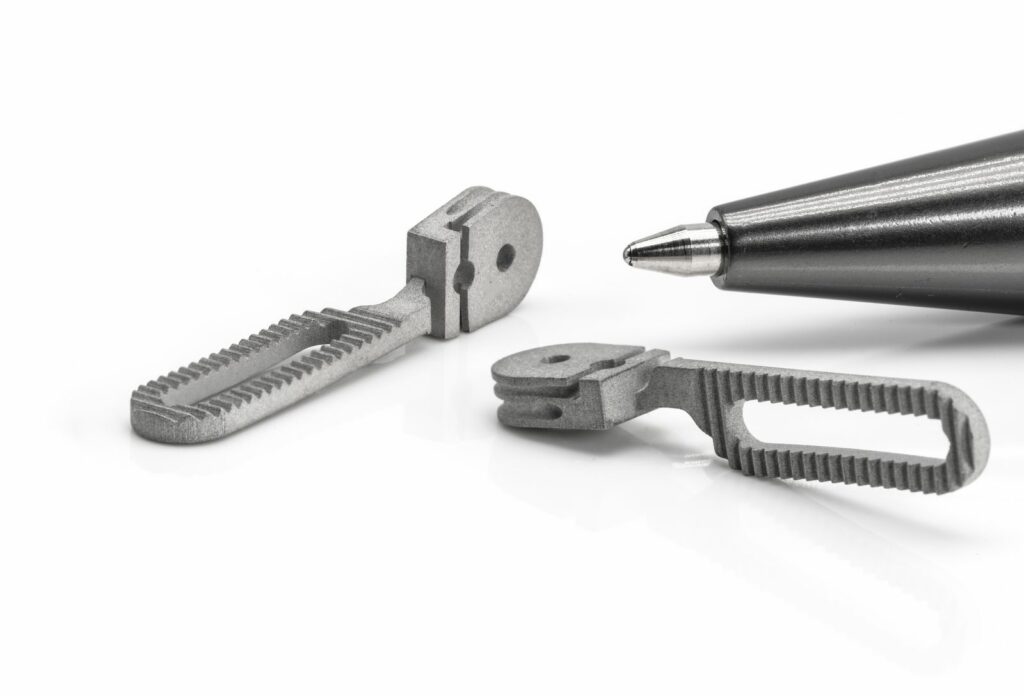
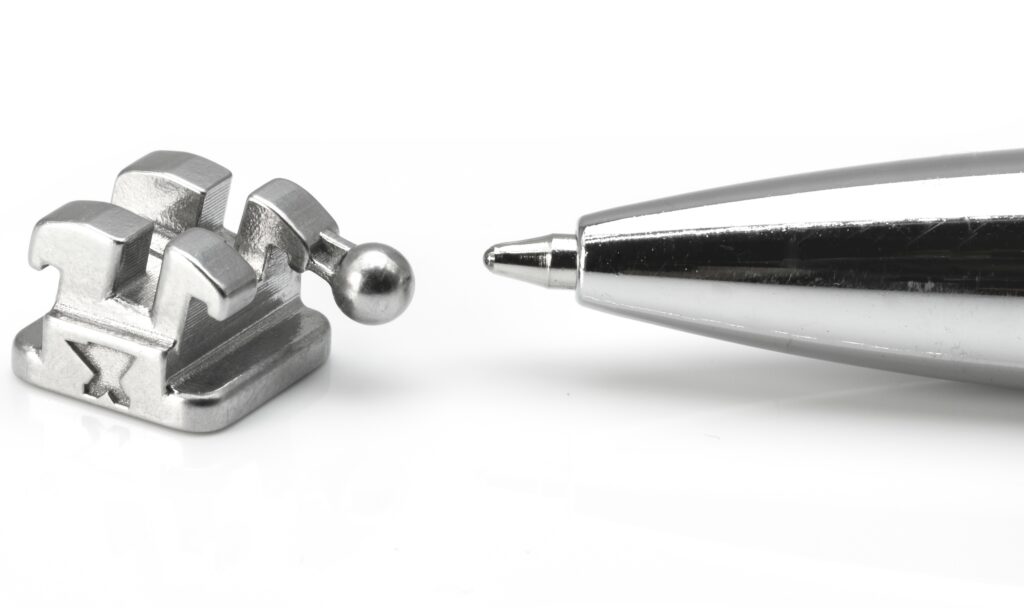
According to the company’s CEO, the Pro25 is most compelling “when manufacturers need to produce complex parts efficiently at scale”, typically small, geometrically complex components that can be produced in large numbers on its larger platform while keeping the level of detail LMM is known for. Orthodontic brackets tick all these boxes.
“They combine small dimensions and complex geometries with a need for high-volume, individualized production”, he explains. “Many different bracket designs can be arranged densely on a single build platform and manufactured together without dedicated tooling for each geometry. This enables mass customization: producing patient-specific parts at scale while maintaining an efficient use of the available build area.”
Yet the printer is only one part of the answer. For patient-specific brackets, “printing the green parts and sintering them are only two elements within a much broader production system.”
Scalable manufacturing starts upstream, with the automated generation, identification and preparation of patient-specific design files. Each bracket geometry must be compensated for the process, uniquely marked for traceability, nested efficiently and assigned to the right machine through an automated print queue.
“The Hammer Pro25 software is designed for integration into this automated workflow, enabling digital production data and print jobs to be transferred to the appropriate systems and machines without creating a separate manual step at the printer”, Mitteramskogler says.
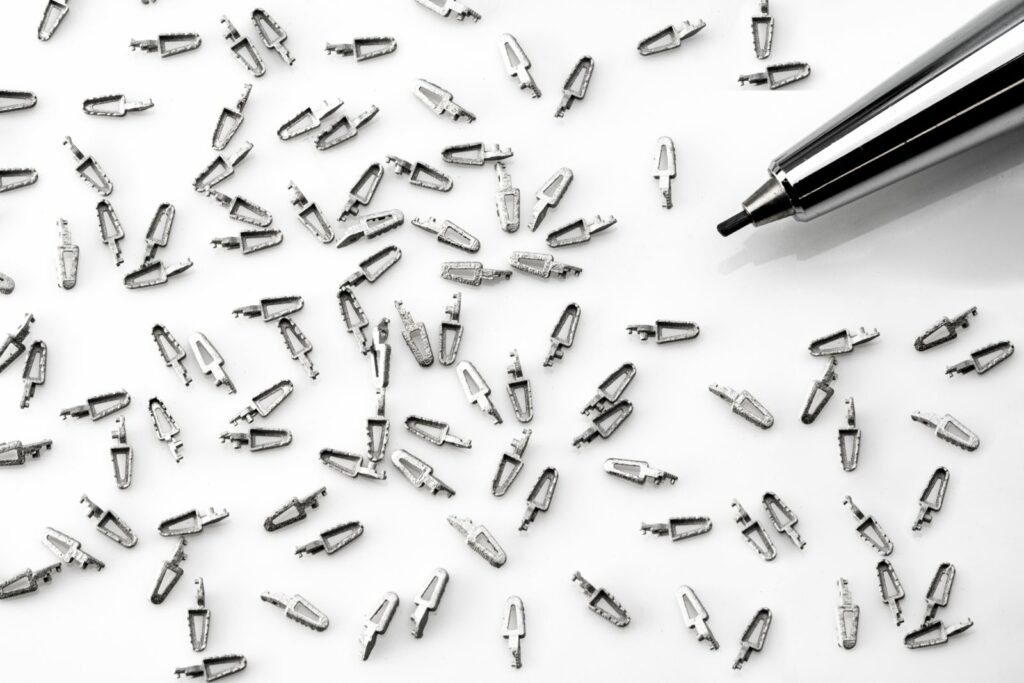
Downstream, further automation potential lies in extracting and cleaning the green parts, placing them on sintering setters and transferring them into debinding and sintering, followed by automated polishing, dimensional and visual inspection, quality-control documentation, sorting and packaging.
The overall workflow, he notes, resembles the highly organized production environment already used by established MIM manufacturers, with the Pro25 operating “as an integrated production unit within the complete digital process- and quality-assurance chain.”
Back in 2022, one of the very first medical use cases of LMM that popped up on our radar came from MetShape, a service provider that then associated the technology with low production volumes. Seeing how far it has come since then, I can’t help but be impressed. Achieving series production in medical 3D printing is not for the faint of heart, but by building on LMM’s structural proximity to MIM, Incus gives manufacturers a path that does not start from scratch. I now look forward to sharing more applications the technology will enable in this field.
This article was first published in the September/October 2026 issue of 3D ADEPT Mag.
This content has been created in collaboration with Incus GmbH. All images: courtesy of Incus GmbH.
THE 3D ADEPT WEEKLY NEWSLETTER
The industry moves fast. Stay ahead.
Every week, the latest additive manufacturing news, in-depth features and real-world applications, straight to your inbox. Plus, be the first to know when a new issue of 3D ADEPT Mag is out.
Free · One email a week · Unsubscribe anytime
Clicking loads our email provider’s sign-up form, including its analytics and Google’s anti-bot protection. You’re only subscribed if you complete the sign-up. Read our privacy policy.