As the surge in entry-level 3D printer shipments tops 1 million in Q1, I can’t help but link it to the growing rise of 3D printer farms across the world. And as 3D printer farms rise, I am pondering whether or not they can scale up production rapidly, cut down on lead times, all without the massive overhead typically associated with traditional manufacturing. In the end, is it not the promise of 3D printer farms?
Mass-produced parts span industries from medical and healthcare to automotive, aerospace, B2B components, and consumer goods. In line with this edition’s theme of 3D ADEPT Mag, this article will focus specifically on consumer goods applications.
For a long time, I associated mass production exclusively with industrial 3D printers operating on the production floors of AM companies or service bureaus. My focus on industrial-grade applications reinforced that view. However, the ‘fall and rise’ of desktop 3D printing has shifted my perspective again, prompting me to consider all AM technologies—regardless of size.
That said, whether we talk about mass production with industrial 3D printers or desktop 3D printers, there is one area that we have never defined: how much is “mass” production?
What quantity is considered “mass” production?
The general understanding is that mass production typically involves manufacturing a large number of identical items, often in thousands or millions, over a sustained period. There’s no single universal number for when production becomes “mass” . However, we came to realize that production hits differently from one product/industry to another, and from one process to another.
In automotive, hundreds of thousands of parts per year would mean mass production while millions of units per year could be the standard in consumer electronics.
In the same vein, in traditional manufacturing (e.g., injection molding, CNC), “mass” often means thousands to millions of identical units. In Additive Manufacturing, volumes are usually much lower before it’s considered “mass” — because the technology is still slower and more expensive per part for many applications. In AM, “mass” might mean hundreds or a few thousand units per year for certain parts, especially if each one is customized.
How does mass production look in the consumer goods sector?
In the consumer goods sector, success stories reveal that brands that mass produce scale up to thousand-and-million-part runs. Interestingly, they often rely on industrial 3D printing.
adidas, the example par excellence
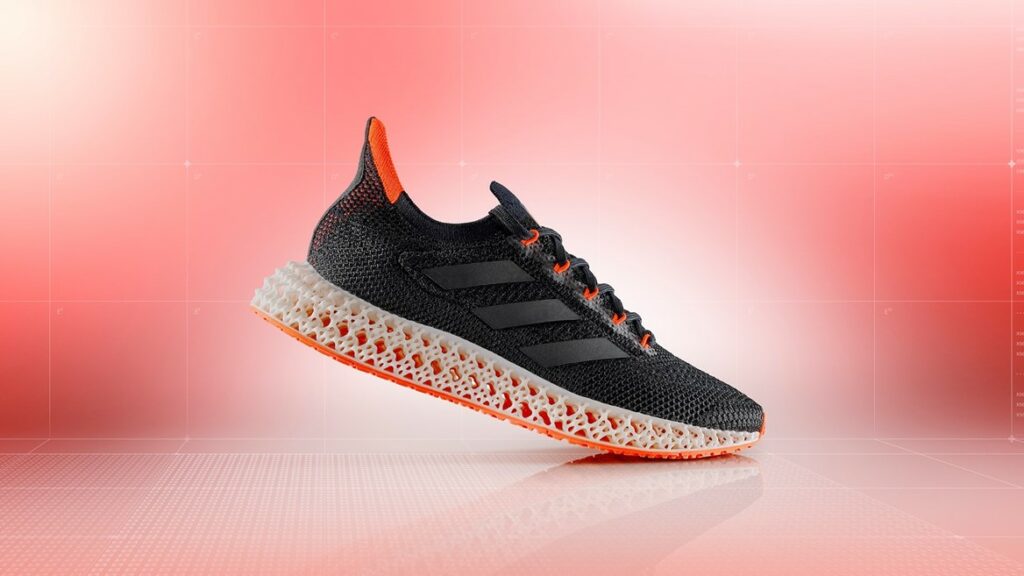
The footwear brand’s recipe of success with 3D printing is achieved with Carbon’s DLS technology.
In 2017, the company released 100,000 pairs of the Futurecraft 4D, a single-print mid-sole, later followed by AlphaEDGE in 2018. 2021 saw the biggest release yet: the Adidas 4DFWD, the world’s highest volume 3D printed shoe with over 2 million sales.
OPPO’s 3D printed smartphone hinge
OPPO, a consumer electronics brand, reminds us that metal 3D printing does not only shine in aerospace applications. With more than 10,000 metal 3D-printed parts produced, BLT’s laser powder bed fusion (LPBF) technology has enabled the creation of a thin yet strong titanium hinge for the new Find N5 folding smartphone. The hinge, 3D printed from titanium on BLT’s LPBF machine, is just 0.15 mm thick. To meet production needs, a single BLT 3D printer can manufacture nearly 300 hinges per day.

Monoqool ‘s 3D printed glasses

It would be strange not to mention one of the most widely achieved applications in the consumer goods sector: 3D printed eyewear.
With 2000+ parts produced via SLS, Monoqool is one of the companies we would like to put on the spotlight here. It 3D prints frames that are lightweight and screwless, sintered as one piece from a polyamide powder.
3D printing helps the company produce more economically a tailor-made product that still goes through several manufacturing steps, including coloring, polishing, and assembly.
What about 3D print farms?
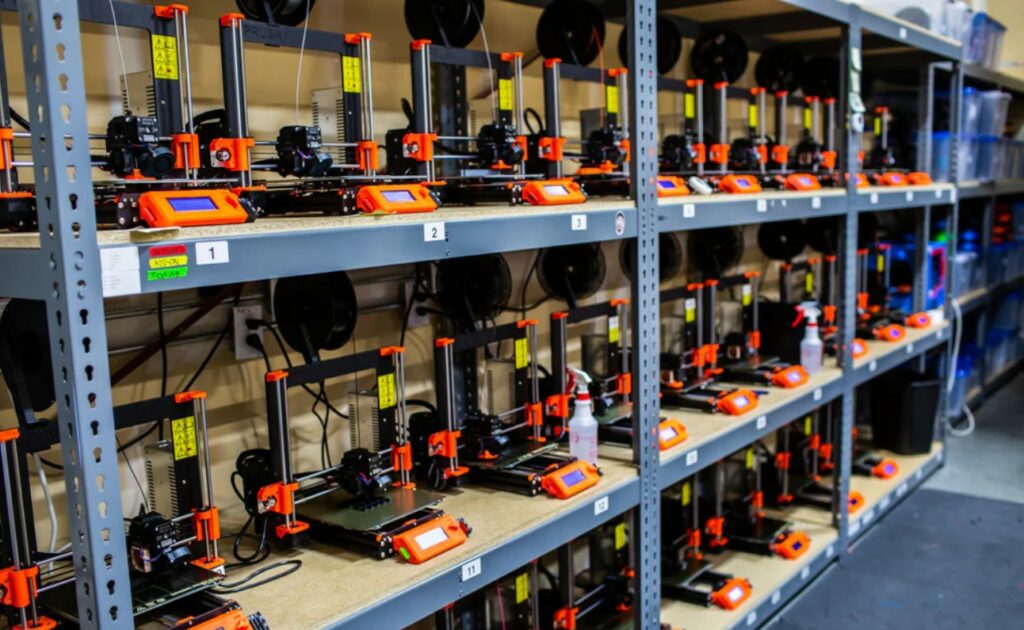
A 3D print farm is basically a group of multiple 3D printers working at the same time to produce parts or products in parallel, similar to a small manufacturing setup. While it would make sense for plastic, resin, or metal 3D printers to mass produce parts or products, 3D print farms are mostly linked to material extrusion (especially desktop 3D printers) and resin — with metal 3D printers being mainly used for industrial purposes.
Prusa Research, Slant 3D, Lost Boys Lab, Zellerfeld, Out of Darts, ZB Designs, Gantri and Jinqi Toys are some of the names leading this segment.
Apart from 3D print farms that operate as service bureaus, we believe that companies focusing their core business on a single product category have been able to achieve true consumer-scale production.
While service bureaus are usually better suited for variety and flexibility rather than sustained mass production of one product, the focus on one product allows businesses to hit consumer-scale volumes — thousands to millions of units per year — in a way general service bureaus rarely can.
Gantri and Zellerfeld are two businesses we have been watching closely.
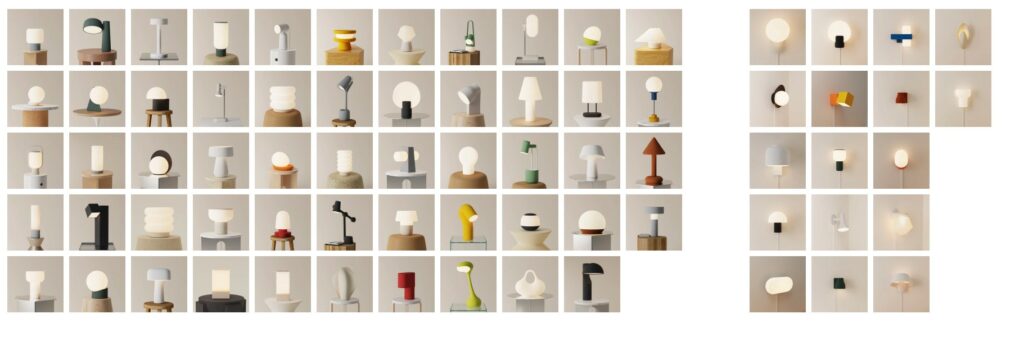
Gantri is using desktop machines to make lamps and other home déco. The California-based company explored several 3D printers, including UltiMaker, before turning to a proprietary 3D print farm and enhancing every stage of its production process.
Today, it operates as a digital manufacturing platform that enables design-forward brands to create new products sustainably and with minimal risk—in California. t’s described as the first digital manufacturing process capable of producing unique, high-quality designer lights on demand.
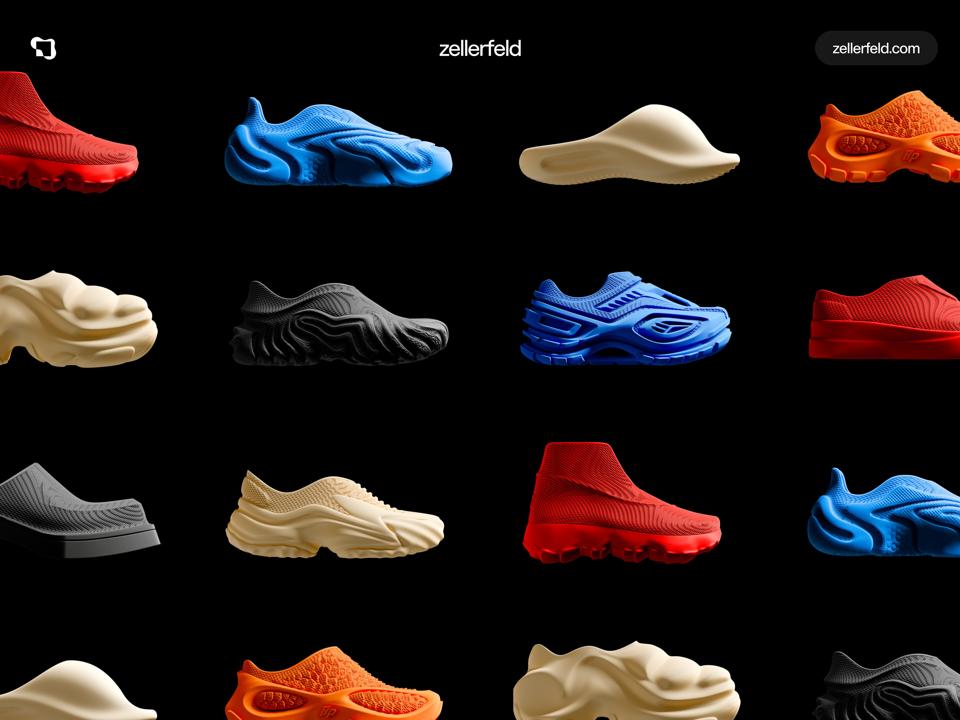
Operating print farms in New York and Hamburg, Germany, Zellerfeld continues to expand its product offerings and production capabilities with a focus on fashion footwear. After building its own facility equipped with 200 3D printers—capable of producing several hundred pairs—the company aims to scale its production environment to several thousand, targeting up to 5,000 3D printers.
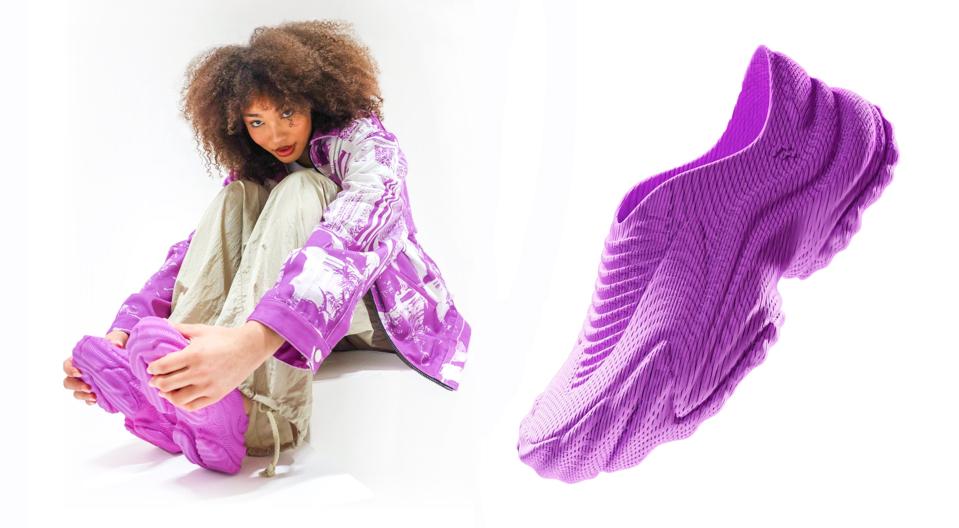
To realize this ambitious vision, Zellerfeld partnered with experts from the Fraunhofer Institute for Additive Production Technologies (IAPT) to conceptualize the new infrastructure that would become the world’s largest additive production factory.
Zellerfeld’s open platform integrates Zellerfeld Studio, an innovative creator studio that is revolutionizing the footwear industry. Originally launched as an e-commerce store built on Zellerfeld’s proprietary full-stack printing technology, zellerfeld.com has evolved into a global gallery where anyone can upload and launch footwear designs within 24 hours.
Zellerfeld Studio provides designers with cutting-edge tools to order samples and bring creations to market at unprecedented speeds. What traditionally took 12 to 18 months to develop can now be achieved in mere days, making Zellerfeld’s technology one to watch in the footwear industry.
In conclusion…
While the definition of “mass” in additive manufacturing varies by industry and product type, 3D printer farms are increasingly proving their capability to drive consumer-scale production. But this business model is not for the faint of heart. In a future article, we will dive into the best practices, failures and successes of those who run a 3D printing farm.
Featured image: Zellerfeld. This dossier has first been published in the July/August edition of 3D ADEPT Mag. Read the entire issue here.
*We curate insights that matter to help you grow in your AM journey. Receive them once a week, straight to your inbox. Subscribe to our weekly newsletter.