


DNV GL, an assurance and risk management company has recently released its classification guideline for the use of additive manufacturing (AM) in the maritime and oil & gas industries.
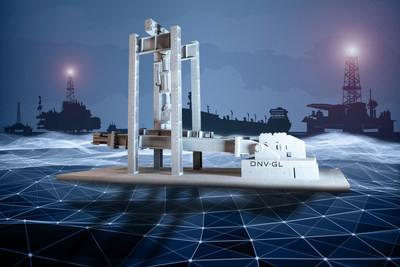
This guideline would help manufacturers and sub-suppliers of materials, parts and components, service suppliers and end users adopting AM technologies, by ensuring that the parts or components created by an AM process and the materials from which they are created have the same level of quality assurance as traditionally manufactured products.
As a reminder, additive manufacturing refers to industrial processes that create 3D objects by adding layers of material. Technologies included in these processes are 3D Printing, Rapid Prototyping (RP), Direct Digital Manufacturing (DDM), layered manufacturing and additive fabrication.
As far as this guideline is concerned, Marit Norheim, Vice President, Material Specialist, Hull, Materials & Machinery at DNV GL – Maritime declared that it will enable end users to get more confidence in the products and allow suppliers “to offer their technologies and products for use in vessels and offshore installations.”
Furthermore, Norheim adds that ” the companies that have designed the parts must protect their intellectual property, so that customers can be sure they are receiving genuine products that are guaranteed fit for purpose.“
Metal printing, an important part in the 3D printing market
Metal printing is one of the most attractive solution for prototyping and more. Its application is particularly observed in the maritime and oil & gas sectors.
According to a research, metal printer manufacturers and materials suppliers will meet the needs of their clients, on a 3D printing metal market which would worth $12B in 2028.
With the new guideline, DNV GL has created a clear pathway for AM certification and has the processes in place to assess every parameter that will impact upon the final products – from the material used, to a technology assessment, manufacturing procedure qualification, data transfer, and the actual printing and post processing.
For further information about 3D Printing, follow us on our social networks and subscribe to our newsletter!
THE 3D ADEPT WEEKLY NEWSLETTER
The industry moves fast. Stay ahead.
Every week, the latest additive manufacturing news, in-depth features and real-world applications, straight to your inbox. Plus, be the first to know when a new issue of 3D ADEPT Mag is out.
Free · One email a week · Unsubscribe anytime
Clicking loads our email provider’s sign-up form, including its analytics and Google’s anti-bot protection. You’re only subscribed if you complete the sign-up. Read our privacy policy.