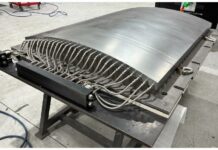
Tidal energy manufacturing involves creating components for various energy extraction technologies, such as tidal barrages, which are like dams, and tidal stream generators, which are like underwater wind turbines. Tidal energy systems, such as turbines, blades, floaters, underwater housings, moorings, face challenges that make traditional manufacturing slow and expensive.
Large scale AM appears to be one solution that could help address these challenges. With a key focus on an advanced 2-meter tidal turbine blade, Thermwood Corporation (USA), the LSAM Research Laboratory at Purdue University (USA), the University of Sheffield (UK), and the University of Oxford (UK) join forces to demonstrate the capabilities of this process.
Thermwood and Purdue are known for their collaboration on predictive simulation and LSAM. They were recently able to merge predictive simulation with large-scale 3D printing, enabling “first-time-right” production of advanced composite parts.
As part of this project, Purdue University’s ADDITIVE3D simulation platform was used to predict and optimize the printing process for the double-sided tool. This advanced physics-based virtual twin models temperature evolution, post-processing effects, and tool performance, including heat treatment, material removal, and anisotropic shape compensation.
The expertise brought by British universities
After printing, Sheffield’s Advanced Manufacturing Research Centre (AMRC) performed precision machining to integrate sensor placements, blade root locator mounts, and resin inlet/outlet features into the component.
The resulting two-sided tool enables single-shot infusion of carbon-fiber reinforcement around a central blade core, streamlining fabrication while improving structural efficiency. The 2-meter blade itself uses a hybrid architecture, combining a stainless-steel root with a polycarbonate core and a CFRP skin, to ensure mechanical strength where needed while reducing weight along the span for optimal performance.
Embedded fiber-optic sensors, strain gauges, thermocouples, and accelerometers further enhance the design by providing real-time structural monitoring and valuable data on manufacturing quality, operational behavior, and overall structural health.
The blade will undergo fatigue testing at the University of Edinburgh’s FastBlade facility, followed by extended sea trials with a scaled turbine system. These trials will generate valuable data on durability, structural performance, and environmental loading; shaping the next generation of high-efficiency tidal turbine blades.
We curate insights that matter to help you grow in your AM journey. Receive them once a week, straight to your inbox. Subscribe to our weekly newsletter.