


Feature first published in the May–June 2021 issue of 3D ADEPT MAG, then online in September 2021. Companies, projects and economic commentary describe that period. A dated clarification distinguishes the Nijmegen bridge opening from its construction phase.
This feature explores five aspects of construction 3D printing in the Netherlands in 2021: production facilities, housing, bridges, industry participants and the economic context.
Our overview published in January–February 2021 presents several aspects of the Dutch AM market. Concrete printing is one area of industrial experimentation.
TU/e’s research involved a consortium including Ballast Nedam, BAM, Bekaert, Concrete Valley, CRH, CyBe, SGS Intron, Verhoeven Timmerfabriek Nederland, Weber Beamix, Van Wijnen, Witteveen+Bos, stichting SKKB. These research–industry collaborations contributed to concrete 3D printing; they do not by themselves establish an international ranking of countries.
In 2021, the country brought together equipment manufacturers, construction businesses and digital architecture specialists. Their approaches and materials differed.
The following five examples and observations are not claimed to be exclusive to the Netherlands.
1. Industrial concrete-printing capacity in Eindhoven
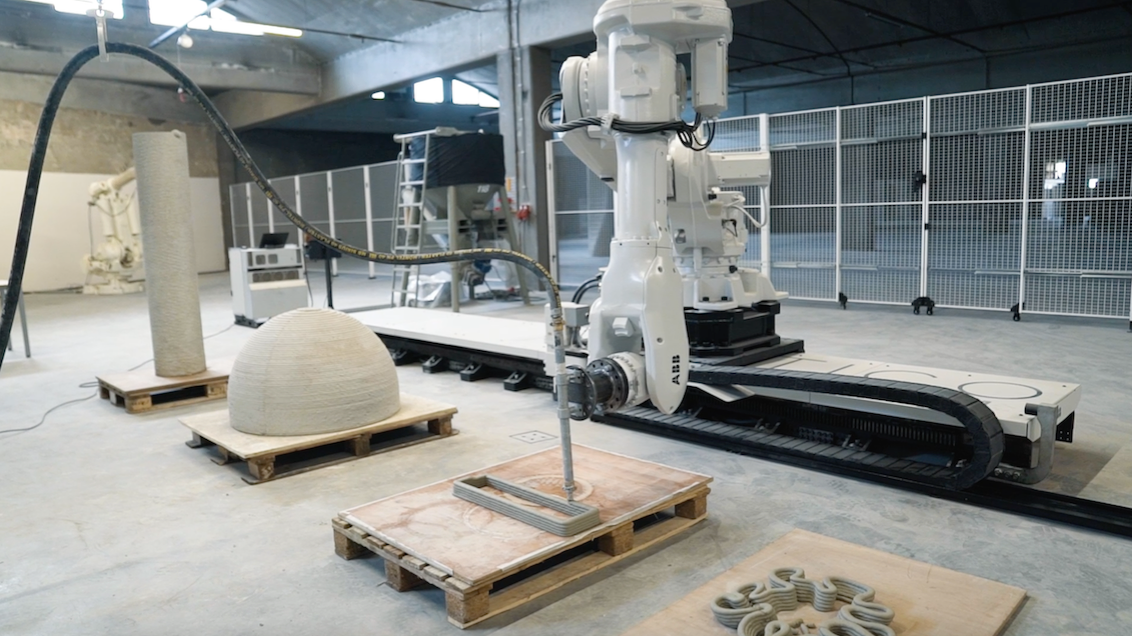
BAM Infra and Saint-Gobain Weber Beamix opened their concrete 3D printing factory in Eindhoven in January 2019. Their announcement also names Bekaert, Witteveen+Bos, TU/e and Van Wijnen among the partners.
The 3D printing house factory was located in Eindhoven, a city considered as the “tech capital” of the country. For the partners, this “commercial industrial location for 3D printing concrete components for construction” is meant to serve as a place of research, a place where they can 3D print in a commercially sustainable way, and a starting point for numerous projects including the “Project Milestone” that you will see below.
In the fourth quarter of 2020, 3D ADEPT also reported the opening of the Vertico facility in Eindhoven, highlighting fine detailing and architectural applications.
2- “Project Milestone”
Project Milestone brought concrete printing into a house actually offered for rent.
In 2018, one year before announcing the opening of the 3D printing factory, the project Milestone was announced. Its goal? 3D printing five houses that will be rented in Eindhoven. At the heart of the project, one can find Eindhoven University of Technology, contractor Van Wijnen, Vesteda (real estate manager), Saint Gobain Weber Beamix (materials company) and Witteveen+Bos, an engineering company. Vesteda, the buyer of these houses, will rent them to those who will be interested. The architects Houben & Van Mierlo designed the project and were inspired by “erratic blocks in a green landscape”.
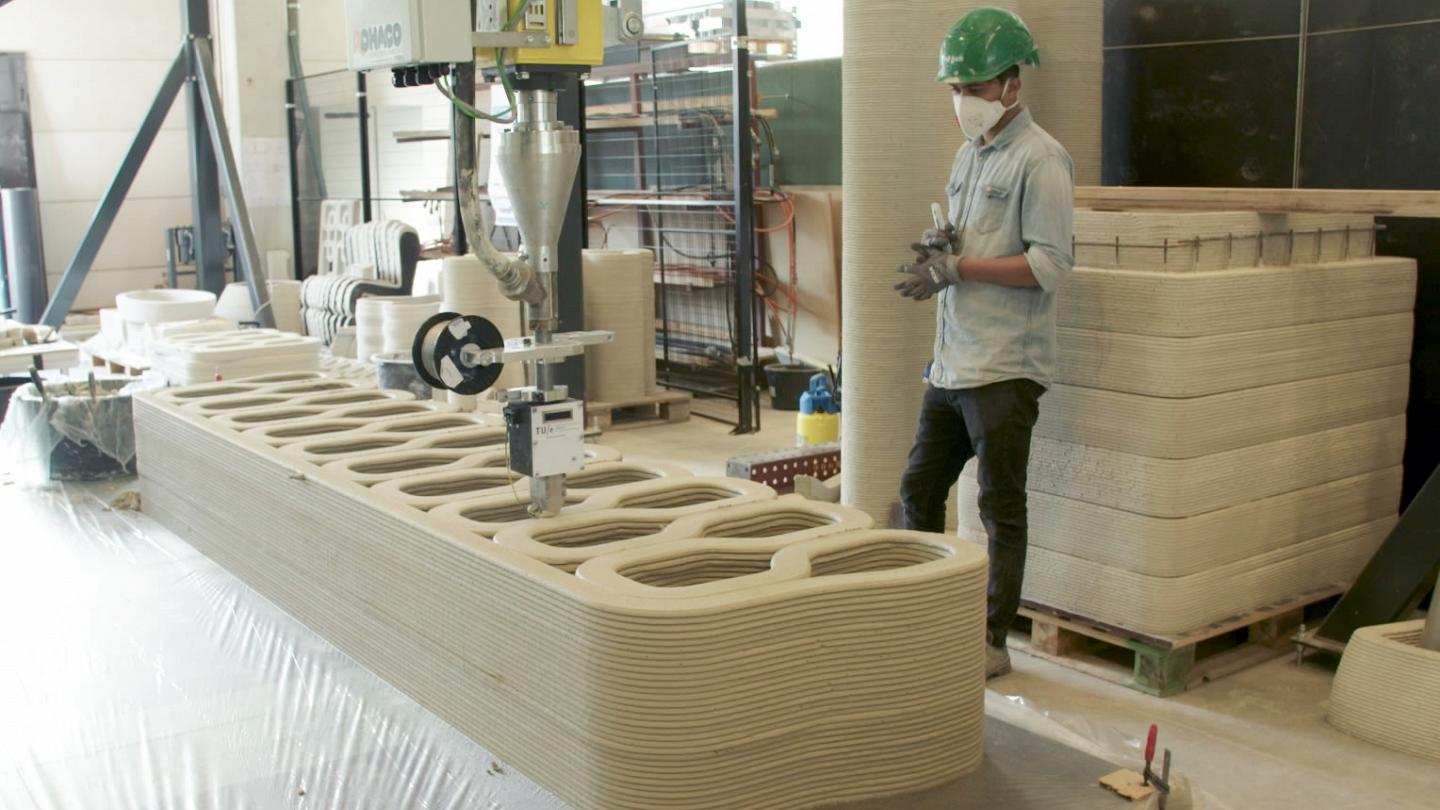
On 30 April 2021, the partners announced the handover to the first tenants. According to Witteveen+Bos, the first house used 24 concrete elements printed at the factory, transported and assembled on site. Roofing, frames and finishing followed: the entire house was not printed in one piece.
3- The Bridge Project
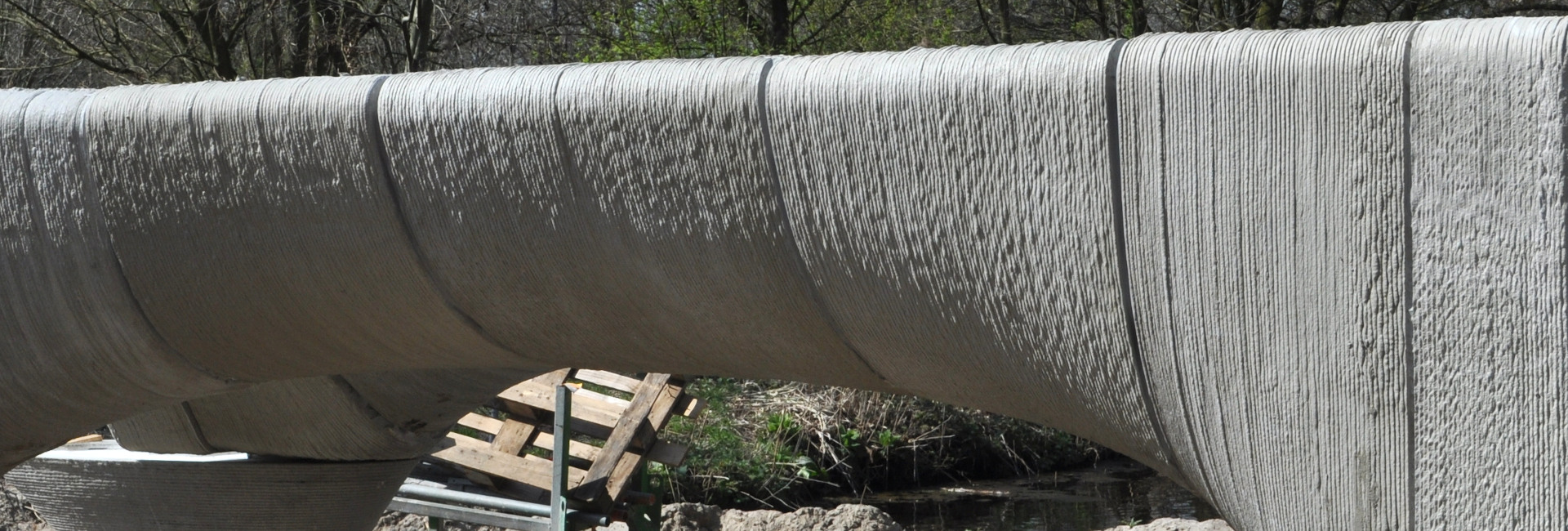
The Nijmegen bridge project combines an initiative by Rijkswaterstaat and designer Michiel van der Kley with TU/e research, components printed by Weber Beamix and construction by BAM.
The original idea was to print a tunnel and Nijmegen had been chosen for the construction. The idea was quite timely as the city – located in the East of the country – wanted to build something eye catching and iconic after its nomination as the Green Capital of Europe in 2018. However, when the partners found the exact location of the construction, “it became clear that a tunnel wouldn’t be that easy, a bridge however would be very welcome”.
When this feature was prepared in spring 2021, the bridge was still under construction. Chronology clarification: in its release dated 8 September 2021, BAM announced the opening and a length of 29 metres. The length envisaged during printing should therefore not have been presented as an already certified record.
4. An ecosystem with varied approaches
The following companies illustrate the diversity observed in 2021. This is neither an exhaustive list nor a global ranking; it brings together businesses with different activities and materials.
Companies mentioned in this feature include Twente Additive Manufacturing, CyBe Construction, Vertico, BAM, Weber Beamix, Coastruction, CONCR3DE, Rohaco, DUS Architects, MX3D and Aectual.
5. Economic commentary in its historical context
The following passage preserves the analysis carried by Lexology and cited when the feature was prepared in 2021. References to the current climate and new rules belong to that historical source; they do not describe today’s economic or tax conditions.
Well, it’s a little bit hard to look at the construction 3D printing without any look at the “general state of the construction sector in a given region”. We did not dive into the legal framework and related jurisdiction – we will let you that part of the work -; but according to Lexology, a comprehensive source of international legal updates, analysis and insights, “the current economic climate has been good for the construction sector. Interesting trends include the redevelopment of existing buildings, sustainability/circularity and innovation. The demand for housing, logistics and data centres and flexible office concepts is also high and investors have shown an appetite for forward-funded projects. Further, new tax rules will likely lead to different ways of structuring projects, which will affect the number of entities used, financing and the moment of legal transfer”. You may find out more about the legal framework on their article dedicated to construction in the Netherlands.
These examples show the Netherlands’ role in construction 3D printing experimentation at that time. Economic and environmental benefits need assessing project by project, accounting for materials, manufacturing and the complete building process.
This feature was first published in the May–June 2021 issue of 3D ADEPT MAG.
For further discussion, watch the Additive Talks recording on the hidden complexities of construction 3D printing, published in September 2021.
THE 3D ADEPT WEEKLY NEWSLETTER
The industry moves fast. Stay ahead.
Every week, the latest additive manufacturing news, in-depth features and real-world applications, straight to your inbox. Plus, be the first to know when a new issue of 3D ADEPT Mag is out.
Free · One email a week · Unsubscribe anytime
Clicking loads our email provider’s sign-up form, including its analytics and Google’s anti-bot protection. You’re only subscribed if you complete the sign-up. Read our privacy policy.