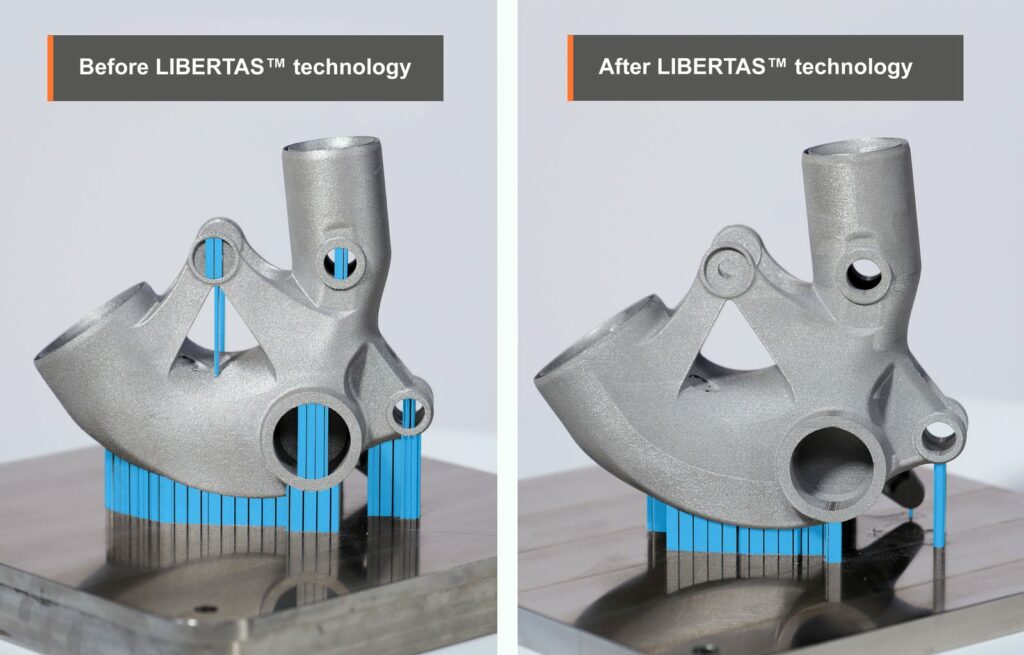
Global engineering technologies company Renishaw has released LIBERTAS technology for its RenAM 500 series metal additive manufacturing systems. This software gives users finer control over laser parameters. Renishaw uses it to deliver a support reduction package. The package would reduce the number of supports while improving the finish of unsupported, or downskin, surfaces.
Supports keep builds stable and help manage heat, the company explains. However, they also consume extra material and lengthen builds. They leave witness marks that users must finish after printing.
How does LIBERTAS work on laser powder bed fusion systems?
RenAM 500 machines use laser powder bed fusion (L-PBF). LIBERTAS adjusts how the laser delivers energy along the part’s geometry. This allows more effective heat control during the build.
According to Renishaw, better thermal management enables fewer supports and steeper downskin angles. It would also preserve build stability while reducing distortion. Users would save material, shorten post-processing and achieve a better finish on downskin features.
“LIBERTAS technology is an enabler, bringing metal AM’s benefits to a greater range of volume production applications,” said Benjamin Diaz, Principal Software Product Manager at Renishaw. “By reducing dependence on support structures, and improving unsupported surface finishes, we are unlocking geometries that were previously unviable due to traditional design for additive manufacturing (DFAM) constraints […]”
Integration with QuantAM and existing machines
The feature sits inside QuantAM, Renishaw’s build preparation software. Users therefore need no new hardware. Renishaw sells licenses per QuantAM seat, and one build file can run on several machines. Existing RenAM 500 users would thus retain their current workflow.
The company’s images show a bike part before and after LIBERTAS. They also show an impeller, removable partial dentures and watch casings.
L-PBF suppliers have long sought to reduce supports. We discussed this goal in our feature on the quest to avoid or minimize support structures in additive manufacturing.
The key point is that this software runs on existing machines. Users can therefore test the upgrade without investing in new hardware. I believe the per-seat licensing model will matter as much as the scanning strategy itself.
Renishaw will show LIBERTAS technology at Formnext in Frankfurt next week, in Hall 11, C11.
THE 3D ADEPT WEEKLY NEWSLETTER
The industry moves fast. Stay ahead.
Every week, the latest additive manufacturing news, in-depth features and real-world applications, straight to your inbox. Plus, be the first to know when a new issue of 3D ADEPT Mag is out.
Free · One email a week · Unsubscribe anytime
Clicking loads our email provider’s sign-up form, including its analytics and Google’s anti-bot protection. You’re only subscribed if you complete the sign-up. Read our privacy policy.