

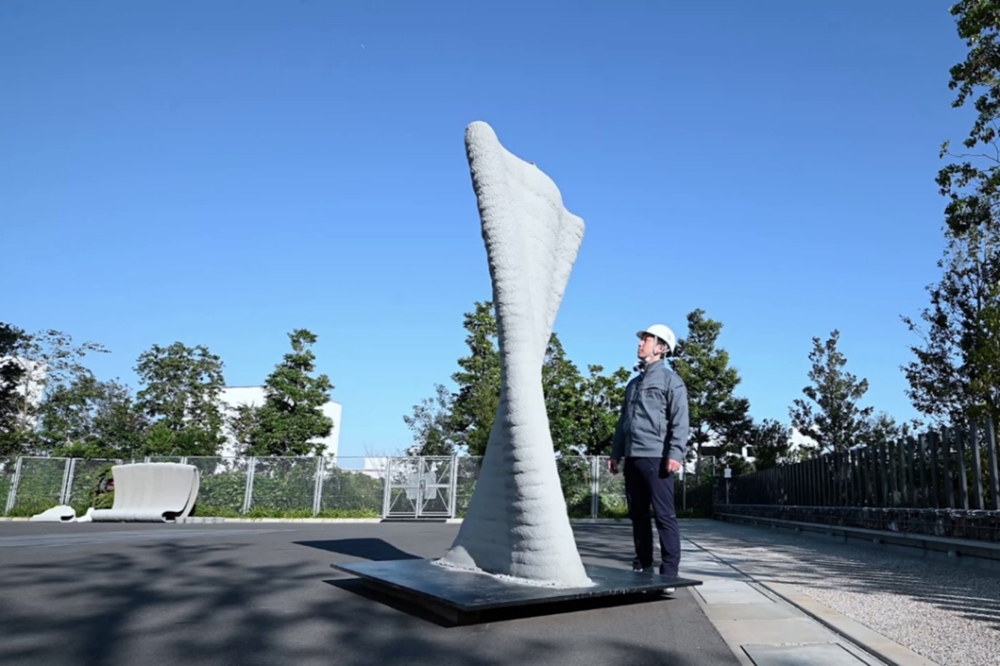
Japanese construction 3D printing company Shimizu Corporation introduces a new construction 3D printer.
With a material spray simulator as the key selling point, the Spray-based 3D concrete printing system can manufacture large, curved reinforced components.
A nine-degree-of-freedom gantry robot with the material spray simulator enables verification of sprayed-material behavior in advance.
The company jointly developed this material spray simulator with the Computational Engineering and Robotics Lab (CERLAB). Professor Kenji Shimada of the Department of Mechanical Engineering at Carnegie Mellon University leads the lab.
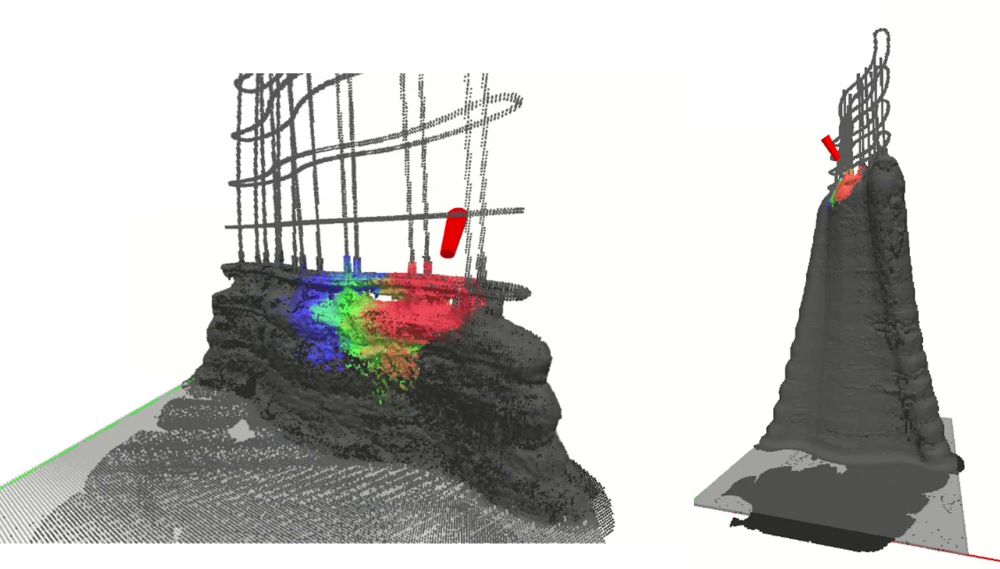
Integrating reinforcement into printed structures
In concrete construction, 3D printing is expected to move into practical use. Field applications have progressed primarily through material extrusion printing. In this process, cementitious materials are deposited layer by layer as they are extruded downward. However, this method makes it difficult to integrate rebars into the printed layers, thereby limiting its applicability to reinforced structural components.
Spray-based printing, which forms structures by spraying cementitious materials, is better suited to producing reinforced structural components. At the same time, the complexity of printer motion control has made it difficult to ensure sufficient fabrication accuracy, presenting a key technical challenge.
Simulating the spray to improve accuracy
In the newly developed system, a material spray simulator determines printing control parameters. It derives optimal nozzle paths, spray distance, angle, speed, material discharge volume, and related conditions. This approach improves printing accuracy while minimizing defect rates. The gantry robot used for printing consists of a seven-degree-of-freedom arm suspended from a two-axis XY motion mechanism mounted atop a portal-type frame.
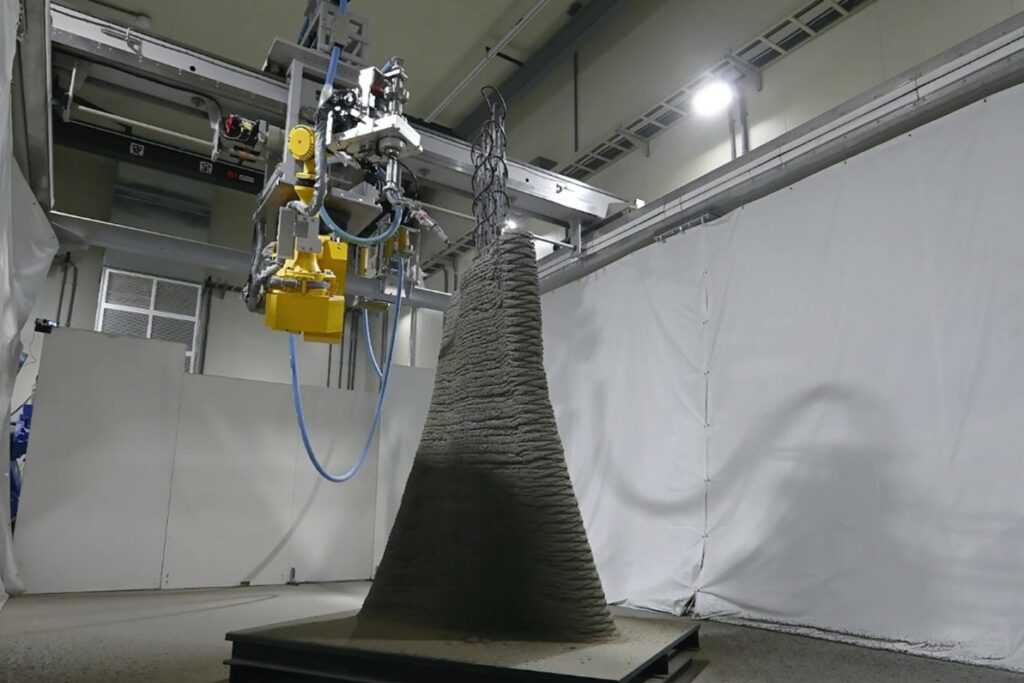
The printable area spans 6 meters in depth, 4 meters in width, and 3 meters in height. The nozzle at the arm tip can spray material in multiple directions across a wide range. This allows it to fill even the interior of reinforced assemblies. In demonstration tests, the system successfully fabricated a twisted curved wall measuring 2.5 meters in height in just four hours. Both the lower and upper layers project outward from the center.
Information on the commercial use of this 3D printer has not yet been provided.
THE 3D ADEPT WEEKLY NEWSLETTER
The industry moves fast. Stay ahead.
Every week, the latest additive manufacturing news, in-depth features and real-world applications, straight to your inbox. Plus, be the first to know when a new issue of 3D ADEPT Mag is out.
Free · One email a week · Unsubscribe anytime
Clicking loads our email provider’s sign-up form, including its analytics and Google’s anti-bot protection. You’re only subscribed if you complete the sign-up. Read our privacy policy.