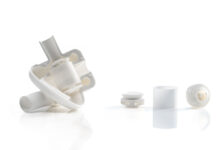
Tanbium, a novel advanced refractory alloy powder, will be explored for the first time for space applications. So far, the material’s capabilities have been assessed in an R&D project where it was optimized for other space components with demanding property requirements, produced via L-PBF and DED.
UK-based material producer Metalysis will develop and supply the material as part of a European Space Agency (ESA)–funded programme.
The ESA-funded Skyrora space propulsion project
The partnership forms part of Skyrora’s award from ESA’s General Support Technology Programme (GSTP). Phase one will run for nine months and focus on de-risking the material production and testing its application via Additive Manufacturing (AM). The developed Refractory Complex Concentrated Alloy (RCCA), Tanbium, will be manufactured by Metalysis and demonstrated in rocket engine components using Skyrora’s in-house additive manufacturing system, Skyprint 2.
This programme stage will raise the technology readiness level (TRL), with subsequent phases targeting TRL 6 for full-scale prototype testing in relevant environments. The other project partner is Thermo-Calc Solutions AB, who has designed and developed Tanbium using Integrated Computational Materials Engineering (ICME). Thermo-Calc Solutions will optimize Tanbium’s composition to Skyrora’s performance requirements in the project.
Upper rocket stage and satellite thruster components are typically made from Niobium Hafnium C103 or Inconel 718, but these materials have limitations in burn time, oxidation resistance, reusability, and weight.
Thermo-Calc Solutions AB has computationally designed Tanbium, a tantalum and niobium-based alloy, to deliver higher-temperature strength, improved ductility, enhanced oxidation resistance, and better laser processability than incumbent alloys, with predictions that it can extend component lifetime and burn time, while reducing weight with no effect upon performance.
European space component production forecasts indicate demand for around 20,000 kg of alloy powder over the next five years for space launch and satellites, based on C103 usage.
Metalysis’ patented FFC Cambridge electrolysis
Skyrora chose Metalysis due to its world-leading expertise in demonstrating niche alloy and novel high-entropy alloy (HEA) powders, and its proven ability to deliver custom refractory alloys with precise physical and chemical characteristics. Metalysis’ patented FFC Cambridge electrolysis process enables the production of bespoke materials in the solid state, overcoming the alloying limitations found in traditional melting.
This capability allows metals with very different chemical and physical properties to be combined, creating advanced alloys such as Metalysis’ unique HEA offering: lightweight refractory HEAs – at commercial scale – a breakthrough in materials science not seen since the Bronze Age. Furthermore, since the natural form of the alloy is a powder, it is suited to downstream consolidation techniques, such as Additive Manufacturing.
Remember, you can post job opportunities in the AM Industry on 3D ADEPT Media for free or look for a job via our job board. Make sure to follow us on our social networks and subscribe to our weekly newsletter: Facebook, Twitter, LinkedIn & Instagram ! If you want to be featured in the next issue of our digital magazine or if you hear a story that needs to be heard, make sure you send it to contact@3dadept.com