

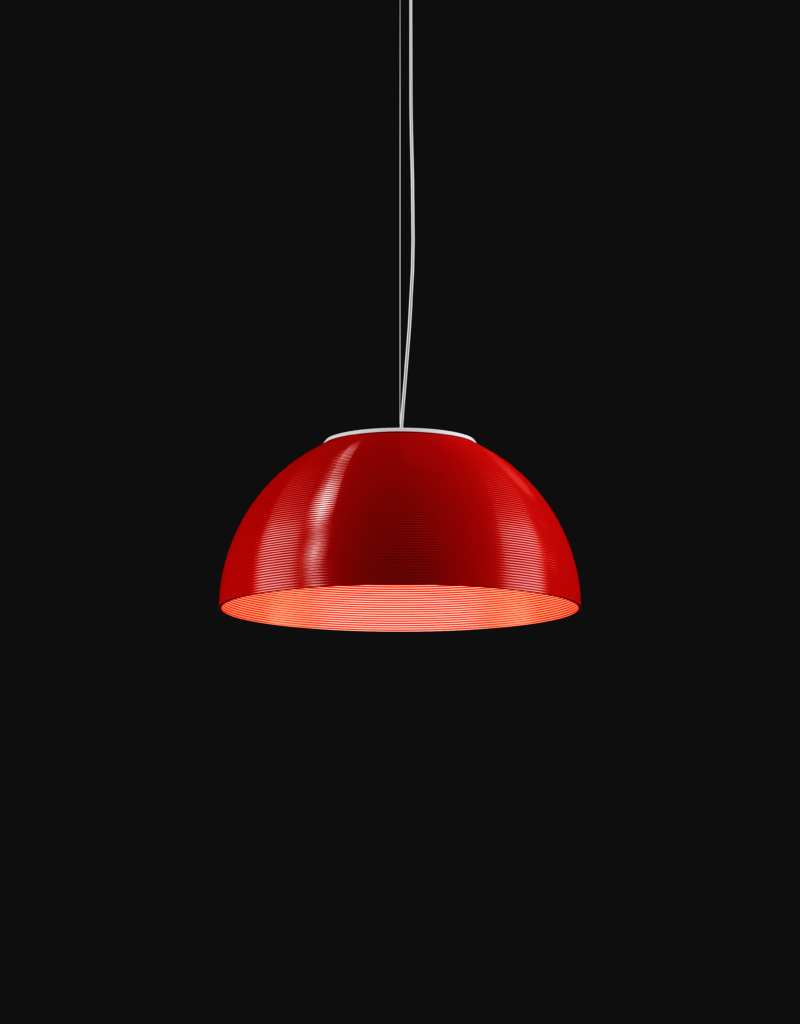
OCL Architectural Lighting, a designer and manufacturer of decorative pendants, sconces, ceiling, outdoor, and custom lighting, is leveraging large-format additive manufacturing to produce luminaires.
Already available in the commercial lighting industry, this new collection of decorative pendants is called Printz™, a name that embodies the use of LFAM to fabricate complex geometries, continuous compound curves, and integrated structural transitions that traditional tooling methods cannot efficiently achieve.
The Printz family debuts with three distinct forms – Ola, Cosma, and Hela – each designed to demonstrate the formal flexibility made possible through AM. OCL would have developed its own in-house material extrusion technology specifically for these lamps. Architectural luminaires roughly measure 45–91 cm in diameter, which is why LFAM is suitable.
With this new collection, OCL follows the examples of Signify and Gantri that have been dedicating their business model to 3D printed applications for the lighting industry.
“Pushing the limits of manufacturing demands experimentation and a willingness to challenge processes built for efficiency rather than complexity,” said David Cervantes, Product Design Manager at OCL. “With Printz, we’ve translated that exploration into a scalable architectural platform. Nonplanar additive manufacturing allows us to move beyond traditional fabrication constraints, and we’re just beginning to explore its potential.”
THE 3D ADEPT WEEKLY NEWSLETTER
The industry moves fast. Stay ahead.
Every week, the latest additive manufacturing news, in-depth features and real-world applications, straight to your inbox. Plus, be the first to know when a new issue of 3D ADEPT Mag is out.
Free · One email a week · Unsubscribe anytime
Clicking loads our email provider’s sign-up form, including its analytics and Google’s anti-bot protection. You’re only subscribed if you complete the sign-up. Read our privacy policy.