

Partner content
KARAKSA™ cellulose fiber reinforced polyamide (PA/CNF) from Asahi Kasei enables reinforced parts to be printed reliably on both industrial and standard desktop FDM (FFF) systems.
Many engineers turn to fiber-reinforced filaments to produce stronger functional parts. However, these materials often require specialized printers, hardened nozzles and complex printing setups.
KARAKSA™, Asahi Kasei’s cellulose nanofiber-reinforced polyamide filament, offers a different approach that enables strong reinforced parts to be produced reliably using widely available FDM (FFF) printers.
By combining mechanical strength with exceptional printability, KARAKSA™ helps engineering teams produce functional components and factory jigs while reducing equipment costs and production complexity.
Reinforced parts that print reliably
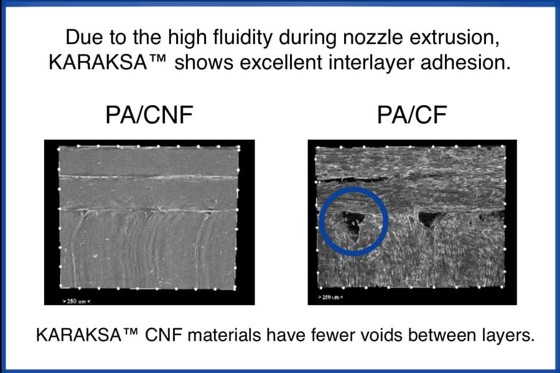
Traditional fiber-reinforced filaments often introduce challenges such as unstable extrusion, poor layer adhesion and increased void formation.
KARAKSA™ PA/CNF uses nanoscale cellulose nanofibers dispersed throughout the polymer matrix, forming a reinforcement network that supports both strength and print stability.
The result is a material designed for consistent production of functional FDM (FFF) parts.
Key advantages include:
- Excellent interlayer adhesion for reliable mechanical performance
- Reduced void formation within printed components
- Stable extrusion behavior during printing
- Ability to print bridges and overhangs with minimal deformation
These properties make KARAKSA™ particularly well suited to functional engineering applications.
Reinforcement without hardware compromise
Many carbon-fiber (CF) and glass-fiber (GF) filaments can be abrasive to printer hardware, requiring hardened nozzles and increasing maintenance requirements.
The cellulose nanofibers in Asahi Kasei’s KARAKSA™ filaments are significantly smaller and softer than conventional reinforcement fibers, reducing the impact on printer components.
This enables:
- Reduced nozzle wear compared with CF-filled materials
- Lower risk of clogging during printing
- Compatibility with industrial and desktop FDM (FFF) printer hardware
Because of the extremely fine reinforcement fibers, KARAKSA™ can also be printed using small nozzles such as 0.2 mm, enabling detailed parts with high surface quality.
Low-Friction and Low-Wear Performance
KARAKSA™-F CNF-Reinforced PA Filament combines high stiffness and dimensional stability with excellent sliding and wear performance. Under the test conditions shown in Figure 2, KARAKSA™-F exhibits a low coefficient of friction comparable to engineering plastics such as MC nylon (monomer cast nylon) and POM (polyoxymethylene), which are widely used for sliding components.
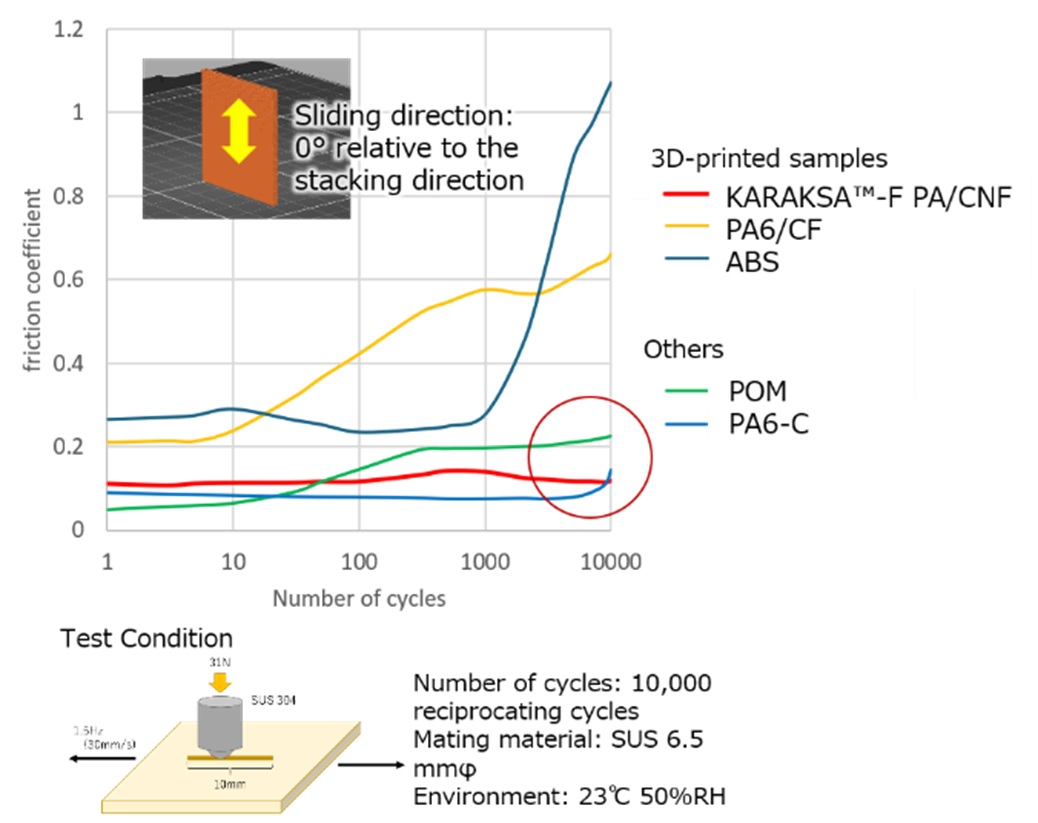
Unlike conventional 3D printing materials, which showed increasing friction with repeated sliding cycles, KARAKSA™-F maintained a nearly constant coefficient of friction, demonstrating sliding behavior comparable to MC Nylon and POM.
It also caused significantly less damage to SUS stainless steel counterfaces than conventional PA-CF materials, as shown in Figure 3.
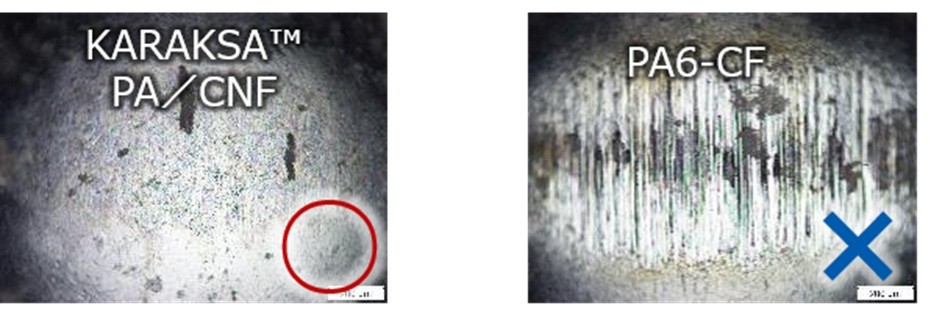
This unique combination of low friction, low self-wear, and low wear on mating parts enables smooth and durable operation. As a result, KARAKSA™-F has the potential to replace conventional materials such as MC Nylon in guides, rollers, bushings, positioning mechanisms, handling equipment, and other sliding applications and functional parts, while offering the design freedom of additive manufacturing.
Key Features
- Low friction comparable to MC Nylon and POM
- Resistance to wear
- Minimal damage to mating materials, including SUS stainless steel
- Potential replacement for MC Nylon in sliding applications
Real-World Applications Enabled by Strength, Dimensional Accuracy and Sliding Performance
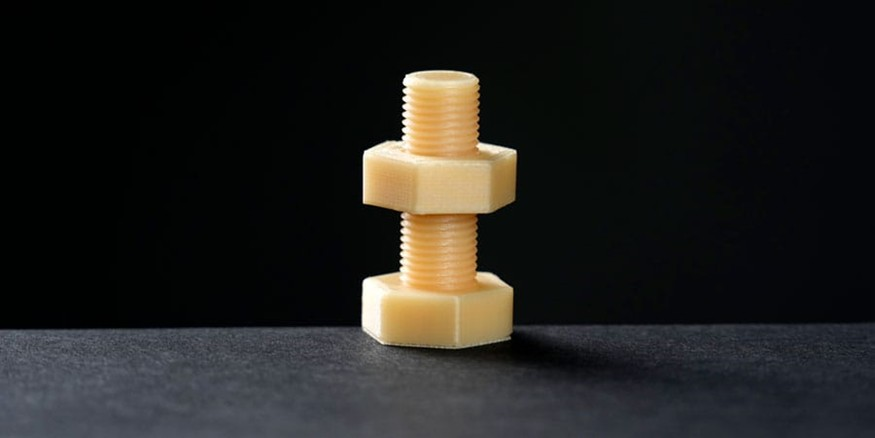
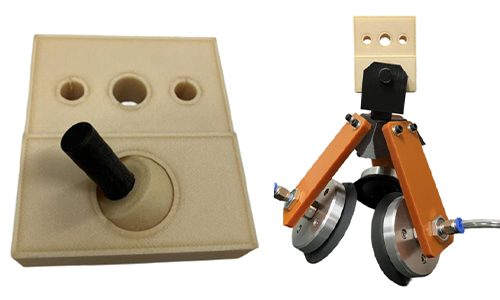
A movable joint component used in an industrial lifting fixture was successfully produced using KARAKSA™-F. The application required high strength, dimensional accuracy and smooth movement between contacting parts. The integrated ball-joint structure used in this application is shown in Figure 4.
As demonstrated by the low-friction characteristics shown in Figure 2 and the reduced wear on mating materials shown in Figure 3, KARAKSA™-F is well suited for moving assemblies and sliding mechanisms. In this application, these characteristics enabled reliable operation while maintaining the dimensional precision required for controlled movement.
Key benefits demonstrated in this application include:
- Excellent dimensional accuracy, enabling precise control of clearances between moving parts and reducing looseness while maintaining smooth articulation.
- Low-friction sliding performance, supporting stable and reliable movement during repeated operation and prolonged use.
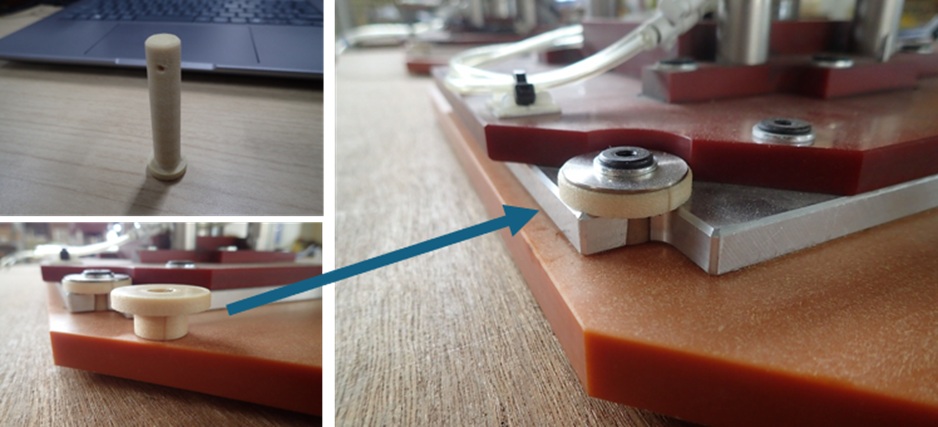
A second application involved a spacer fixture shown in Figure 5, where strength and dimensional accuracy were required to maintain precise positioning and stable assembly. The rigidity and dimensional stability of KARAKSA™-F enabled reliable fixture performance while taking advantage of the design flexibility of additive manufacturing.
Key benefits demonstrated in this application include:
- High strength, enabling the fixture to securely support and position components during assembly and operation.
- Excellent dimensional accuracy, allowing precise spacing and repeatable positioning while reducing the need for machining or adjustment after printing.
These examples demonstrate the suitability of KARAKSA™-F for functional components and fixtures requiring strength, dimensional accuracy, and smooth sliding performance.
Lower total cost of reinforced printing
Because KARAKSA™ materials remain compatible with standard desktop FDM (FFF) printers, reinforced parts can be produced without the capital cost of specialized industrial systems.
Engineering teams can produce strong functional components using accessible printing platforms while maintaining the performance required for real applications.
Benefits include:
- Lower capital investment for reinforced printing capability
- Scalable printer farm deployment
- Reduced total cost of production for reinforced parts
Typical applications include:
- Factory jigs and fixtures
- Functional mechanical components
- Sliding and moving parts
Available in two grades, view KARAKSA™ filament on Filament2Print
https://filament2print.com/en/blog/karaksa-filaments-asahi-kasei
For more information about KARAKSA™, please visit the KARAKSA website.
https://www.asahi-kasei.co.jp/karaksa/en/
THE 3D ADEPT WEEKLY NEWSLETTER
The industry moves fast. Stay ahead.
Every week, the latest additive manufacturing news, in-depth features and real-world applications, straight to your inbox. Plus, be the first to know when a new issue of 3D ADEPT Mag is out.
Free · One email a week · Unsubscribe anytime
Clicking loads our email provider’s sign-up form, including its analytics and Google’s anti-bot protection. You’re only subscribed if you complete the sign-up. Read our privacy policy.