

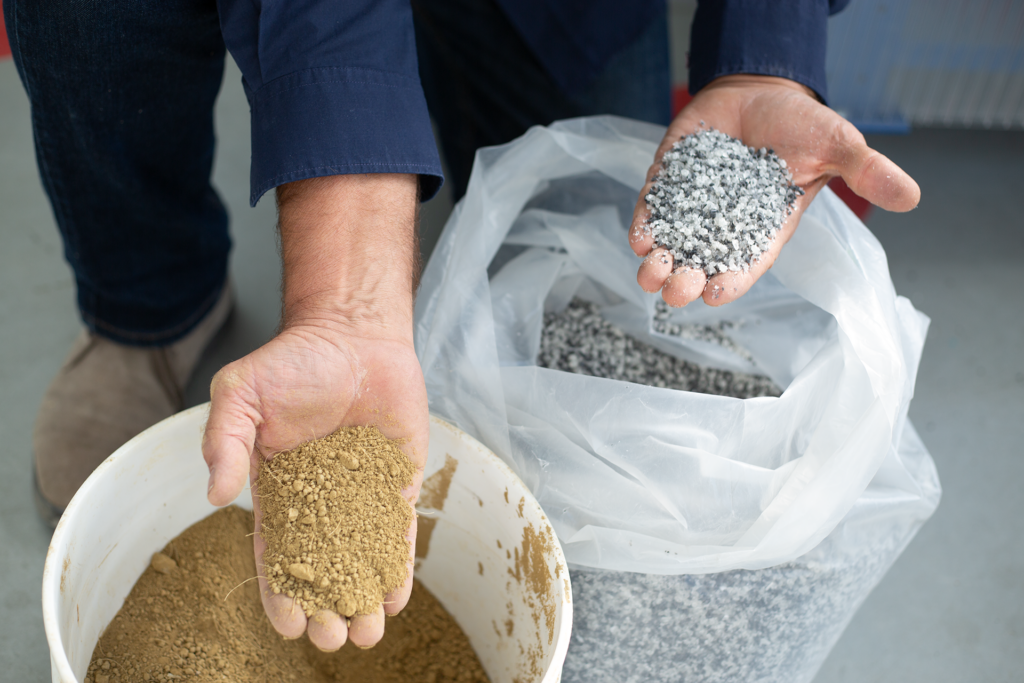
Although they work well, composite materials are often hard to recycle because their components are tightly joined together. To address this issue, WASP has developed a patent-pending Dual Extrusion Technology that prints earth and plastic within the same process.
Built on two extrusion processes (Liquid Deposition Modeling (LDM), used for paste-based materials such as clay and earth, and Fused Granulate Fabrication (FGF), which extrudes thermoplastic granules), the 3D printer manufacturer said the layers obtained at the end can be separated and recycled.
According to the Italian company, this approach would introduce plastic reinforcement layers into earth-based structures.
Freshly extruded earth is soft and can only carry so much before it collapses, which is why overhangs and cantilevers remain a weak point of earth printing. According to WASP, the plastic layers allow “geometries that would otherwise be difficult to achieve due to material collapse.”
A recycling approach to composites
As composites are not often recycled for 3D printing, WASP introduces a different way of thinking about composites: “not as a permanent combination, but as a reversible system in which each material can be separated and recovered at the end of the object’s life.”
For the company, the combination of a natural material like earth with plastic seems obvious as plastic is already present in large quantities around us, and the challenge is to use it responsibly and recover it afterward.
The project extends a long thread in WASP’s work. In 2021, the company and Mario Cucinella Architects completed TECLA, a habitat in Massa Lombarda printed from raw earth sourced from local soil.
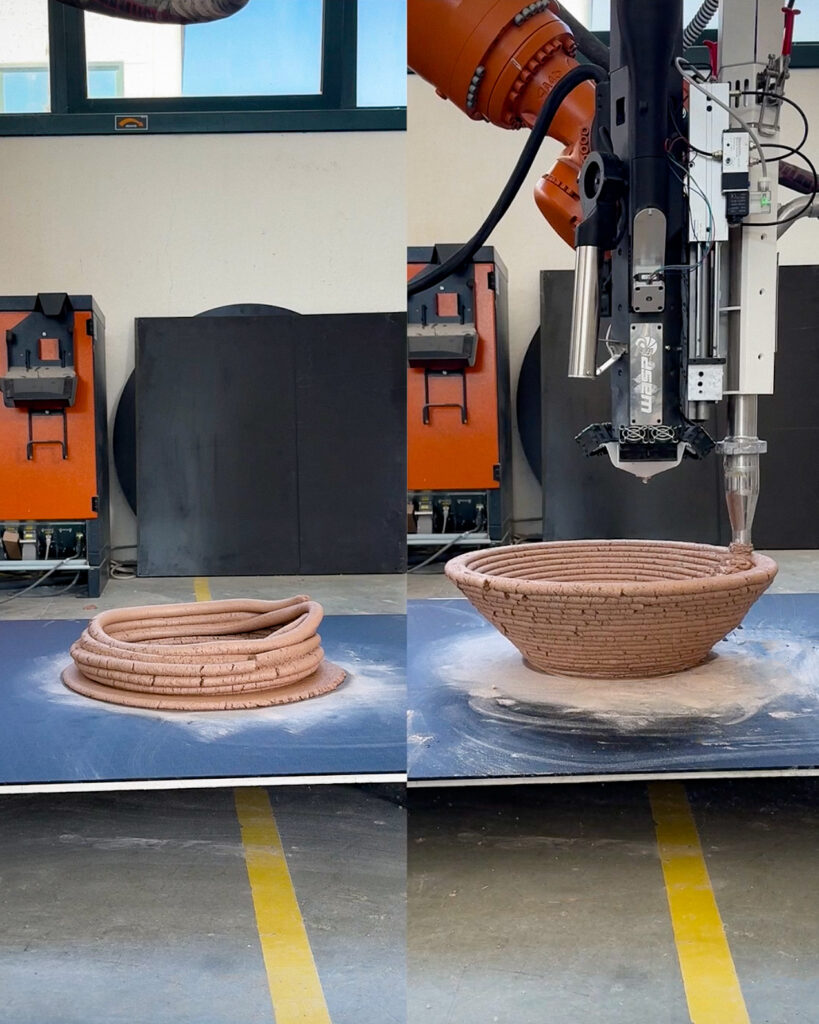
3D-printed earth structures are usually built in dome-like shapes because those shapes are naturally strong. If materials can be reinforced and later recovered for reuse, architects could create more complex designs without sacrificing the sustainability benefits of earth construction.
That said, it is early days. WASP says the first tests are underway, and several questions remain open: which polymers are used and whether they come from recycled feedstock, how separation works in practice and at what cost, how the interface between earth and plastic behaves over time, and whether the approach scales from objects to building elements.
The company says it will share more results and applications as the project takes shape. Those results will show whether reversible composites remain a compelling idea, or become a credible building block for circular construction.
THE 3D ADEPT WEEKLY NEWSLETTER
The industry moves fast. Stay ahead.
Every week, the latest additive manufacturing news, in-depth features and real-world applications, straight to your inbox. Plus, be the first to know when a new issue of 3D ADEPT Mag is out.
Free · One email a week · Unsubscribe anytime
Clicking loads our email provider’s sign-up form, including its analytics and Google’s anti-bot protection. You’re only subscribed if you complete the sign-up. Read our privacy policy.