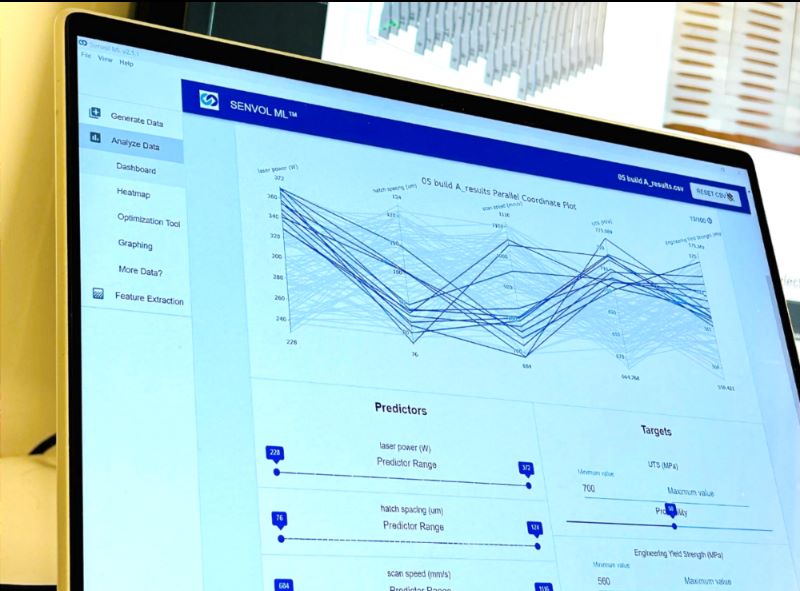
Machine learning software, Senvol ML™, to be used to predict material performance based on in-situ monitoring data
Senvol has received funding from the U.S. Navy to lead a project focused on demonstrating that based on in-situ monitoring data, Senvol’s machine learning software, Senvol ML, can accurately predict the material performance of parts made on a metal wire directed energy deposition additive manufacturing (AM) machine.
The goal of the project is to implement a standardized procedure for assessing AM parts for quality acceptance and installation using data-driven machine learning algorithms that provide insights needed to achieve target mechanical performance requirements. Senvol will utilize its AM machine learning software, Senvol ML, to analyze in-situ monitoring data from various sensor types and of various modalities.
The project, titled “Additive Manufacturing Sensor Fusion Technologies for Process Monitoring and Control” commenced in July 2025 and will run through July 2027.
For additive manufacturing to be successfully implemented into the Navy’s supply chain, it is essential to be able to ensure quality and develop sufficient evidence to support the acceptance of an AM part for installation. The solution proposed by Senvol under this project would allow the Navy to implement a standardized procedure for assessing AM parts for quality acceptance and installation using data-driven machine learning algorithms that provide insights needed to achieve target mechanical performance requirements.
The approach demonstrated in the project will help the Navy progress toward achieving qualified, equivalent AM parts from a more flexible and scalable AM supply base, both organic and commercial, without the need for costly and time-consuming qualification and testing. Furthermore, the solution offered will bring the Navy closer to addressing that need and enabling the use of in-situ monitoring data for part acceptance by integrating in-situ monitoring requirements into NAVSEA policy.
During the project, Senvol will use Senvol ML to parameterize the data collected from the in-situ monitoring sensors and compute summary features associated with the specific phenomena that are deemed worthwhile gathering information about. The objective is for Senvol’s machine learning software to accurately predict material performance characteristics from in-situ monitoring data, as well as to choose process parameters likely to produce parts with the desired characteristics.
Senvol President Zach Simkin commented, “Quality assurance in additive manufacturing is critical. For a part to be accepted into the supply chain, there needs to be sufficient confidence regarding how the part will perform. Progress in this area continues to evolve, and we believe that developing a consistent approach to analyzing in-situ monitoring data – and developing actionable guidance from it – will enable AM users to more readily meet part acceptance thresholds.”
*We curate insights that matter to help you grow in your AM journey. Receive them once a week, straight to your inbox. Subscribe to our weekly newsletter.