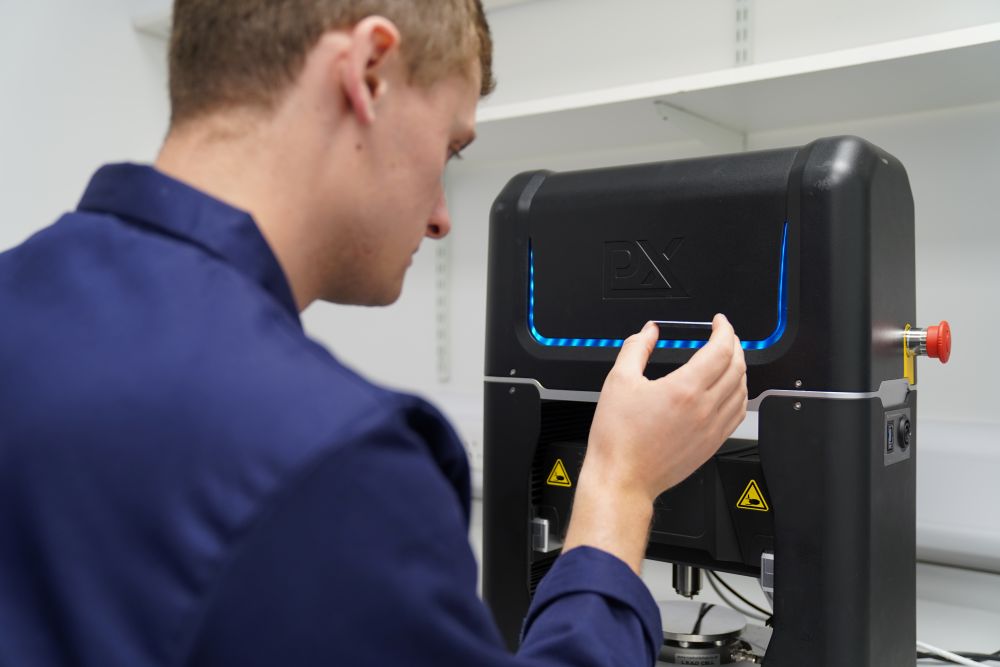
To map strength variation across 3D printed parts, Plastometrex, a provider of mechanical testing solutions, introduces a new MultiScale capability.
So far, conventional methods such as tensile testing cannot map variation at small length scales, while hardness cannot provide full stress-strain response. This testing gap can mean over-conservative safety factors, unnecessary weight, or undetected local weakness in high-performance parts.
The new MultiScale capability is designed to capture high-resolution mechanical property variation across thin, welded, and complex geometries that are typically inaccessible to conventional mechanical testing.
This capability is integrated into the company’s PLX-Benchtop testing system. With this capability, engineers can use the system to:
- Test directly on components and specimens as thin as 0.75 mm, extracting accurate mechanical data without destructive sectioning.
- Map mechanical properties across welds and complex geometries with 1.5 mm indent spacing, providing high-resolution insight into local variations and process performance.
MultiScale has already been used by NASA to characterize local variations in mechanical properties within spaceflight components. By mapping stress-strain responses across an additively manufactured part, process-structure-property relationships were revealed, which helped to inform manufacturing optimization and reduce conservative safety factors.
One particular finding which stood out was how yield strength fell by approximately 15% as wall thickness decreased: an insight which would have been missed by tensile testing
*We curate insights that matter to help you grow in your AM journey. Receive them once a week, straight to your inbox. Subscribe to our weekly newsletter.