

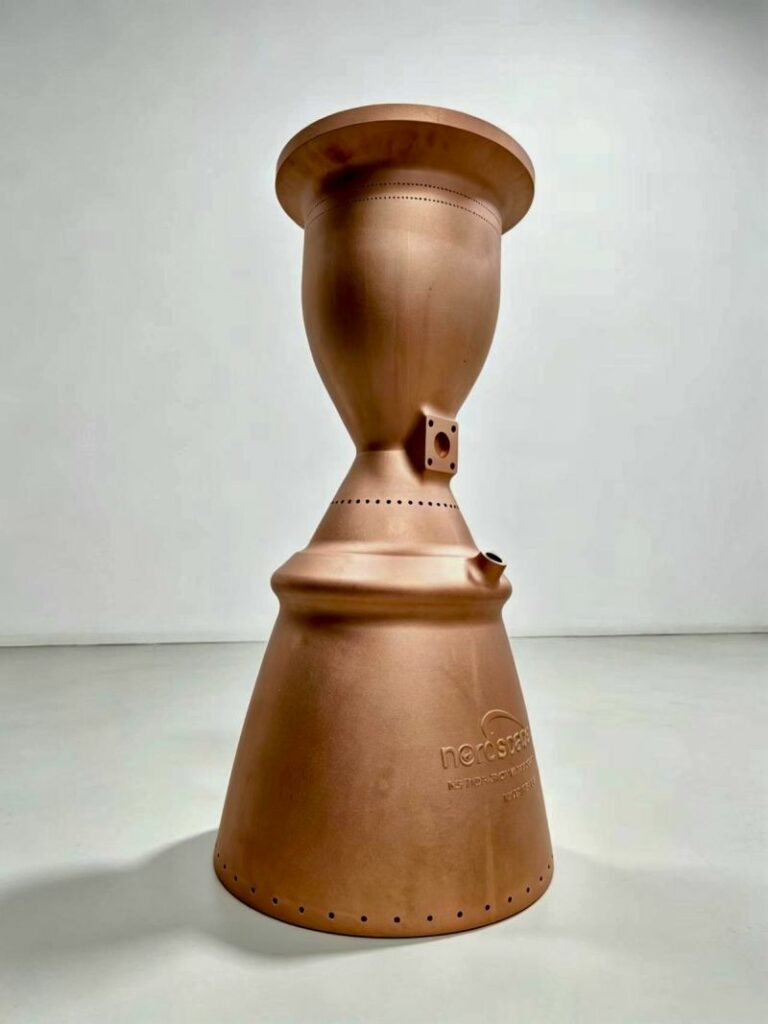
Aerospace defense company NordSpace recently unveiled a massive metal 3D printed combustion chamber, built for its light and medium lift orbital launch vehicles.
To support its R&D efforts and following the opening of its Ontario-based Advanced Manufacturing for Aerospace Lab (AMA Lab), the company secured up to $335,000 in funding from the National Research Council of Canada Industrial Research Assistance Program (NRC IRAP) to support a research and development project that will advance its large format multi-material additive manufacturing capabilities for medium-lift rocket engines.
The Canadian developer of vertically integrated solutions for responsive orbital launch vehicles, portable spaceports, and turn-key satellites has spent years designing, building, and testing the Hadfield-10 series.
This series marks the company’s first liquid engine to combine additive manufacturing with regenerative cooling. Every test they ran helped reduce the risks for the new Hadfield‑150 engine and for Canada’s goal of reaching orbit independently.
The Hadfield-150 series

Designed specifically around metal additive manufacturing, the Hadfield‑150 series drives NordSpace’s Tundra and Tundra+ launch vehicles. Its capabilities can help NordSpace grow it into a larger reusable medium‑lift rocket.
Designed and printed in-house, with testing also planned in-house, it is intended to deliver sovereign capability while being produced at Rocket Factory 1 using an expanding fleet of metal 3D printers at the AMA Lab, soon home to the country’s largest known metal 3D printer.
Its reusable, medium‑lift architecture removes much of the time, cost, and infrastructure normally required for iterative engine development, and its engine‑out capability is designed to allow a mission to continue even if one engine fails early in flight.
Above all, Hadfield‑150 is engineered to accelerate Canada’s Launch the North initiative by bringing sovereign orbital access online quickly, affordably, and through advanced additive manufacturing.
The company says testing will begin later this year on Blackhawk, its new orbital engine test cell at Area 66, with full stacked vehicle testing to follow at its Atlantic Spaceport Complex (ASX) in Newfoundland and Labrador.
According to NordSpace, the patent pending Hadfield-150 orbital-class engine is the only one of its kind in the country to reach this stage of development.
Source: NordSpace — Hadfield-150 development announcement.
THE 3D ADEPT WEEKLY NEWSLETTER
The industry moves fast. Stay ahead.
Every week, the latest additive manufacturing news, in-depth features and real-world applications, straight to your inbox. Plus, be the first to know when a new issue of 3D ADEPT Mag is out.
Free · One email a week · Unsubscribe anytime
Clicking loads our email provider’s sign-up form, including its analytics and Google’s anti-bot protection. You’re only subscribed if you complete the sign-up. Read our privacy policy.