

Ceramic 3D printing company Lithoz is embarking on a new project funded by the EU: the TRIATHLON. The project brings together universities, industrial designers and technology suppliers in the same consortium. They will unite skills to develop disruptive approaches for designing more robust, low-maintenance, low-emission, and highly responsive hydrogen-electric powertrains for megawatt class aircraft.
An aluminium nitride heat exchanger
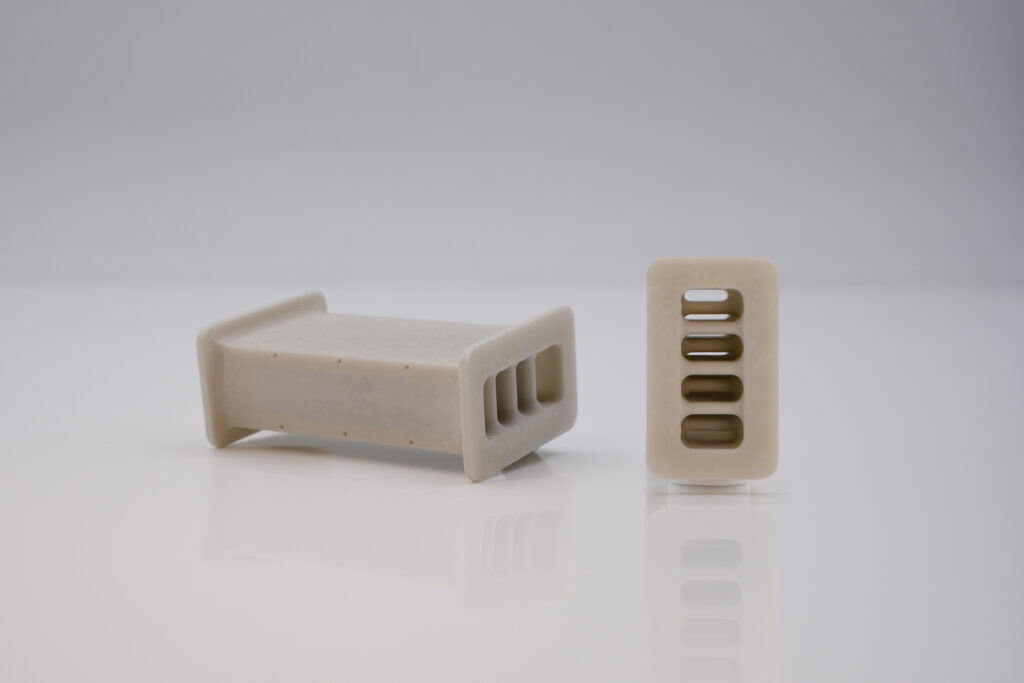
As part of the project, the company will develop and manufacture a heat exchanger designed by Ergon Research. The exchanger will use aluminium nitride (AIN). For the manufacturing process, the company will rely on its Lithography-based Ceramic Manufacturing CeraFab System .
According to Lithoz, AIN is the perfect material for addressing the thermal management of these high-performance components due to its excellent thermal expansion coefficient and conductivity (211 W/mK). This dramatically increases thermal efficiency and enables compact, lightweight system architecture, which is crucial for electrified aviation.
Ceramic printing in hydrogen applications
It may be the first time we see Lithoz’s LCM technology applied to a hydrogen project, but ceramic 3D printing itself is no stranger to the field. In fact, ceramics have already proven to be a strong production candidate for key components in hydrogen generation. A notable example comes from 3DCeram, which previously showcased the capabilities of SLA 3D printing in a separate EU-funded initiative.
Dr. Johannes Homa, CEO of Lithoz, commented on the project’s success so far: “This is a breakthrough application of our ceramic 3D printing technology in a completely new field. Aerospace and sustainability are key growth areas for Lithoz, so achieving serial production with aluminium nitride is a significant milestone for these sectors. This material opens up design and application possibilities that no one else can currently realise, making a decisive contribution to a greener future in aviation through ceramic AM.”
Upon validation, the heat exchanger will be used in hydrogen-electric propulsion systems for aircraft in the megawatt class.

Make sure to follow us on our social networks and subscribe to our weekly newsletter : Facebook, Twitter, LinkedIn & Instagram ! If you want to be featured in the next issue of our digital magazine or if you hear a story that needs to be heard, make sure to send it to contact@3dadept.com
THE 3D ADEPT WEEKLY NEWSLETTER
The industry moves fast. Stay ahead.
Every week, the latest additive manufacturing news, in-depth features and real-world applications, straight to your inbox. Plus, be the first to know when a new issue of 3D ADEPT Mag is out.
Free · One email a week · Unsubscribe anytime
Clicking loads our email provider’s sign-up form, including its analytics and Google’s anti-bot protection. You’re only subscribed if you complete the sign-up. Read our privacy policy.