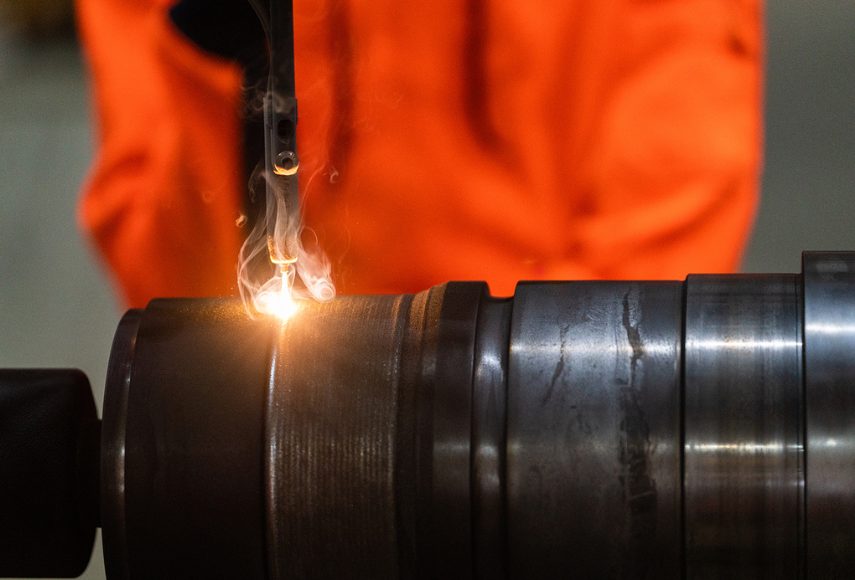
Surface engineering company LaserBond has joined forces with researchers from Adelaide University and Swinburne University of Technology to develop wear-resistant coatings that would rely less on tungsten. LaserBond leads the project which received $150,000 in funding from the Additive Manufacturing Cooperative Research Centre, also known as AMCRC.
Tungsten is getting harder to source worldwide, which pushes prices up and exposes Australian miners and manufacturers to supply risks, according to the AMCRC. To address this issue, the work consists in assessing whether titanium carbide (TiC), or other tungsten carbide composites, could replace the fused tungsten carbide found in high-performance laser-clad coatings.
TiC can be sourced from a wider range of suppliers and could lower raw material costs. Agglomerated tungsten carbide composites will be explored as a second option.
“Our customers rely on these coatings to protect critical assets operating in some of the harshest conditions, so simply waiting for global supply to stabilize isn’t an option,” says Dr Surinder Singh, R&D Engineer and project lead at LaserBond.
How will the new laser cladding coatings be tested?
Swinburne will handle the early work on materials and cladding. The best candidates will then be scaled up in industrial trials at LaserBond’s Cavan facility. The first target is mining components that wear out quickly.
Each candidate coating will go through abrasion, corrosion, impact and erosion tests; Their results will be compared with hard chrome and with the hardfacing materials LaserBond already uses.
For Colin Hall, Industry Professor and research lead at Adelaide University, finding a new material is only the beginning. “The coating also has to perform, be deposited crack-free at production speed and withstand demanding operating environments”, he explains.
It should be noted that a digital acoustic monitoring system will be installed in Cavan to spot cracks during deposition. Together with faster deposition, this would help the team improve coating performance in less time.
“This is exactly the type of challenge collaborative R&D can help Australian industry solve,” comments Simon Marriott, Managing Director of the AMCRC.
The project adds to a busy year for the research center, which approved its first five CORE projects with an $11M investment in May, before launching a $3.25 million STARTER Project Funding Program for SMEs and start-ups in July.
As tungsten supply tightens, the real value of this project lies in its route to industry: the coatings that pass the tests will be trialed directly on LaserBond’s production site.
THE 3D ADEPT WEEKLY NEWSLETTER
The industry moves fast. Stay ahead.
Every week, the latest additive manufacturing news, in-depth features and real-world applications, straight to your inbox. Plus, be the first to know when a new issue of 3D ADEPT Mag is out.
Free · One email a week · Unsubscribe anytime
Clicking loads our email provider’s sign-up form, including its analytics and Google’s anti-bot protection. You’re only subscribed if you complete the sign-up. Read our privacy policy.