Researchers have used a wire arc process to 3D print single crystals of Ti-6Al-4V. These crystals reach a meter in height and a centimeter in diameter. The team includes Beijing Institute of Technology (BIT), Tsinghua University and University of California, Los Angeles (UCLA) researchers. Their findings appear in a paper published online in Nature.
A single crystal is a metal part without grain boundaries. According to Tsinghua University, the work follows more than ten years of research by Associate Professor Yinan Cui’s team. The university also highlights the importance of these materials for aero-engines, gas turbines, semiconductors and nuclear energy.
Conventional manufacturing routes rely on seeds, molds and directional solidification. They struggle to combine large sizes, complex shapes, several materials and low cost.
How does the additive manufacturing approach work?
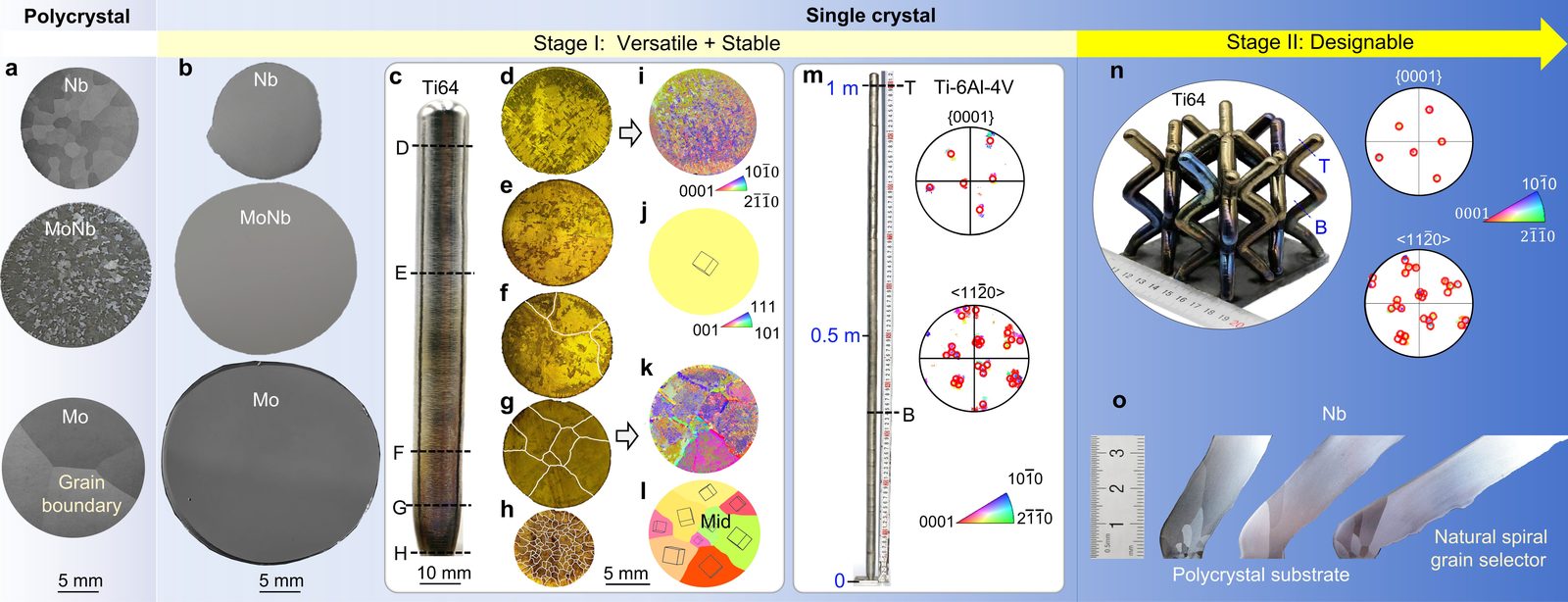
The team calls its approach a “deep-squat pulsed wire arc additive manufacturing method (DSP-WAAM)”. A gas tungsten arc melts a 1.2 mm Ti-6Al-4V wire. The researchers chose wire instead of powder to avoid stray grains caused by powder spatter.
For the titanium builds, the current peaks at 200 A for 0.5 s. It then drops to a base of 20 A for 9.5 s, according to the report. Tsinghua says the process needs no seed, mold or support.
According to the paper, the researchers produced specimens with diameters of 6 mm and 20 mm. They also produced parts exceeding one meter in height. The paper describes the height as “theoretically unlimited”.
The same approach delivered single crystals of tungsten, molybdenum, niobium and MoNb alloys. The team also printed lattices made of a single crystal, with zigzag-shaped struts. Interestingly, the authors describe these lattices as a first.
On mechanical performance, the abstract reports “an order-of-magnitude increase in creep resistance over standard grain-size scaling predictions”. The researchers attribute this gain to the absence of grain boundaries and a process-induced hierarchical α/β architecture. In tensile tests at 873 K (about 600 °C), the single crystal showed a yield strength of 389 MPa. By comparison, the polycrystalline material reached 226 MPa.
Wire arc, really?
Wire arc additive manufacturing (WAAM) often appears in applications where size matters. One recent example is the nearly two-ton stamp form die mold ORNL and Boeing printed a few weeks ago.
To me, this process choice suggests an important point about single crystals. The way heat reaches the material matters as much as the heat source.
The research mentions turbines, space reactors and laser mirrors as fields that need single crystals. However, the team has yet to demonstrate its approach on a real component.
The authors also acknowledge that AM still struggles to produce pure tungsten parts without microcracks. We highlighted this challenge in our discussion on refractory metals and post-processing.
A real-world application example could help assess the commercialization potential of this approach.
THE 3D ADEPT WEEKLY NEWSLETTER
The industry moves fast. Stay ahead.
Every week, the latest additive manufacturing news, in-depth features and real-world applications, straight to your inbox. Plus, be the first to know when a new issue of 3D ADEPT Mag is out.
Free · One email a week · Unsubscribe anytime
Clicking loads our email provider’s sign-up form, including its analytics and Google’s anti-bot protection. You’re only subscribed if you complete the sign-up. Read our privacy policy.