Claude from Anthropic is widely regarded as one of the most advanced large language models currently available. While the system is designed to handle complex tasks, additive manufacturing (AM) companies, particularly software providers, have only recently begun to demonstrate how such AI assistants could enhance engineering tools and workflows.
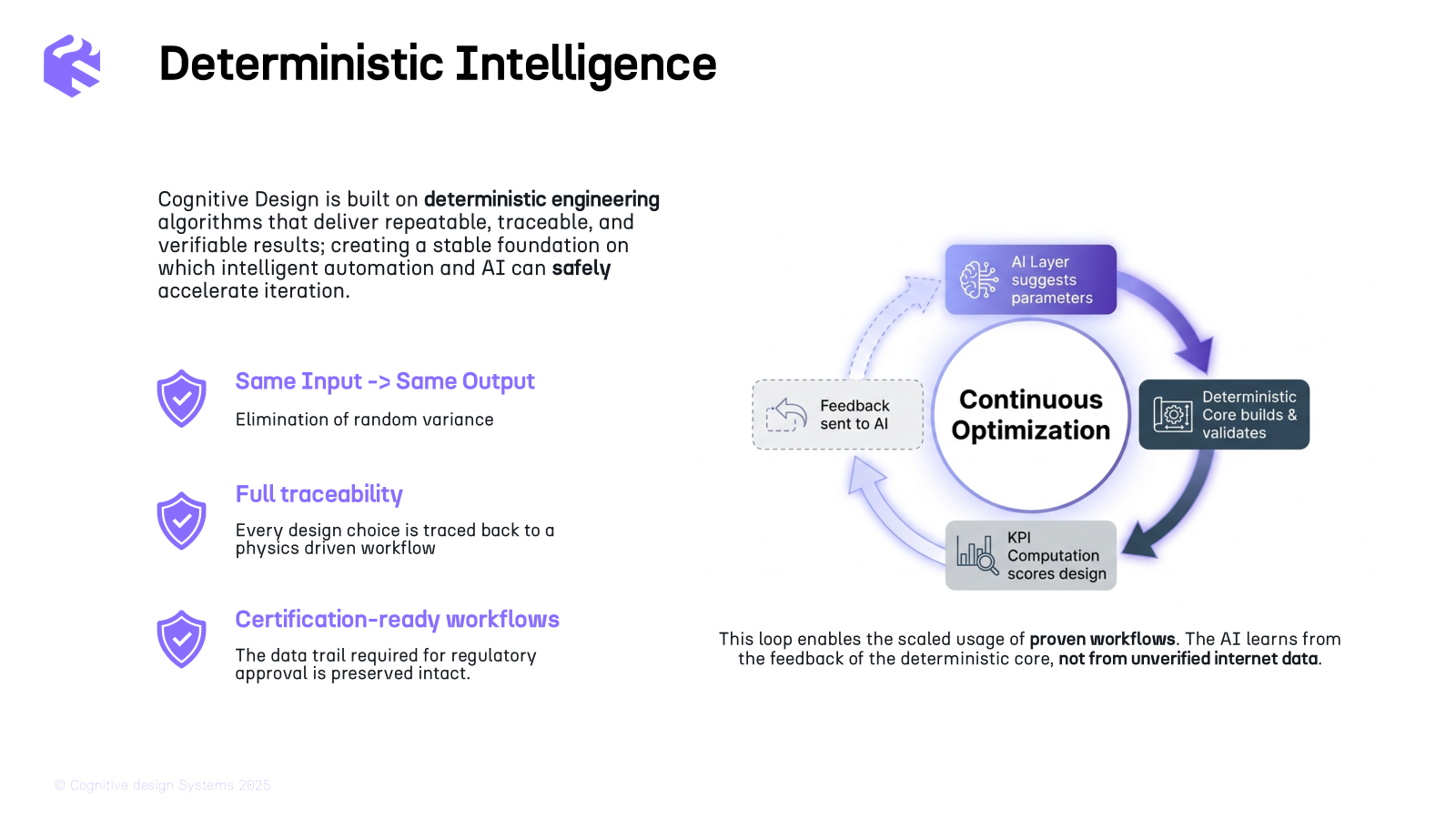
This is the direction explored by Cognitive Design Systems (CDS), a France-based software developer that builds AI-powered design software to help engineers create and optimize industrial parts.
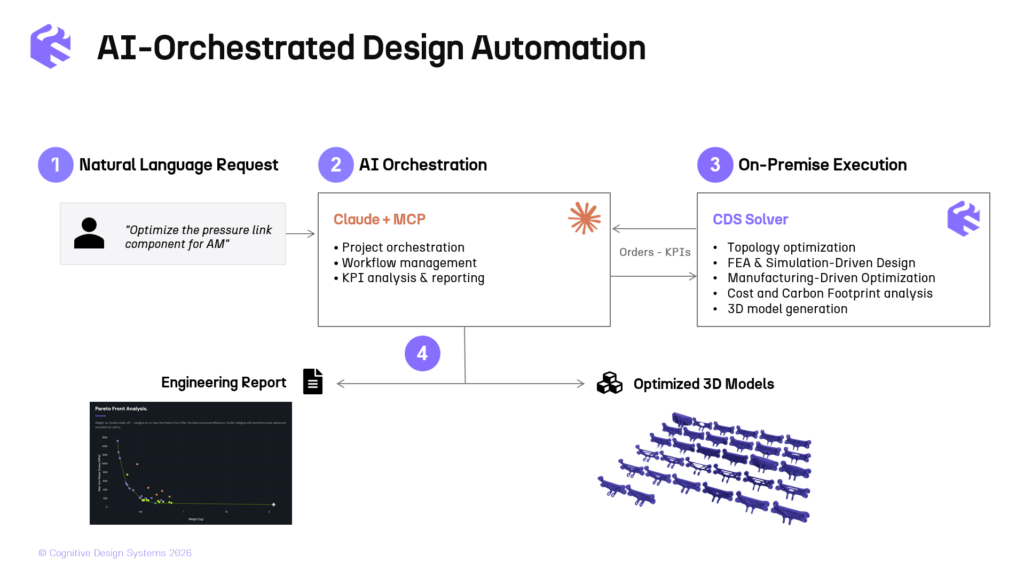
To demonstrate how artificial intelligence can automate the early stages of engineering design, the company connected its Cognitive Design engineering software to the large language model Claude using an on-premises Model Context Protocol (MCP) server.
For those who are not familiar with an on-premises Model Context Protocol (MCP) server, please note that it is a local server that allows an AI model to securely access and interact with company software, files, and tools inside a company’s own infrastructure.
In CDS’ case, the result is a workflow in which an AI agent can independently explore and optimize different design options for a mechanical part, running simulations, evaluating performance, and refining the geometry, without continuous human intervention.
Directions from the engineer to automate testing and improve design ideas
 To move faster from requirements to optimized part concepts, the engineer remains the one setting the direction.
They begin by pointing the system to a CAD file on a local network and defining the key parameters (load cases, materials, and performance targets). From there, the platform automatically determines which surfaces must remain unchanged and which areas can be redesigned. It then runs an optimization loop that successively generates design variants, performs meshing and finite element analysis, evaluates stresses, and refines the geometry with manufacturing constraints in mind.
Although the process can run autonomously, the engineer can step in at any stage to adjust targets or guide the exploration. In practice, this shifts the engineer’s role from manually testing designs to supervising and steering the process.
If the approach proves reliable, it could reduce the iterative back-and-forth between CAD, simulation, and review, compressing work that typically takes weeks into a much shorter design cycle.
“Engineers have always known what great design looks like. The bottleneck has never been judgment; it has been execution time. This removes the bottleneck, while keeping the engineer in the loop at every step,” Rhushik, CEO, Cognitive Design Systems states.
The numbers speak directly to program economics. Where a typical development cycle yields 3 to 5 explored concepts before timeline pressure forces a decision, this workflow produces 50+ fully analyzed variants in the same period. Engineers stop operating software and start making decisions: which trade-off best fits the application, which geometry holds up under the edge-case load, which configuration hits the weight and cost targets simultaneously, a press communication confirms.
Read more: 4 software strategies that can be explored to enable Lightweighting with Additive Manufacturing
*We curate insights that matter to help you grow in your AM journey. Receive them once a week, straight to your inbox. Subscribe to our weekly newsletter.