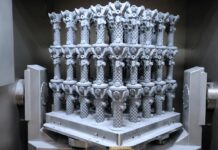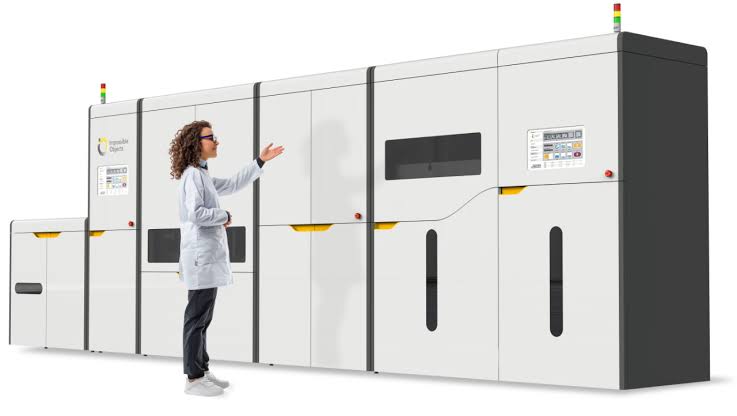
Impossible Objects, the developer of Composite-Based Additive Manufacturing (CBAM) technology, just secured a $40 million Series B funding round. Inflection Equity led the round, with participation from Aaron Wealth Management, OCA Ventures, Impact Capital and Excell Partners. The company also reports $20 million in U.S. government contracts and awards.
When the company released Model One, its first CBAM printer in 2017, the CBAM process was still largely a promise. After raising $6.4 million in Series A funding, with OCA Ventures already among the backers, it started building the ecosystem around the process. We have particularly witnessed its partnership with TIGER on thermoset composites and with Owens Corning on high-performance materials. The company also extended its European reach with Ricoh 3D and accelerated build preparation with Dyndrite.
With the release of CBAM 25 the company sheds light on the possibility of CBAM to achieve volume manufacturing.
While the technology ecosystem seems strong, we have often doubted CBAM’s ability to move beyond pilot projects. Impossible Objects confirms it has taken five orders since launching the CBAM 25 in early 2025, with deployments at the U.S. Air Force, the National Institute for Aviation Research, the Oregon Manufacturing Innovation Center and Rochester Institute of Technology.
Not surprisingly, defence is clearly the main driver. According to the company, at U.S. Army Rock Island Arsenal the technology can support production of up to 10,000 drone bodies per month. Its SBIR Phase I and II awards cover long-range drones, integrated wiring inside printed parts, and lightweight wing and fuselage structures. CBAM is also included in the U.S. Air Force Technology Roadmap.
As far as performance is concerned, Impossible Objects claims the CBAM 25 prints up to 25 layers per minute, 15 times faster than competing production AM technologies, and produces composite parts with strength of up to 200 MPa, up to four times that of competing AM processes.
“Our CBAM 25 system is designed from the ground up to meet the high productivity and high reliability needs of advanced manufacturing combined with the flexibility and tool-less manufacturing that modern flexible supply chains require,” said Steve Hoover, CEO of Impossible Objects.
How will the funds serve?
The funds will be used to increase system production, expand customer deployments and build out the service and commercial organisation needed to support a growing installed base.
Hopefully, that installed base will grow beyond defense programs and applications demonstrating the technology capabilities will be shared publicly.
*We curate insights that matter to help you grow in your AM journey. Receive them once a week, straight to your inbox. Subscribe to our weekly newsletter.