

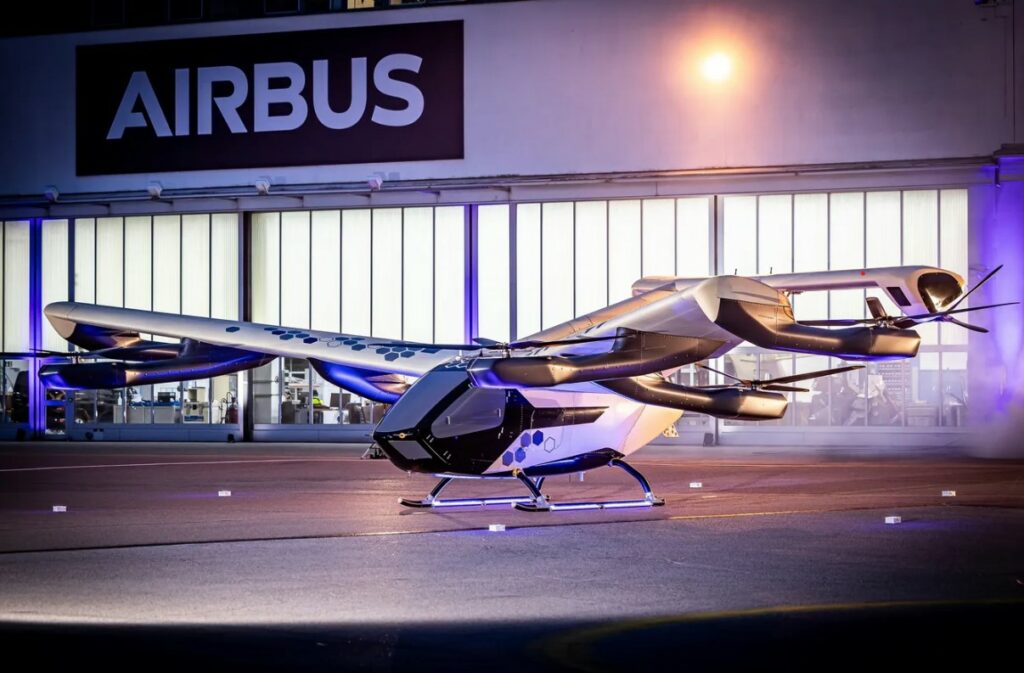
Building an additive manufacturing strategy is hard enough in a single business unit. The technology is maturing rapidly, the qualification landscape keeps shifting, and each of the internal stakeholders (engineering, procurement, operations, quality) has a unique definition of what “ready for production” means.

Now imagine doing that across three business units that have almost nothing in common except the corporate name.
That is the challenge Hauke Schulz operates in every day as AM Roadmap Leader for the Airbus Group, spanning Airbus Commercial, Airbus Helicopters, and Airbus Defence & Space. Three segments with different regulatory environments, different production scales, different customer expectations, and different relationships to risk. One roadmap.
Three worlds inside one group
The differences between Airbus’s three business units reflect fundamentally different operating logics.
Airbus Commercial operates at the highest volume and under the most visible regulatory scrutiny. Every AM part that enters a commercial aircraft must clear the FAA, EASA, or both. The certification timeline for a structural or safety-critical component is measured in years.
The upside is also the most significant: a qualified AM part on the A320 or A350 family has a production runway of thousands of aircraft. When Liebherr-Aerospace integrated a 3D-printed titanium flex shaft into the A350 high-lift system, replacing seven conventional parts with one printed component, with full EASA approval for serial production, it validated a certification pathway that can now be applied to subsequent parts. Each milestone is slow, but worth acknowledging.
Airbus Helicopters occupies an interesting middle ground. Helicopters operate in both civil and defense environments, which means the qualification requirements can shift dramatically depending on the customer and the mission.
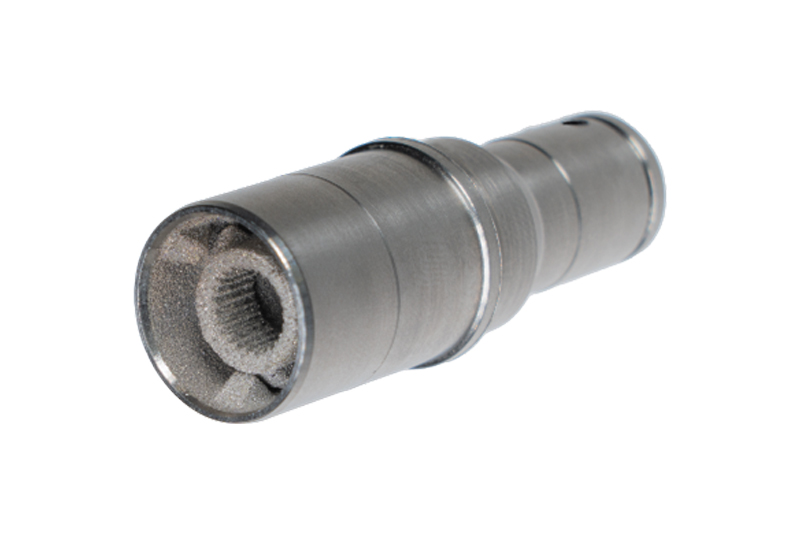
The division has been among the most active in building real AM production capability within the group. As 3D ADEPT Media reported in a conversation with Frank Rethmann, Airbus Helicopters has been producing titanium locking shafts for Airbus A350 doors by additive manufacturing since 2017, with more than 13,500 produced to date. The division’s 3D printing center at Donauwörth now spans titanium, aluminium, and polymer processes, with a production area that has doubled in recent years.
The qualification challenge at Helicopters is explicit: establishing certification routes for parts of increasing criticality while collaborating with both internal Airbus teams and external regulatory authorities. Digitalization of the qualification and quality assurance process is identified as a key enabler, but that digitalization itself has to be qualified.
As for Airbus Defence & Space, it operates under a different set of pressures entirely: defense procurement cycles, classified programs, and customers whose requirements are shaped by operational environments rather than regulatory frameworks.
The AM opportunities here are significant. They include, for instance, obsolescence, MRO, and the ability to produce parts for platforms whose original supply chains no longer exist. The problem is the path to qualification is less standardized.
How do you build a coherent group-wide AM strategy when the three business units have different definitions of what a qualified part means, different timelines for what “fast” looks like, and different risk cultures?
Let’s just take into account three considerations:
Certification. A process qualified for an A350 component under EASA requirements cannot automatically transfer to a Defence & Space platform. The evidence requirements, the documentation, the design authority structure; all differ. This means that even when the underlying AM technology is identical, qualification work has to be repeated. The costs of this duplication fall most heavily on the supply chain.
Production scale mismatch. Commercial Aviation justifies the investment in qualification and tooling through high production volumes. A qualified AM part on a high-volume platform is economically viable in a way that the same part on a low-volume defense platform may not be. Building a roadmap that makes AM economically rational across both contexts requires a different value argument for each business unit and, obviously, different metrics for success.
Partnership complexity. As Satair’s approach to certified spare parts demonstrates, the civil AM ecosystem has developed sophisticated mechanisms for certifying parts through the aftermarket supply chain, with over 300 part numbers now certified across the Airbus fleet. Replicating that kind of ecosystem logic across defence programmes, where transparency and supply chain visibility work differently, is a fundamentally harder problem.
A group-wide roadmap
A roadmap that works for three business units with different certification pressures, different production scales, and different customer expectations cannot simply be a list of technology investments. It has to do several things simultaneously.
It has to identify where AM creates value that is common across all three and build shared infrastructure there. Process qualification data, for instance, is expensive to generate. If a material and process combination can be qualified once and used across multiple business units, the economics change significantly.
It has to be honest about where the three business units’ needs diverge irreducibly and build separate pathways for those cases rather than forcing convergence that doesn’t serve anyone.
And it has to cultivate the external networks, with regulators, with supply chain partners, with technology providers, that allow the group to surface opportunities it cannot see from the inside. At the scale of Airbus, no single team has visibility into everything that matters.
As we explored in our earlier analysis of the civil vs. defense certification divide, the two worlds have largely developed their AM qualification frameworks in parallel, with limited exchange of ideas. For an organization like Airbus that operates in both, simultaneously, that divide is a daily operational reality and the reason why Hauke Schulz will be speaking on April 22, around our virtual Additive Talks table.
What this means for aerospace and defense professionals
If you work in a multi-segment aerospace or defense organization, or in a supply chain that serves more than one type of customer, the Airbus AM challenge is instructive in several ways:
- How does your organization handle qualification investments that could theoretically benefit multiple programs or business units? The cost of duplication is often invisible until it becomes a barrier to scale.
- Where in your organization does AM strategy actually get decided? At the business unit level, at the group level, or nowhere in particular, with each program making independent choices that never aggregate into a coherent capability?
- What would it take to build shared qualification infrastructure across programs with different regulatory requirements? And who has the authority to make that investment?
These are questions that shape what a serious group-wide AM roadmap has to solve and they are precisely what Hauke Schulz will bring to the table at Additive Talks, Season 6.
Wednesday, April 22 | 15:30–16:30 CEST | 09:30–10:30 EDT
THE 3D ADEPT WEEKLY NEWSLETTER
The industry moves fast. Stay ahead.
Every week, the latest additive manufacturing news, in-depth features and real-world applications, straight to your inbox. Plus, be the first to know when a new issue of 3D ADEPT Mag is out.
Free · One email a week · Unsubscribe anytime
Clicking loads our email provider’s sign-up form, including its analytics and Google’s anti-bot protection. You’re only subscribed if you complete the sign-up. Read our privacy policy.