Airbus is pionneering the concept called “designed for DED.”
Airbus is relying on wire-Directed Energy Deposition (w-DED) to create structural aircraft parts with less resulting material waste, compared to machining.
The aerospace OEM’s move from printing small components to creating large, structural titanium parts up to seven meters (over 23 feet) long would enable the company to boost production from hundreds of grammes per hour to several kilogrammes per hour.
This approach also reveals how the company diversifies its manufacturing process and does not only rely on FDM 3D printing. As a reminder, the company produced more than 25,000 flight-ready 3D-printed parts in 2025 using Stratasys FDM 3D printing process.
With over 200,000 3D printed parts in active flight today, the impact is already measurable : 43% weight reduction and 85% reduction in lead time for parts used in the Airbus A350 alone.
Tapping into large-scale additive production could deliver even greater benefits.
First, how does the process work ?
The technique uses a multi-axis robotic arm, armed with a spool of titanium wire, moving with digital precision. Energy, in the form of a laser, plasma, or electron beam is focused onto the wire, instantly melting it and fusing it layer-by-layer onto a surface.
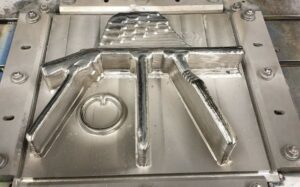
Superficially similar to welding, but with a 3D model as its guide, it prints the object from the ‘ground up’ into what is known as a ‘blank’. This blank looks very much like the final required shape, i.e. ‘near net shaped’, which subsequently undergoes a quick machining to conform to the exact dimensions of the part design.
Titanium is one of aviation’s most challenging materials. Beyond its strength, and lightness, the material is compatible with modern carbon fibre composite structures (such as corrosion resistance, relative expansion coefficients and other properties).
Consider that traditional forging – i.e. machining a part from a solid block – creates a high proportion of raw material ‘waste’. This is measured by the ‘buy-to-fly’ ratio (the amount of raw material purchased versus the amount that actually ‘flies’ in the aircraft). In traditional methods, one might need to recycle between 80% and 95% of the titanium originally bought.
With w-DED, such waste is mostly prevented at source. This is because the part is ‘grown’ into a shape that is already very close to the final design (a ‘near net shape’), there is very little left to machine away.
First parts already installed in the Airbus A350
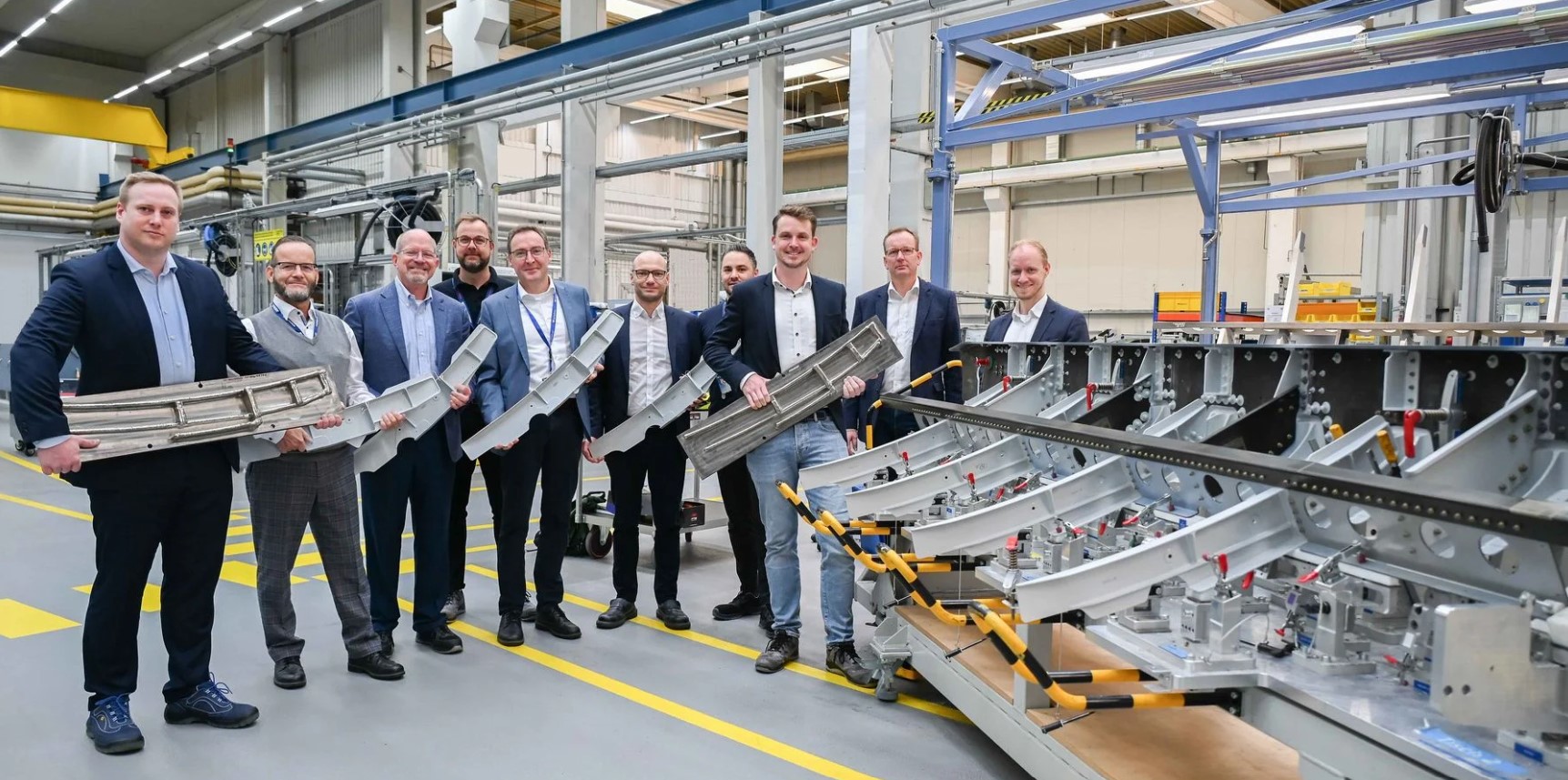
On top of polymer 3D printed parts, the Airbus A350 now features Airbus largest w-DED parts into its Cargo Door Surround area. These particular Airbus-designed parts for this exploratory phase were 3D-printed by a qualified supplier using plasma w-DED, ultrasonically inspected by Testia Bremen and finally machined and installed in Airbus factories.
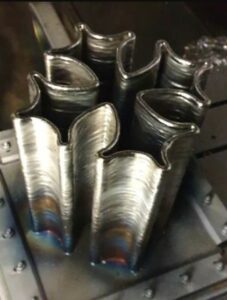
These parts are functionally and geometrically identical to the traditional forged components they replace, but they deliver immediate, real-world cost savings. Looking forward, the next aim is to progress, step by step, from the A350 w-DED parts and into more critical applications on other programmes and other aircraft applications (including the wings and landing gear in the longer term).
*We curate insights that matter to help you grow in your AM journey. Receive them once a week, straight to your inbox. Subscribe to our weekly newsletter.