The multidisciplinary team from XISUI Design is behind the completion of Boulder Park, a 13,000m2 community park in Ji’nan (China), that blends functional and experiential activities.
The name of the project – Boulder Park – comes from the fact that boulder is a material symbolizing eternity which is central to the park design. Boulders placed over a sandpit are transformed into climbing and resting play structures; stones in the shallow creek can become part of the water play installation.
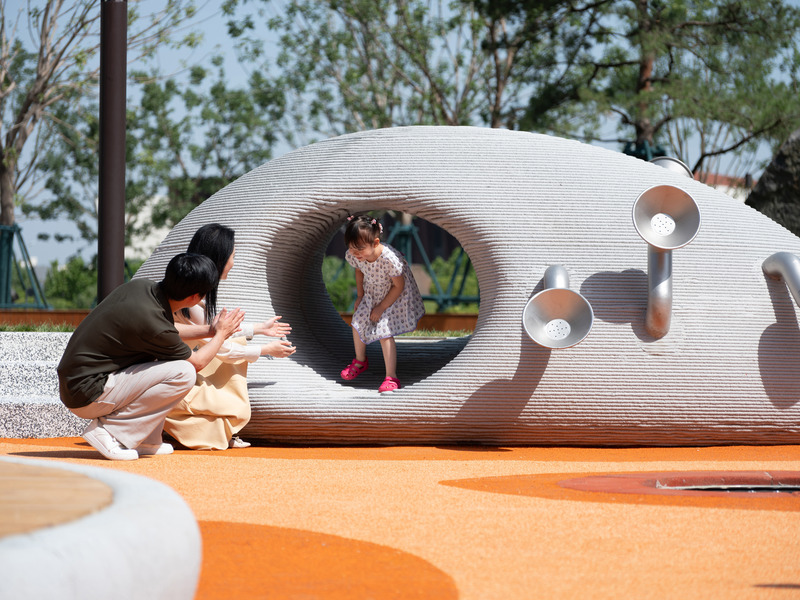
However, the park drew our attention today, because it features a massive rock cave adventure space constructed using advanced concrete 3D printing from Guanli Intelligent Technology Co., Ltd.
This playground integrates children’s play areas with water features and natural landscapes, offering a space for intergenerational interaction and community engagement.
According to the design firm, the process they used includes a computer-controlled robotic arm that precisely extrudes liquid or semi-solid concrete, which then solidifies, building the structure layer by layer. The essence combines digital design and material science, offering unprecedented freedom and complexity in spatial design and construction. The resulting layered rock textures create distinctive surface textures that visually resemble the natural rock formations of boulders and caves. Moreover, its advantage of forming organic shapes at once improves both the spatial accuracy and user experience.
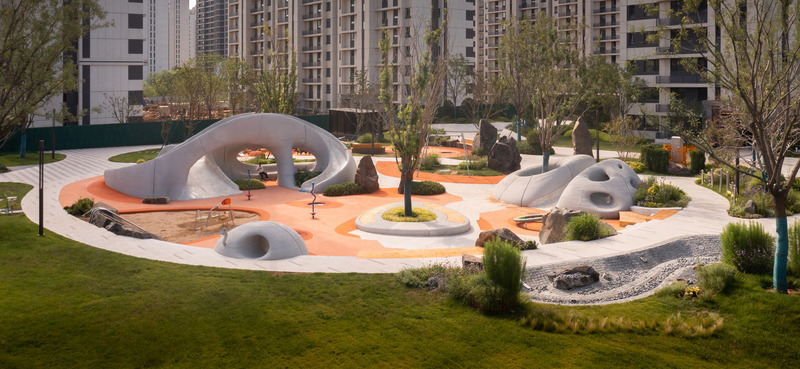
Photo credit: Hu Yihao, XISUI Design, 2024
“Landscape structures and installations are often small in scale, with low load requirements and simple, clear functional needs. In the application of 3D-printed concrete technology, compared to architecture, landscape projects may have even more diverse usage scenarios,” explains Hu Yihao, Lead Designer. “Although the current 3D concrete materials still face a series of challenges, such as uneven stress distribution and relatively simple reinforcement methods, the 3D printing materials used in Boulder Park have an average strength of 50MPA, surpassing the traditional C40 concrete strength standard.“
“This technical specification is more than sufficient to meet the structural needs of most landscape installations and structures,” adds Mr. Yihao. “In landscape projects, outdoor durability, the ability to achieve organic shapes, ease of construction and installation, and cost savings in labor are the primary considerations. 3D printing technology, with its significant advantages in these aspects, has become an ideal choice for this purpose.”
The project required a budget of CNY 2.5 million and was completed on June 26, 2024.
Video credit: CHENIN Visual
Remember, you can post free-of-charge job opportunities in the AM Industry on 3D ADEPT Media or look for a job via our job board. Make sure to follow us on our social networks and subscribe to our weekly newsletter: Facebook, Twitter, LinkedIn & Instagram! If you want to be featured in the next issue of our digital magazine or if you hear a story that needs to be heard, make sure to send it to contact@3dadept.com.