

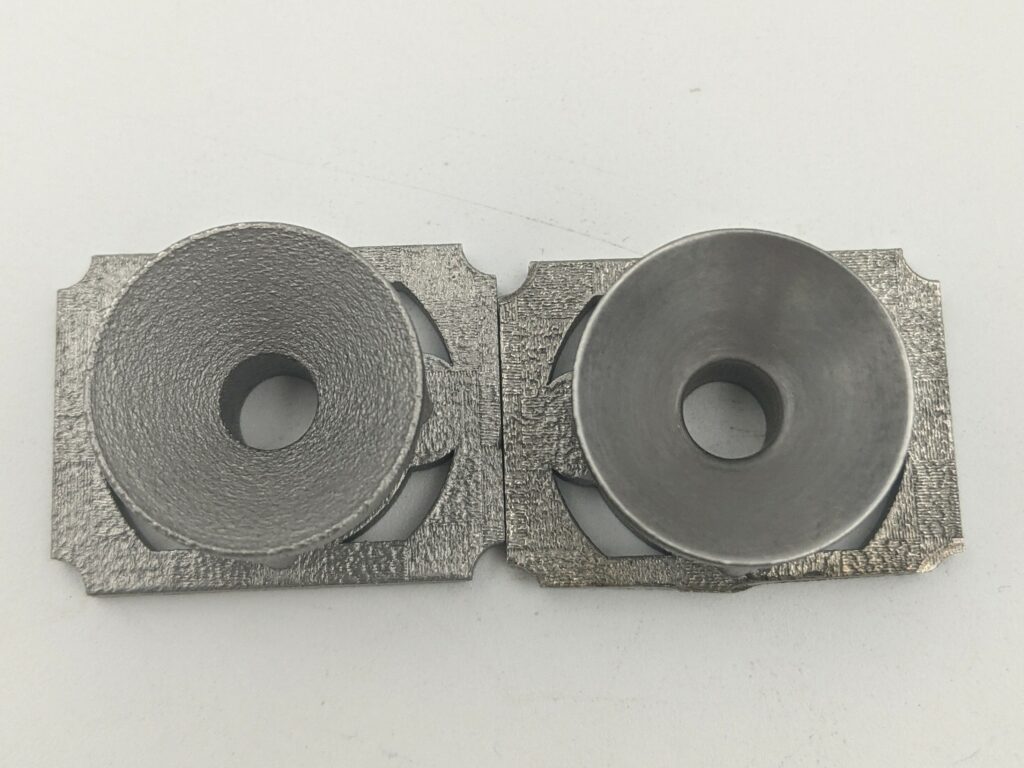
A contribution by Kirk Gino Abolafia, technical marketing manager at Voxel Innovations when published in 2023. The PECM performance figures cited are supplier-reported and need application-specific verification.
Additive manufacturing can produce implant geometries adapted to a patient’s anatomy, including orthopedic applications. It supports design iterations, lightweighting and porous structures. Material selection, mechanical strength, surface condition and device validation remain decisive. This feature concerns post-processing of metallic implants; conventional PECM does not apply to non-conductive PEEK polymer.
Osseointegration is the direct structural and functional connection between living bone and an implant surface. It is not simply fusion at a molecular level, nor does it alone establish every aspect of a device’s clinical performance.
A few design considerations that affect osseointegration may include, but are not limited to:
- Material biocompatibility and control of degradation or corrosion products, including metal ions.
- Suitable topography in bone-contact regions, potentially including roughness or porosity designed for bone anchorage.
- Geometry and mechanical properties that provide appropriate load distribution without excessive stress concentrations.
In series production, cost, feature resolution and surface condition need to be considered together. Powder size, laser scanning strategy, layer thickness and deposition parameters can change the outcome. Increasing throughput must not sacrifice a safety requirement. Not every implant surface should be superfinished: articulating surfaces and bone-anchorage regions perform different functions.
Pulsed electrochemical machining (PECM) is one option for machining and finishing some metal AM parts. Suitability depends on geometry, conductive material, production volume and tooling development.
How PECM Works
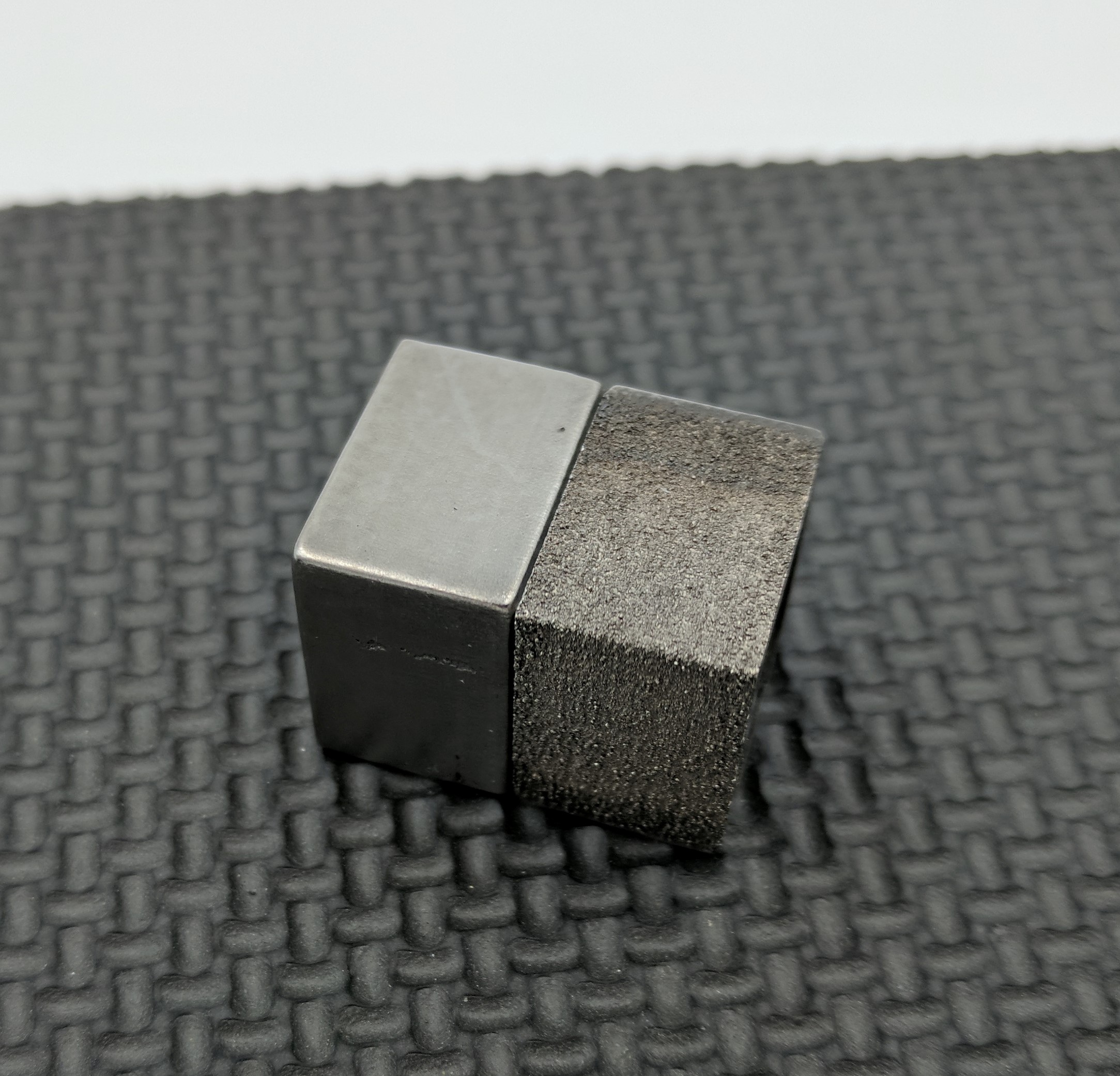
PECM removes material by anodic dissolution. Pulsed current passes between the tool, or cathode, and the workpiece, or anode, through electrolyte in a small gap. Tool shape helps determine the resulting geometry. Removal also depends on the electrical pulses, flow and electrolyte properties rather than tool-to-part distance alone.
The electrolyte conducts ions, flushes reaction products and helps control temperature. The process is described as non-thermal because removal does not rely on melting or vaporization; this does not mean that no heat is produced in the circuit.
Without cutting contact, PECM can combine shaping and finishing without generating the mechanical burrs or recast layers associated with some other processes. This does not eliminate every potential defect: dimensions, surface condition and cleanliness still need inspection.
The absence of contact greatly reduces mechanical tool wear. A suitable cathode can process repeated features in series. Process stability and tooling condition still need monitoring; unlimited maintenance-free production cannot be assumed.
PECM is primarily used as a machining process for complex metal components for the energy, aerospace, and medical device industries, and generally machines a workpiece that begins as bar stock or a near-net shape. However, the process can also be used as a secondary machining or postprocessing operation on additive components, and its unique capabilities can be especially advantageous for additive medical implants.
AM and interbody fusion cages
Interbody fusion cages are placed in the disc space between adjacent vertebral bodies. They differ from vertebral body replacement implants. An anatomically matched design may improve mechanical support but does not guarantee better clinical outcomes for every patient.
One concern is subsidence, meaning the cage sinks into the vertebral endplate. This is not simply fatigue wear: geometry, contact area, bone quality, endplate preparation and loading matter. Its consequences depend on severity and clinical context.
A biomechanical study published online in 2022 compared patient-specific cages with two commercial models in a cadaveric model. It measured stiffness and compressive failure force, with results favouring the patient-specific design depending on the comparator. It did not directly measure osseointegration, patient mobility or long-term clinical durability.
Despite these benefits, however, AM has inherent limitations which may disrupt both the economics of manufacturing these parts, as well as their functionality—and many of these limitations are centered around surface quality.
Surface Quality and Implants
Articulating surfaces in a hip prosthesis need to meet friction and wear requirements. Appropriate finishing can contribute to performance. Ion release also depends on alloy, corrosion, interfaces and operating conditions; roughness alone does not predict biocompatibility.
Bacterial adhesion and biofilms are another concern. Results from in vitro tests on spinal-cage materials depend on material and bacterial species. A smooth surface therefore does not provide universal antibacterial protection. Finishing, cleaning, sterilization and infection prevention have distinct roles; no generic “antibacterial adhesive” guarantees that bone will colonize the surface first.
AM’s surface quality limitations
Depending on process and device requirements, as-built metal parts may need additional finishing. Layer effects, adhering particles, supports and orientation influence surface condition. Downward-facing, or downskin, surfaces can be particularly challenging; results depend on machine, material and parameters.
Build-stage productivity gains should be assessed alongside their consequences for finishing. A faster setting is not necessarily less accurate, but parameter changes need qualification before production use.
Limitations can also be specific to the part, such as with the spinal cages used in lumbar interbody fusion surgery mentioned earlier. While certain aspects of the cage must have a porous, osseointegrative surface, other aspects must have smoother surface quality, and these combined features may be difficult for AM processes to produce in higher part volumes.
Potential benefits and limits of PECM
Fortunately, PECM may be capable of alleviating many of these limitations, acting as both a secondary machining and finishing operation for high-volume metal-AM implants, such as spinal fusion cages, hip arthroplasty devices, and others.
In this contribution, Voxel Innovations reports that PECM can reduce some wall thicknesses below 100 µm. That figure is specific to the geometries and conditions studied. The cited 0.3–0.5 mm range for AM is not a universal minimum wall thickness across processes, materials and orientations.
The supplier also reports examples of roughness falling from 5–10 µm Ra to below 0.5 µm, or even 0.1 µm Ra. These are reported results, not a guarantee for every part. Throughput, repeat count and cost should be compared with other processes for a defined application and acceptance criteria.
As the process prioritizes electrical conductivity of a given material over its hardness, PECM is capable of machining complex features in tough materials commonly used in metal additive implants, such as Cobalt-Chrome alloys and titanium alloys, including Ti64.
PECM can combine machining and finishing in selected regions. Dissolution still needs control to meet geometry requirements and preserve useful structures; the process does not automatically make every implant defect-free or ready for clinical use.
A purpose-designed cathode may finish selected interbody-cage surfaces while preserving porous bone-contact regions. Tool access, electrolyte flow and local material removal need assessment. The objective is not to remove all implant roughness indiscriminately.
PECM can complement metal AM where finishing needs and production volume justify its development. The approach should include representative-part trials, dimensional inspection, surface characterization and residue control. FDA technical considerations for AM devices emphasize cleaning validation, particularly for complex geometries.
About the author
At publication in 2023, Kirk Gino Abolafia was technical marketing manager at Voxel Innovations in Raleigh, North Carolina. Voxel’s technical education portal presents the supplier’s perspective and applications.
This article was first published in the March/April 2023 edition of 3D ADEPT Mag.
THE 3D ADEPT WEEKLY NEWSLETTER
The industry moves fast. Stay ahead.
Every week, the latest additive manufacturing news, in-depth features and real-world applications, straight to your inbox. Plus, be the first to know when a new issue of 3D ADEPT Mag is out.
Free · One email a week · Unsubscribe anytime
Clicking loads our email provider’s sign-up form, including its analytics and Google’s anti-bot protection. You’re only subscribed if you complete the sign-up. Read our privacy policy.