

Feature first published in the March–April 2021 issue of 3D ADEPT MAG. Roles, software tools and expectations reflect interviews with Altair and Sika Automotive at that time. Quoted estimates are not universal cost or performance ratios.
Additive manufacturing expands automotive design options, but a convincing demonstration is not always an industrially viable solution. How can lightweighting, performance, throughput and cost be reconciled? This 2021 feature brings together a software provider’s perspective and that of a component manufacturer.
At the beginning, most of the use cases that car manufacturers shared regarding their use of additive manufacturing highlighted the way the technology supported a given part development process by finding design issues prior to the fabrication of production tools. Over time, the opportunity to meet other needs has been raised; automotive designers have explored a certain flexibility with AM that they never experienced with any other technology, yet they said that the market has not reached an inflection point where the use of AM will become systematic for every part, for every design.
The reasons for this, might lie in the fact that there are too many design considerations/ crucial automotive requirements to meet, and areas for improvements that automotive designers expect from software providers to get there.
This article aims to discuss the current design considerations, automotive designers should take into account and the areas for improvement expected from AM technologies’ providers. In this vein, we have gathered Altair and Sika Automotive around this “table”.
Altair Engineering Inc. aka Altair provides product design and engineering, enterprise services, data analytics, IoT and cloud computing services across a wide range of services. In the AM industry, the software provider works closely with automotive OEMs and suppliers to deliver additive manufacturing projects while offering one single software solution that addresses the full breadth of designing to manufacturing. Jaideep Bangal, Design and Manufacturing – Global Technical Team, Altair Engineering has brought to this segment the perspective of a software provider.
Sika Automotive is a supplier of automotive bonding, sealing, damping and reinforcing solutions for vehicle BIW, body structure, interior, and exterior components. The company has been using AM for a few years now, to speed up the product development process for functional structural components that it delivers for various OEMs. Thomas Gasparri, Senior Program and Additive Manufacturing Manager, Dimitri Marcq, Lead Engineer CAD as well as Jose Bautista, Global Product Manager provide the perspective of a manufacturer of automotive parts in this topic.
A look at design considerations automotive engineers should absolutely take into account
A quick discussion with various engineers highlights a wide range of design considerations they often take into account in their work. Those considerations may vary depending on whether we are talking about interior parts or external parts of the vehicle.
The list seems to be non-exhaustive, but some items are mentioned more than others for internal parts. They include for instance, weight, temperature, complex geometries, moisture, part consolidation and costs.
Mass is one important constraint among several. Its priority depends on the component, loads, safety, cost and vehicle objectives. A lighter geometry must still meet these requirements.
According to Bangal, Design and Manufacturing – Global Technical Team at Altair Engineering, the introduction of DfAM methods has provided the engineer with better tools to reduce weight of parts.
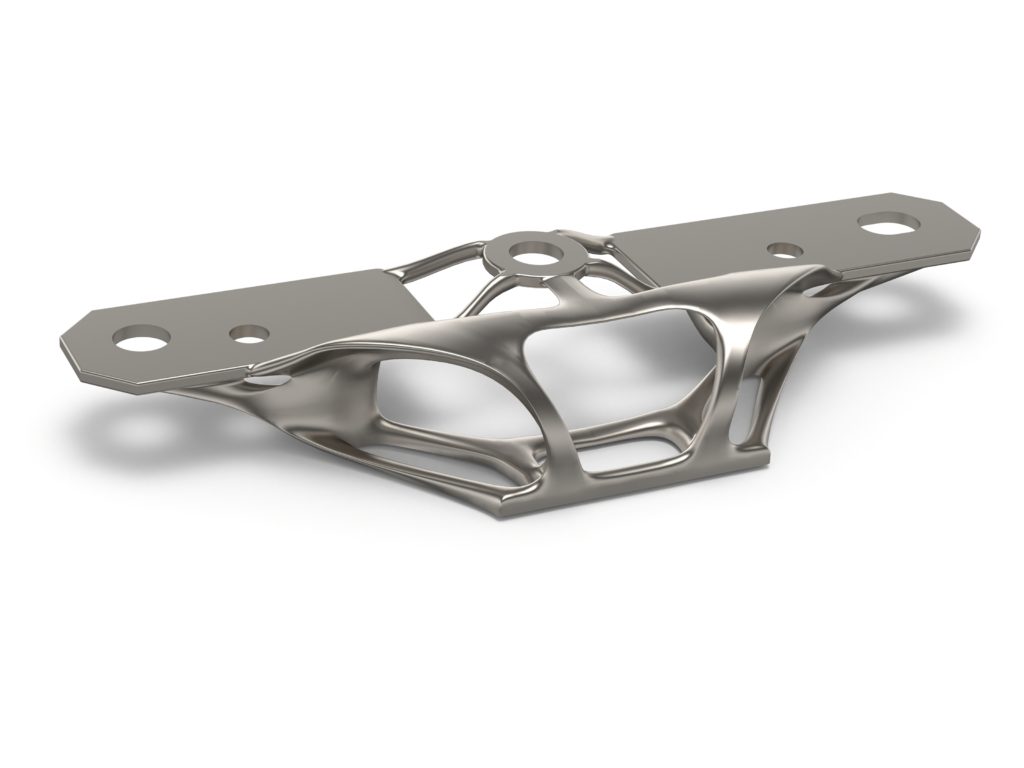
“Since the implementation of DfAM, automotive design has become better equipped to take full advantage of weight saving technologies like topology optimization. When these design technologies are coupled with a manufacturing process that can now drastically reduce the mass needed to manufacture the part, we experience new levels of lightweighting opportunities. A lighter vehicle equates to improved fuel economy or longer range”, he explains.
Consolidating several parts may offer benefits, but it needs assessing alongside other requirements. Design for AM does not replace thermal, mechanical or environmental checks.
Requirements for temperature resistance, deformation under load and moisture resistance vary with component location and function. They need specifying for the selected material and process rather than being reduced to one minimum value for all automotive parts.
For Bangal, “there should be one solution for the entire ‘design for additive manufacturing’ product development cycle that will help designers create the most efficient designs for any given performance criteria regardless of any additive manufacturing method (SLM, binder jet, FDM etc.); optimize orientations and support structures; and quickly simulate printing process virtually to check manufacturing feasibility”.
This integration is the objective Bangal presents. It does not remove the need to define component-specific constraints and verify simulation results.
The “DfAM” method’s paradox
Our feature on design for additive manufacturing discusses tools including topology optimisation, lattice structures, part consolidation and customisation. These are options, not mandatory steps in every design. DfAM means designing for the selected process’s capabilities and constraints and the intended use.
Priorities and design rules therefore vary with the application, materials and available production resources.
Dimitri Marcq, Lead Engineer CAD at Sika Automotive told 3D ADEPT Media they had to adapt their guidelines. Taking the example of DfAM methods utilized to reduce printing time and material volume, he notes:
“At first, we start by defining the AM technology based on part type, end use, quantity to produce and lead time. Then the design is optimized for the selected technology: orientation, limitation of material quantity required to print the part, resolution definition to improve the printing speed [or even] part design based on material properties. Such guidelines are being developed within Sika Automotive for each technology. For some specific features, it can be interesting to use off-the-shelf parts fitted on the printed parts. This allows to decrease printing time, by removing some complexity”.
Lattice structures can combine lightweighting, stiffness or energy absorption. Their value depends on architecture, material and loading; they are not inherently superior to solid parts for every application.
“Lattice structures [are ideal] for our reinforcement applications (lighter parts, better energy absorption, etc.). We [have already produced] a few samples: they were easy to print and really stiff. This type of structure can only be 3D printed, and is therefore limited to small volumes production. On top of that, the software that we are using daily is not designed to engineer such geometries. Dedicated software would be required to progress in that direction”, Marcq points out.
Marcq’s observation concerns the geometries and production resources discussed by Sika in this interview. It should not be generalised to every lattice or every AM production capacity. As a reference, a 2021 OptiStruct example explicitly considers mass, stiffness and cost trade-offs alongside manufacturing constraints.
The question of costs: what increases costs? And most importantly, how to avoid an expensive cost of the final part during the manufacturing stage?
The economic comparison depends on volume, tooling amortisation and equipment utilisation. AM may avoid some dedicated tooling and allow a machine to serve different parts, while retaining preparation, production and finishing costs. A 2014 Deloitte analysis distinguishes volume economics from production flexibility; it does not establish one profitable threshold for every part.
Whether unit cost is higher or lower than with a conventional process needs establishing for a defined part, volume and cost scope. A general multiplier is not enough to decide whether AM is appropriate.
“Automotive has specific needs in terms of scale, cost and materials that differ from other industries. Production speed and part costs are the top barriers to overcome in order to increase the use of AM in the automotive industry”, Thomas Gasparri from Sika Automotive recognizes.
Design changes can be a double-edged sword in that they can increase or reduce the final cost of the part- depending on the angle from which you analyse.
Gasparri highlights printed prototypes as a way to test several designs before committing to production tooling:
“AM enables designers and engineers to try numerous iterations simultaneously that may reduce upfront costs caused by tooling design modifications. Mistakes in the tool design do not show until after machining. Multiple design changes go from the designer to the tool engineer until the final tool design and quality are achieved. This adds costs and increases the time to market.
AM is a bridge between concept and final mass production. It allows to jump in and test a design without having to invest in that tooling. The final design is printed by AM to validate the performance. Once a functional design is approved, the tool machining can start and the expensive design changes can be avoided.”
However, according to Altair’s expert, an exclusive focus on AM reveals that “more than 40% of the costs associated with additive manufacturing have come from waste. This includes: material waste by printing tons of supports and post-processing afterwards (because of a wrong design/part selection for 3D printing); time waste by printing using incorrect orientations (resulting in print failures); as well as financial waste via trial and error printing methods, rework labour and machine costs, etc.”
The 40% figure is the interviewee’s estimate. Its scope and calculation method were not supplied; it cannot be applied as an average across all additive manufacturing.
Geometric complexity can also increase preparation, printing, depowdering or inspection time. Quotations and comparisons should include these operations rather than considering material volume alone.
To avoid the final expensive costs, the expert says “designers must understand the manufacturing constraints, 3D printer-specific design guidelines, and most importantly, that predicting and fixing manufacturing defects early is the key for avoiding the above-mentioned cost.”
Areas for improvement & future outlooks
Remotely accessible computing tools or services may facilitate collaboration. Their effect on lead times and cost depends on data, service levels and available skills. They do not replace design responsibility or component validation.
To those automotive engineers who are working on their designs in-house, Bangal affirms that “learning to use [these DfAM] tools is the easy part.” “Getting out of one’s comfort zone and adapting to next generation design and manufacturing methods is a slow change.” Speaking of Altair’s contribution in this field, he adds: “Altair has developed a novel design methodology that quickly and efficiently identifies opportunities through design exploration, converging the appropriate KPI mix that is desirable to our customers. This process continues to be refined as new technologies are developed and has proven to be very successful in arriving at substantial weight savings within acceptable performance and cost boundaries. This methodology is currently being advanced through our new Design AI tool that collects optimal datasets, auto-selects the best machine learning model, and enables the user to do quick what-if studies for fast, collaborative design improvements. The bottom line: the challenge is to not only develop a cool design, but more importantly, to achieve the appropriate cost, weight and performance mix.”
Last but not least, to advance the automotive industry, a collective effort beyond what OEMs can achieve is indispensable. Although, software providers and automotive engineers/designers from part manufacturers were the first involved in this article, it should be noted that these efforts also include material suppliers and next-gen machine manufacturers.
In this vein, to make their work as part manufacturers easier, Gasparri urges software providers to develop tools that “will help [them] get the best orientation, depending on the technology selected, in order to optimize the part / support material ratio; tools that will help [them] define the optimum batch size” and to machine manufacturers a “plug & play eco-system (printers / materials / parameters), with an open-source strategy.”
This feature has first been published in the 2021 March/April issue of 3D ADEPT Mag.
THE 3D ADEPT WEEKLY NEWSLETTER
The industry moves fast. Stay ahead.
Every week, the latest additive manufacturing news, in-depth features and real-world applications, straight to your inbox. Plus, be the first to know when a new issue of 3D ADEPT Mag is out.
Free · One email a week · Unsubscribe anytime
Clicking loads our email provider’s sign-up form, including its analytics and Google’s anti-bot protection. You’re only subscribed if you complete the sign-up. Read our privacy policy.