

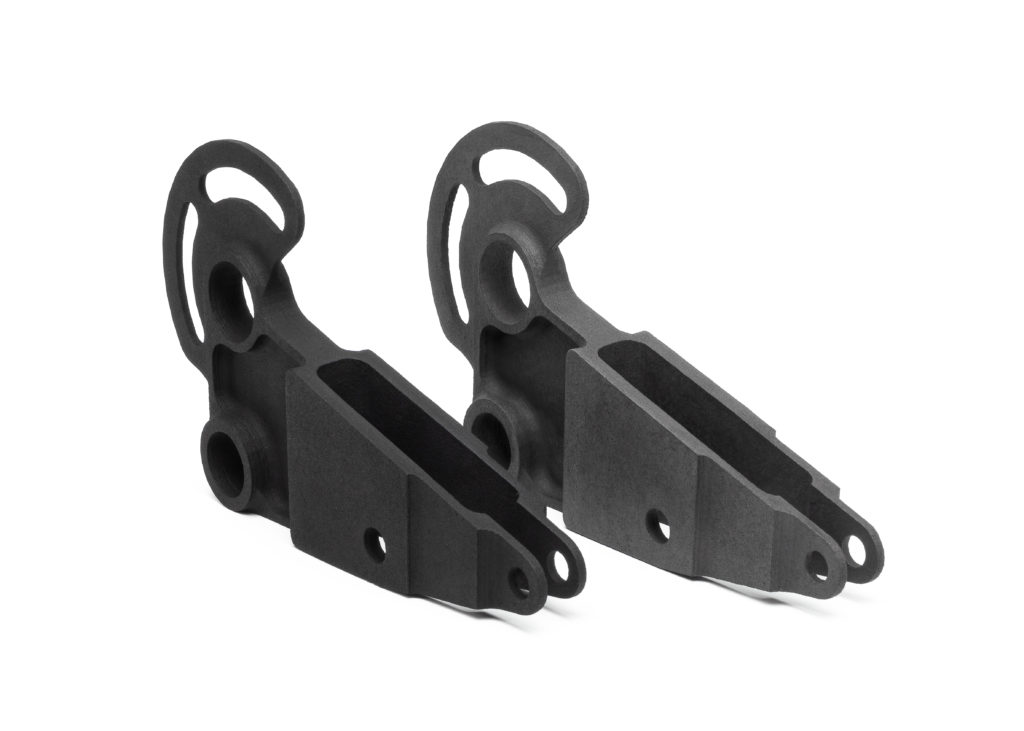
Industrial customers across Europe will now experience the potential of 3D printed composite parts produced with Impossible Objects’ composite-based additive manufacturing technology (CBAM).
The 3D printer manufacturer is one of the first companies that opened our eyes on the potential of composites for AM, and its ability to create everything from car and aircraft parts to athletic gear. So far, the company’s solution was mainly available to Fortune 100 companies, government agencies, and other customers across America.
Thanks to a new partnership with Ricoh3D, the additive manufacturing brand of Japanese company Ricoh, Impossible Objects will be able to deliver strong and lightweight printed composite parts to Europe-based customers.
History reveals that both companies have partnered with same organizations to expand their activity. Each of them explored a collaboration with TIGER for instance, to bring 3D printed thermoset composites to new industries and to develop new applications based on SLS Technology.
Ricoh3D’s customers will benefit from advantages such as superior strength-to-weight ratios, fewer geometric restrictions, superior high-temperature performance, and greater chemical resistance.
According to the US-based manufacturer, the CBAM solution produce parts up to ten times faster than conventional fused deposition modeling (FDM) 3D printing. The key to success would lie in the combination of high-performance polymers like Nylon and PEEK with carbon fiber and fiberglass sheets. The process therefore opens up new opportunities for applications like drones where FDM is not often regarded as a production candidate, because of the short, chopped fiber formation and lamination between layers, which cause parts to fall apart under force.
“Composites are set to be an area of huge growth in additive manufacturing in the coming years. These new materials will change the game across a number of industries,” said Mark Dickin, Additive Manufacturing & Molding Engineering Manager at Ricoh 3D. “Impossible Objects’ CBAM process is nothing short of a revolution in the way composites are manufactured, so we are proud to be working with the company to be at the forefront of the European movement.”
Remember, you can post job opportunities in the AM Industry on 3D ADEPT Media free of charge or look for a job via our job board. Make sure to follow us on our social networks and subscribe to our weekly newsletter : Facebook, Twitter, LinkedIn & Instagram ! If you want to be featured in the next issue of our digital magazine or if you hear a story that needs to be heard, make sure you send it to contact@3dadept.com
THE 3D ADEPT WEEKLY NEWSLETTER
The industry moves fast. Stay ahead.
Every week, the latest additive manufacturing news, in-depth features and real-world applications, straight to your inbox. Plus, be the first to know when a new issue of 3D ADEPT Mag is out.
Free · One email a week · Unsubscribe anytime
Clicking loads our email provider’s sign-up form, including its analytics and Google’s anti-bot protection. You’re only subscribed if you complete the sign-up. Read our privacy policy.