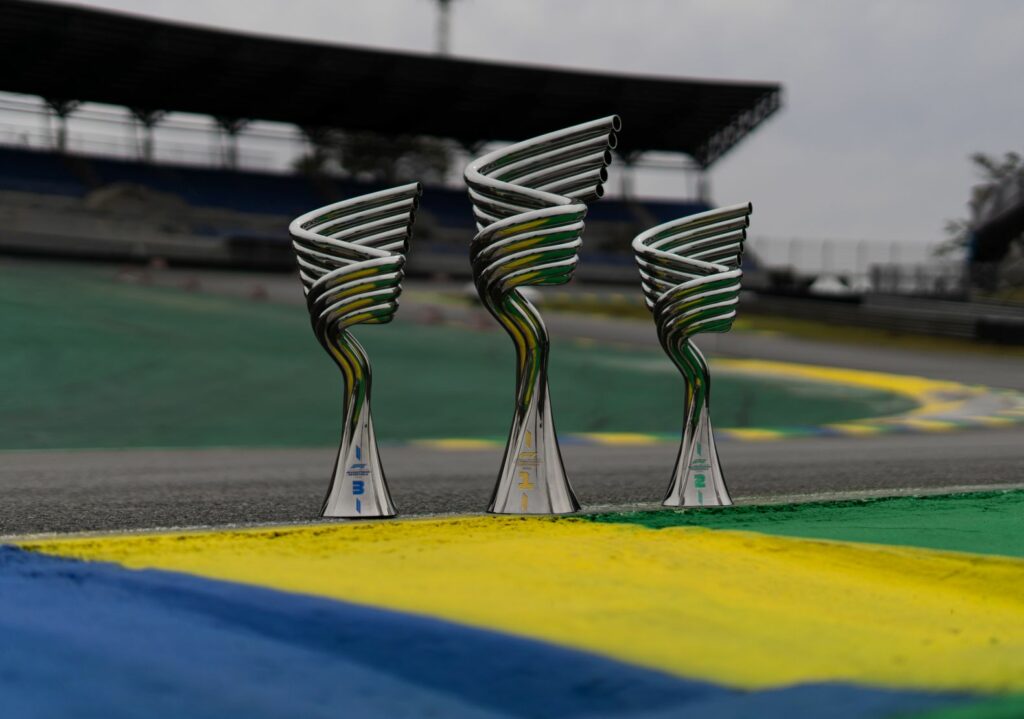
The trophy Lando Norris lifted at Interlagos on November 8 was 3D printed in titanium. Fábio Castellotti, Fernando Lambiasi and Gabriel Fonte of São Paulo-based studio Secret Weapon designed it. This 3D printed titanium trophy served the Formula 1 MSC Cruises Grande Prêmio de São Paulo 2026. BTOMEC Ferramentaria e Usinagem de Precisão manufactured the trophy. The precision tooling and machining company operates in Joinville, Santa Catarina, Brazil.
From the first sketches to the last polishing step, the project took about ten months.
This is the second F1 podium trophy made by Additive Manufacturing that we have covered this season. In September, we reported on Pirelli’s Monza podium trophy.
What does a V10 exhaust have to do with it?
Secret Weapon specializes in acoustic engineering and high-performance exhaust systems, and the design starts there. The concept links five pipes from one cylinder bank of a V10 exhaust manifold to five lines of a musical staff. This nods to the high-pitched sound of naturally aspirated engines that marked Formula 1 history.
The five pipes trace the Senna S of the Autódromo José Carlos Pace, including its descent. They also turn anticlockwise, just like the circuit. From different angles, the sculpture evokes the map of Brazil, a waving chequered flag, an eighth note or a treble clef. Meanwhile, the base recalls the kerbs of Interlagos.
Race exhaust manifolds use complex bends to fit pipes of controlled lengths into tight spaces. Not surprisingly, BTOMEC chose Selective Laser Melting (SLM), a laser powder bed fusion process. It builds the geometry layer by layer from titanium powder.
How was the titanium trophy 3D printed?
According to the press kit, each unit contains more than 20,000 layers. Printing takes approximately 190 hours. The team then spends around 500 hours on finishing work. This includes removing support structures, treating the surface, manual finishing and electropolishing.
The team uses 5-axis CNC machining to engrave the F1 logo and inscriptions in low relief directly into the titanium. These details therefore form part of the trophy rather than separate components.
The colors do not come from paint either. According to the organizers, controlled oxidation forms microscopic layers of titanium oxide on the surface. Their thickness changes how the surface reflects light. This creates shades of green, yellow and blue, the colors of the Brazilian flag.
The trophy measures 55 cm in height, 22.5 cm in width and 24.3 cm in depth, for a weight of 5.7 kg.
Finishing took more than two and a half times as long as printing.
For complex metal parts with demanding surface requirements, the post-processing know-how weighs as much as the 3D printer itself.
THE 3D ADEPT WEEKLY NEWSLETTER
The industry moves fast. Stay ahead.
Every week, the latest additive manufacturing news, in-depth features and real-world applications, straight to your inbox. Plus, be the first to know when a new issue of 3D ADEPT Mag is out.
Free · One email a week · Unsubscribe anytime
Clicking loads our email provider’s sign-up form, including its analytics and Google’s anti-bot protection. You’re only subscribed if you complete the sign-up. Read our privacy policy.