

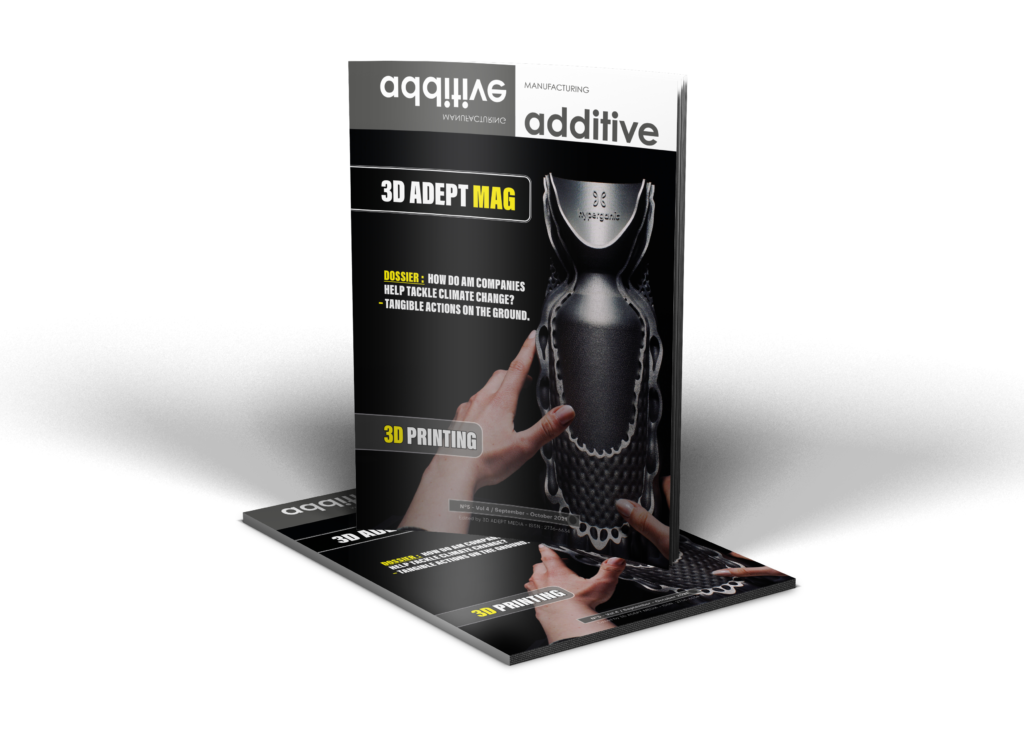
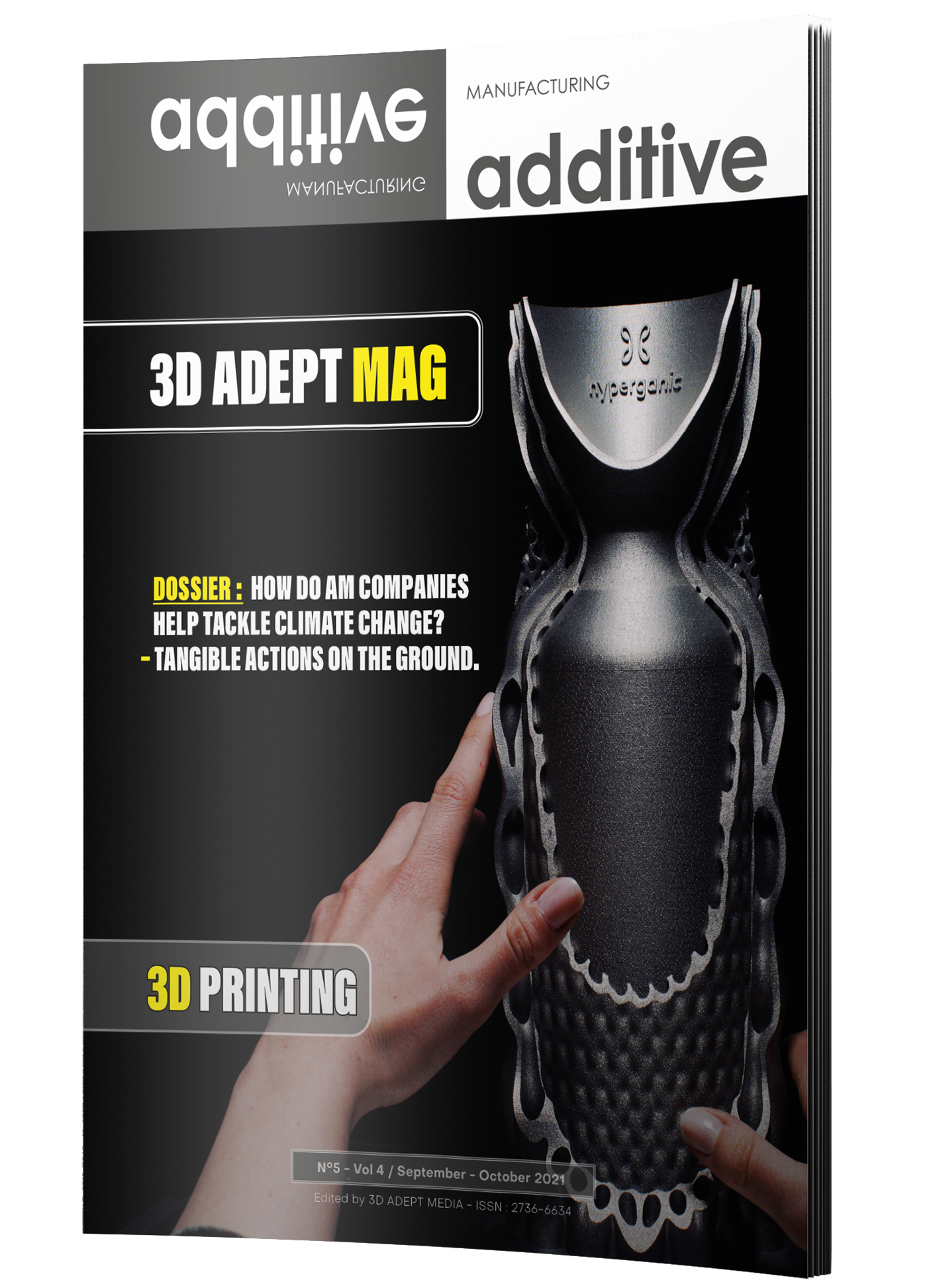
Archive — September/October 2021 issue of 3D ADEPT Mag. This page presents the contents of that issue; the events, roles and market context refer to its publication period.
This edition of 3D ADEPT Mag focuses on ‘sustainability’. This may sound redundant when you see how much this word, as well as the words “climate change”, are used at every turn, in all industries and in political debates. Only, to date, the hype has been about a lot of promises and yielded little to no action.
At 3D ADEPT Media, we wanted to go beyond these promises for the Additive Manufacturing industry and for all vertical industries that use these AM technologies. One of our main challenges for this edition was to find relevant questions that would avoid any form of “greenwashing”, questions that allowed contributors to share key ideas, figures and tangible actions that show how they are working to achieve their net zero emission goals.
It seems easy for large companies with resources and big budgets to do this, but let me tell you that smaller companies are not lagging behind. Unlike large companies where decision making often slows down the implementation of actions, smaller companies have the opportunity to think about a business model that takes these concerns into account from the very beginning of their venture.
From a manufacturing point of view, whether before or after an object is actually manufactured, sustainability issues are refocusing the debate on “materials“. The dossier, ‘post-processing’, ‘research’ and ‘applications’ sections highlight the importance of rethinking the production of materials and their use through different lenses and companies.
Moreover, the manufacturing perspective reveals that even if they have to act individually, industry players have to consider other stakeholders. Software providers therefore play an important role, as do 3D printing service providers, 3D printer manufacturers and post-processing companies.
So no, this edition of 3D ADEPT Mag is not a set of fine words, it is an edition that shows what has already been done, what is being done and what remains to be done. It is an edition that calls for action and analysis of the type of society we want to build.
Exclusive features
How do AM companies help tackle climate change? – Tangible actions on the ground.
Climate change is a topic that is on everyone’s lips. Governmental authorities have sounded the alarm so loudly that both legal entities and individuals feel they have a mission: play their part in addressing climate change issues. Among the multiple fields this problem can be tackled on, there is manufacturing.
This dossier discusses the reasons why climate change and sustainability issues are often addressed interchangeably within organizations. It also discusses the way each stakeholder influencing parts production via Additive Manufacturing addresses these questions. Focus on the software, materials and manufacturing perspectives.
With contributions from Dr. Runze Huang, independent researcher in sustainability, LCA, and techno-economic analysis of AM, Hyperganic, 6K Additive & PolySpectra.
FOCUS on YOU Series: Guaranteed
Once you have decided to go down the Metal Additive Manufacturing (AM) route, the next step is at least equally important. While “value for money” is often the most analysed criterion, the truth is, working with a solutions provider must go beyond this important argument. Indeed, not only is the market filled with companies offering AM services, but also confusion can quickly arise when one realizes there is also a wide range of metal AM technologies. What criteria should you use to favour one technology over another? And most importantly, how should/do you envision the future of your production with that Metal AM solution? Guaranteed provides key responses here.
Additive Manufacturing Shapers| Equinor
Equinor: An “Additive Mindset” to address climate change and sustainability issues
Brede Lærum and Pantea Khanshaghaghi discuss how Equinor approaches additive manufacturing, climate ambitions and sustainability. Their interview presents the company’s perspective and examples; it is not an independent assessment of its climate performance.
Post-processing | Materials
Powder recovery in an AM production: What? Why? How?
Today, material producers have developed metal powders with AM production in mind. However, their high cost has increased the demand for recycling of unmelted powder – especially in powder-bed AM processes. For manufacturers who are willing to explore reuse or recycling strategies, meeting this demand also means enabling sustainability performance – or at least enabling an environmental framework to sustainability. Most importantly, meeting this demand requires to leverage interdisciplinary resources that go beyond the simple expertise of material experts.
The present feature ambitions to discuss some of the powder recovery/reuse technologies and strategies that could be used to save metal powder while taking into account these interdisciplinary resources. It might serve as a complementary resource to the dossier “Issues raised by metal powder removal”, as it will also focus on the importance of the recovered powder with regards to sustainability and viability of materials.
With contributions from Solukon, Evonik, Renishaw. Etc.
Materials | Research
Does nature hold the answer to sustainability? A look at biomimicry and its practical use within the 3D Printing sphere.
If everything we use comes from natural resources and that natural ecosystems are often described as models of sustainability, does that mean that every 3D printed product inspired by nature is de facto a sustainable product?
With contributions from Libonati Flavia, researcher and Associate Professor, at Università degli Studi di Genova
Guest Column
The SUPREME project reveals the performance and sustainability advantages of AM component production
The SUPREME project — “Sustainable and flexible powder metallurgy processes optimization by a holistic reduction of raw material resources and energy consumption” — ran from September 2017 to December 2020. CORDIS records a total cost of about €9.53 million, including about €7.89 million in EU funding under Horizon 2020 (grant 768612). The project combined work on powder production, additive manufacturing and near-net-shape processes, including metal injection moulding and hot isostatic pressing. EPMA presents its results in this guest column.
Applications | Materials
What 3D printing materials are an interesting choice for fashion and what is this sector’s approach to sustainability?
Fashion is a substantial manufacturing sector with material use and supply chains relevant to sustainability discussions.
At the time of this 2021 issue, the COVID-19 crisis was putting additional pressure on the sector and drawing attention to its supply chains and business practices.
Those issues include but are not limited to the delicate and intricate supply chains, the increment of brands’ digital presence, as well as the experimentation with new technologies such as 3D Printing and materials – mainly bioplastics or recycled materials. The article below will discuss the use of 3D printable materials in the fashion industry and this sector’s approach to sustainability concerns.
Words of Andreina Martinez Tancredi .
Start-up Area
How recyclable and 3D printable are metals? F3nice told us.
We will remember spring 2020 as a period of confinements that led to the shutdown of several activities around the world. For Luisa Elena Mondora and Matteo Vanazzi, in addition to the pandemic that hit their beloved country – Italy – even more than most countries, spring 2020 also comes with the memory of the creation of F3nice. Both cofounders actually came up with the idea of F3nice in 2019, on the heels of an analysis in the Oil & Gas industries. With the decommissioning of offshore assets for the oldest oil fields in the North Sea, and the digital inventory for on-demand and “just in time” production of spare parts, they investigated the possibilities to use the high value scrap metal from offshore decom to power a circular economy project. The two entrepreneurs ambitioned then to produce sustainable AM feedstock that could empower the metal AM industry and in particular, the digital inventory initiative. In this Q&A series, we have asked Mondora 7 questions to help us understand how recyclable and 3D printable are metals.
Formnext Preview
This preview describes Formnext 2021, for which nearly 450 exhibitors had registered when the article was prepared. It introduces a selection of the solutions announced for that edition.
Download the September/October 2021 magazine: single-page PDF or double-page PDF. Each file is approximately 50 MB.
THE 3D ADEPT WEEKLY NEWSLETTER
The industry moves fast. Stay ahead.
Every week, the latest additive manufacturing news, in-depth features and real-world applications, straight to your inbox. Plus, be the first to know when a new issue of 3D ADEPT Mag is out.
Free · One email a week · Unsubscribe anytime
Clicking loads our email provider’s sign-up form, including its analytics and Google’s anti-bot protection. You’re only subscribed if you complete the sign-up. Read our privacy policy.