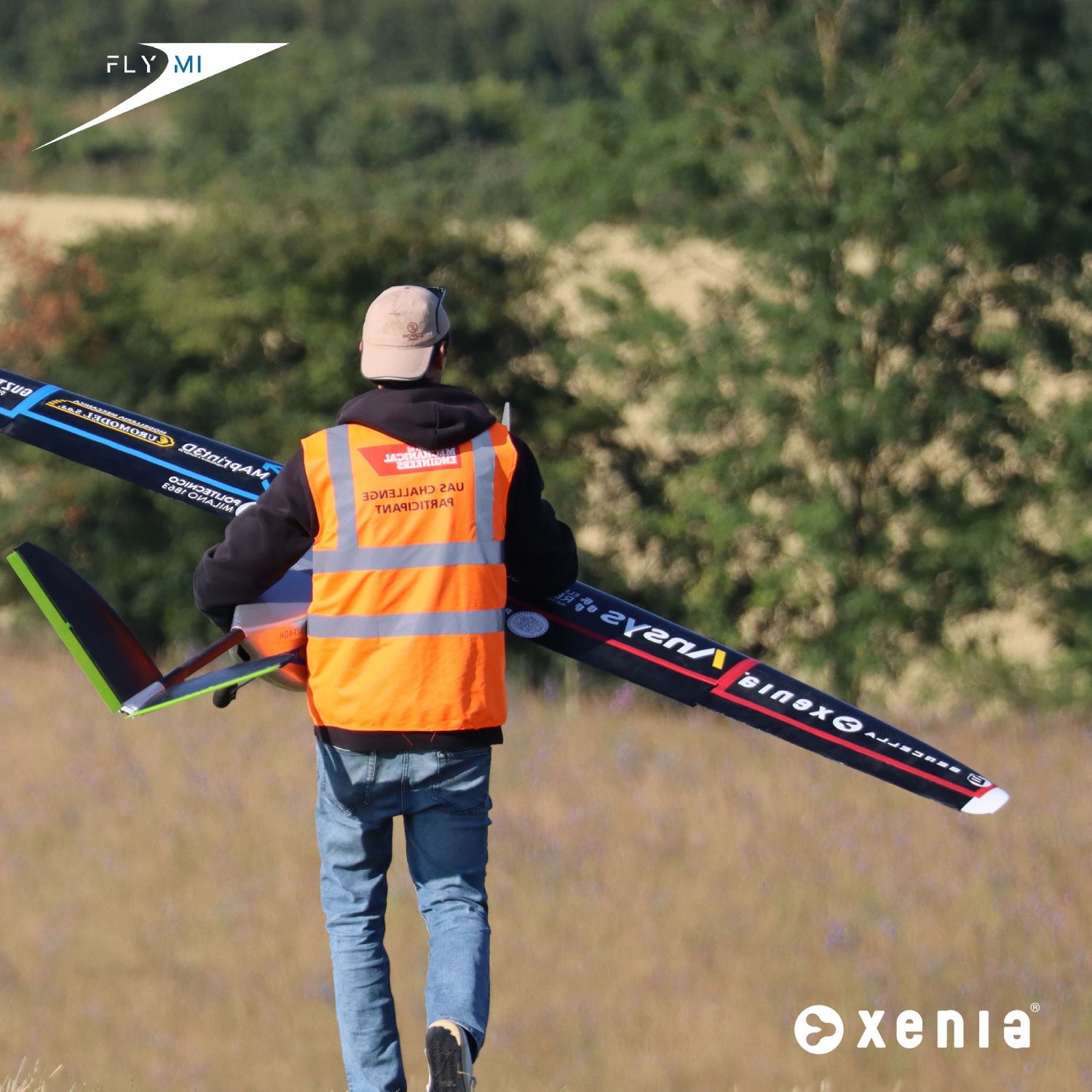
Material producer Xenia Materials recently supported the development of O.L.I.V.I.A. (Optimized Lightweight Intelligent Vehicle for Immediate Assistance), an autonomous drone designed to compete in the UAS Challenge 2025, held in the United Kingdom.
The project is led by Fly-Mi EUROAVIA Milano, the student association of the Politecnico di Milano. This partnership marks the second consecutive year of cooperation between Xenia and the Fly-Mi team, following the success of their previous project, NYX.
The UAS Challenge brings together university teams from around the world to design and fly unmanned aircraft for humanitarian scenarios. With O.L.I.V.I.A., the students demonstrated remarkable technical skill and teamwork, securing third place overall and gaining international recognition for their rigorous engineering approach.
What is O.L.I.V.I.A.?
O.L.I.V.I.A. is a fixed-wing drone with a V-tail and semi-elliptic high-wing configuration, capable of fully autonomous missions, from take-off to landing, while carrying up to 1.75 kg of payload. Developed using advanced composites, it combines structural efficiency with lightweight construction and high aerodynamic performance. Its dual-battery system and redundant positioning and communication links also earned the team the Safety Award for system reliability.
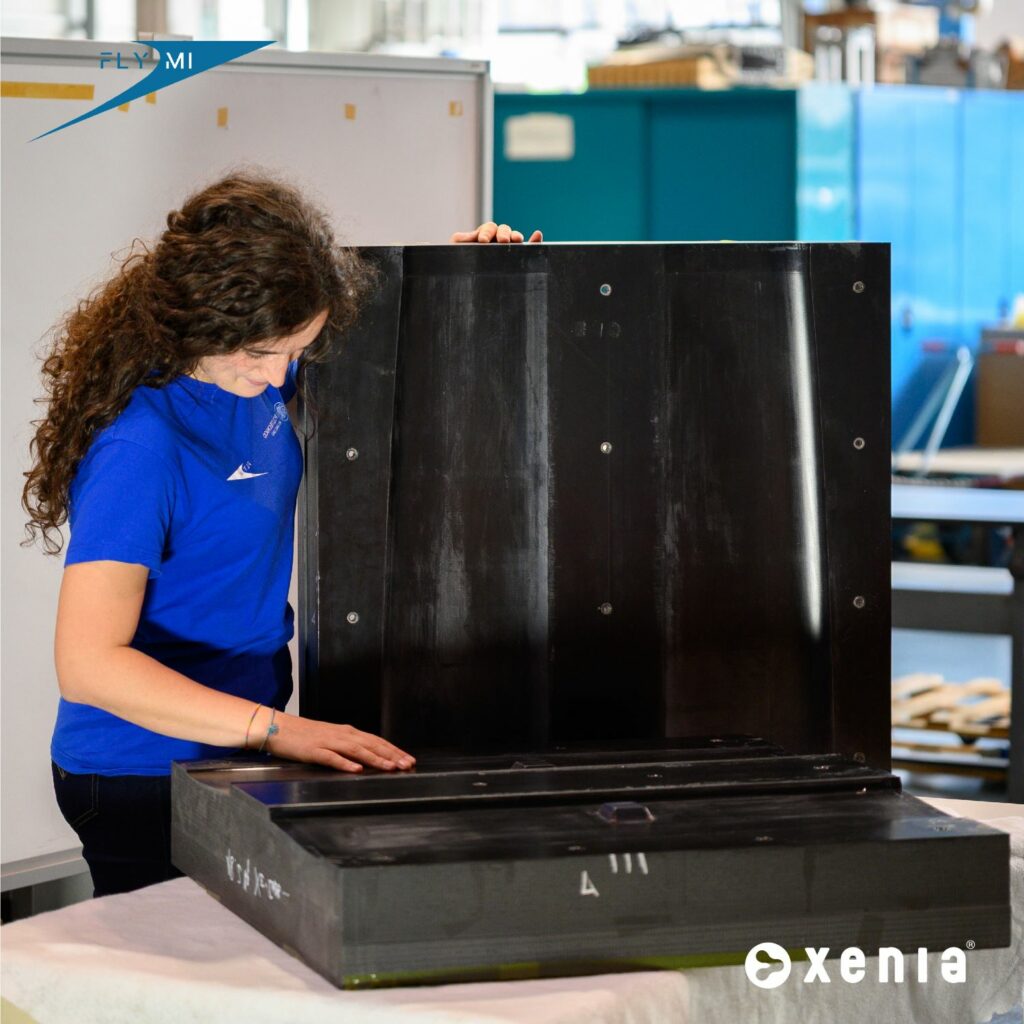 To achieve the precise aerodynamic and structural requirements of the high wing, the team needed high-quality moulds capable of withstanding autoclave lamination cycles. For this purpose, they relied on Xenia’s XECARB® 40-C20-3DP, a high-performance 3D-printable polycarbonate reinforced with 20% carbon fibre. This material provided excellent machinability, dimensional stability and thermal resistance, enabling the production of smooth, precise moulds that ensured the wing’s aerodynamic efficiency.
Its lightweight design also facilitated handling and accurate positioning during lamination, while its mechanical integrity allowed the moulds to endure multiple autoclave cycles at 120 °C and 2 bar without deformation, perfectly supporting the fabrication of the carbon fibre components that make O.L.I.V.I.A. both lightweight and robust.
“Xenia’s XECARB® 40-C20-3DP material allowed us to create moulds that were precise, strong and easy to work with during the autoclave lamination process” said the Fly-Mi EUROAVIA Milano team. “Having reliable moulds was crucial to achieving the aerodynamic performance and structural quality needed for O.L.I.V.I.A., and it played a major role in helping us secure third place in the competition.”
By working closely with academic institutions and student teams, Xenia continues to encourage innovation and technological growth, contributing its know-how to the development of lightweight, high-performance solutions for the aerospace industry.
*We curate insights that matter to help you grow in your AM journey. Receive them once a week, straight to your inbox. Subscribe to our weekly newsletter.