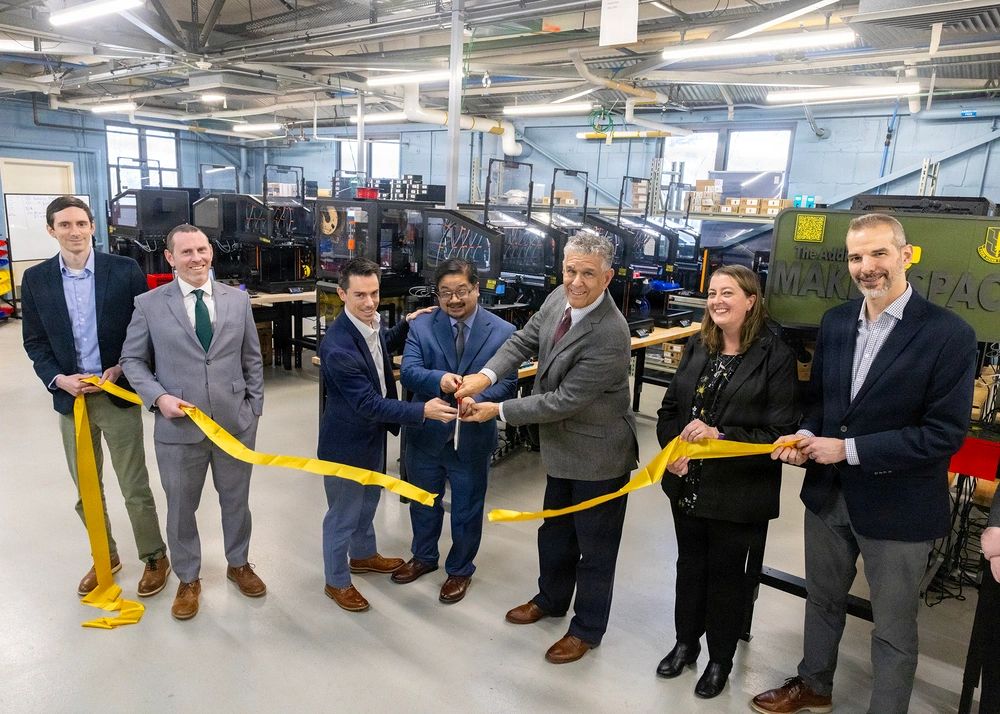
The U.S. Army has inaugurated a dedicated additive manufacturing facility at Picatinny Arsenal, New Jersey, marking another step in the military’s broader push to embed 3D printing capabilities directly into its engineering and development infrastructure.
The Additive Makerspace, which opened on March 19 with a ribbon-cutting ceremony, is designed to provide DEVCOM Armaments Center engineers with a dedicated environment to design, prototype, and manufacture parts army, reducing dependence on traditional supply chains and accelerating the pace of innovation.
The facility houses more than 50 3D printers and supports a range of advanced additive manufacturing technologies and material options. Compatible materials include plastics, metals, ceramics, and composites, giving engineers meaningful flexibility across a wide spectrum of applications and development stages.
The space is facilitated by the Analysis, Materials, and Prototyping Directorate (AMPD), under the Armaments Center’s Munitions Engineering Technical Center (METC), whose mandate covers manufacturing engineering, prototyping, producibility, and reverse engineering in support of armaments technologies.
“We know this space will be a valuable tool for Armaments Center engineers to utilize these technologies and expertise, so we can drive speed and innovation to the battlefield,” said Thomas Fasano, Senior Scientific Technical Manager of AMPD.
The opening reflects a wider institutional shift within the U.S. military. Similar innovation labs have been established at other Army and Department of Defense locations, including the Maneuver Innovation Lab at Fort Moore, Georgia, and the Airborne Innovation Lab at Fort Bragg, facilities designed to empower both civilians and soldiers to develop tangible solutions from the ground up.
From a technology adoption standpoint, the Picatinny makerspace illustrates a maturing approach to additive manufacturing in defense: no longer confined to R&D departments or advanced prototyping labs, 3D printing is increasingly being positioned as an operational asset. Applications range from simple plastic components to complex metal vehicle parts, demonstrating how the technology is scaling across use cases within military environments.
By bringing these capabilities closer to the point of need, the Army aims to reduce reliance on traditional supply chains and increase operational readiness, particularly relevant consideration in contested logistics environments where speed and adaptability are decisive.
For the additive manufacturing industry, initiatives like this signal continued institutional demand for scalable, multi-material AM solutions, and reinforce the strategic value of building robust, on-site manufacturing capacity rather than relying solely on centralized production.
*We curate insights that matter to help you grow in your AM journey. Receive them once a week, straight to your inbox. Subscribe to our weekly newsletter.