

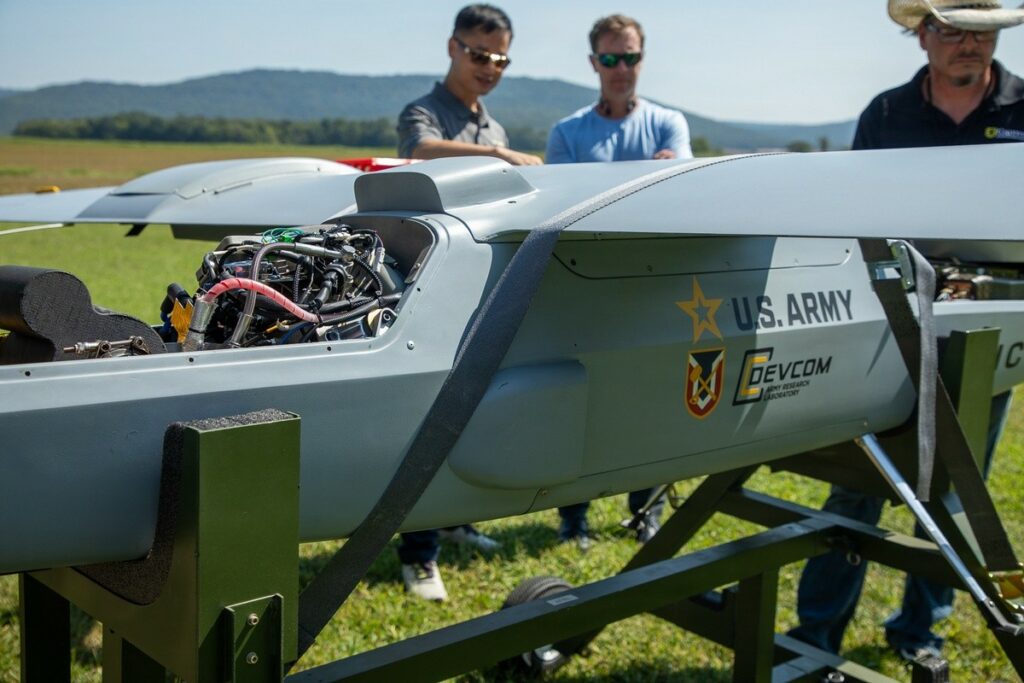
Small drones have long faced a fuel mismatch. Most run on gasoline, whereas militaries rely on kerosene-based fuels. Researchers at the U.S. Army Combat Capabilities Development Command Army Research Laboratory addressed this challenge with the flight demonstration of a 3D printed heavy-fuel engine.
The system is a heavy-fuel rotary-engine series hybrid developed under ARL’s Versatile Tactical Power and Propulsion essential research program. The engine works with a novel 400-volt motor-generator system. It aims to support vertical takeoff and landing in contested environments.
For flight tests, ARL and its industry partners built an aircraft around the propulsion system. These partners included Griffon Aerospace. The result is VICTOR (Versatile Intelligence Controlled Tactical Operational Reconnaissance and Attack). This Group 3 midsized unmanned aircraft flew near Huntsville, Alabama.
Making heavy fuel work in a rotary engine
Rotary engines are compact and power-dense, which makes them attractive for mid-sized drones. However, heavy fuel is harder to atomize and vaporize than gasoline. Rotary engines are also prone to leakage.
ARL researchers started with a clean-sheet design and advanced computational fluid dynamics models. They aimed to improve fuel atomization and vaporization. At the same time, they sought to limit leaks of compressed air and fuel vapor.
“The use of advanced manufacturing, including 3D metal printing, allowed us to rapidly redesign engine components based on lessons learned through experimentation,” said Dr. Chol-Bum “Mike” Kweon, DEVCOM ARL program manager. “It enabled us to design an air-cooled engine that reduces propulsion-system size and eliminates the need for liquid coolant.”
As with Beehive Industries’ 3D printed jet engine for unmanned defense vehicles, metal 3D printing served here first as a development tool. It shortened the cycle of testing, learning and redesign. In addition, it made an air-cooled design possible. Removing a drone’s liquid cooling circuit reduces weight and volume. Both factors affect endurance and payload.
What comes next
The program brought together more than 30 universities, over 13 federal laboratories and over 20 industry partners. It has also produced tens of patents and patent applications. According to Kweon, findings have already been “transitioned to industry partners for maturation and integration into capabilities that could enable mid-sized drones to operate beyond line of sight.”
Lessons from the program will feed into PULSAR (Persistent Unmanned Aircraft System for Logistics, Strike, Autonomy, and Reconnaissance). This concept uses a swarm of VICTOR drones for multi-mission operations. Military partners will receive access to both VICTOR and PULSAR for further experiments. Meanwhile, industry partners continue to refine VICTOR for other applications.
THE 3D ADEPT WEEKLY NEWSLETTER Every week, the latest additive manufacturing news, in-depth features and real-world applications, straight to your inbox. Plus, be the first to know when a new issue of 3D ADEPT Mag is out. Free · One email a week · Unsubscribe anytime Clicking loads our email provider’s sign-up form, including its analytics and Google’s anti-bot protection. You’re only subscribed if you complete the sign-up. Read our privacy policy.The industry moves fast. Stay ahead.