We are long past the debate over whether companies should digitize their processes. It’s widely acknowledged that modern and advanced manufacturing must incorporate key elements such as the digital thread, digital twin—and now, AI as a critical assistant on the production floor.
The real question is: how can it be done effectively?
Ivan Madera, an Additive Manufacturing executive known for building credibility through his leadership at aerospace and defense AM company Morf3D, offers a glimpse into what his new venture, Adaptiv AI, aims to deliver.

The truth is, we’ve spent far too much time watching companies like Morf3D go the extra mile to explore AM applications (in series production) that could be reproducible and repeatable in a first-time-right print. That reproducibility and repeatability all depend on process complexities – all of which Madera aims to address through Adaptiv AI.
“Adaptiv AI addresses the inefficiencies and fragmentation across the manufacturing value chain, particularly in sectors like aerospace and defense. Our platform addresses challenges related to slow decision cycles, legacy infrastructure, and disconnected data by integrating AI and intelligent automation to optimize production, minimize waste, and expedite mission-critical outcomes,” Madera states from the outset when we asked him the problems he was trying to solve with Adaptive AI.
I would be lying if I didn’t tell you that one of my hidden concerns about such digital transformation is that a couple of jobs might be lost along the way. However, Madera is envisioning a factory where their AI operating system interacts with its human counterpart, rather than suppressing them. From my limited experience with AI, it feels like amplifying capabilities, or if I may — giving engineers the equivalent of years of industry expertise, driven by advanced data analysis.
“Adaptiv AI is an enterprise-grade platform that modernizes industrial manufacturing by fusing artificial intelligence, advanced analytics, and real-time systems integration. Built for regulated, complex environments, Adaptiv AI enables manufacturers to scale smart operations, improve visibility across production systems, and make informed decisions faster while maintaining compliance and security,” he explains.
How would this raise the interest of AM users?
It is clear to me that all manufacturing technologies can easily benefit from advanced data analysis. So, my question to Madera was: what’s in it for AM users in particular? – and he said:
“Additive manufacturing often produces minor variations from part to part, and no two prints are identical. With AI and machine learning, we can identify these differences in real-time and adjust the process to ensure every part meets quality standards. At Morf3D, we previously captured this data manually and ran it through a statistical model; however, with today’s AI tools, the entire process is now automated. We can track quality across parts, machines, and production lines to save time and boost consistency.”
Beyond quality assurance for these users, Adaptiv AI would function as a predictive system that will coordinate work upfront across the entire value chain, and this in real time.
Taking the example of digital twins, for instance, research from LTIMindtree and Capgemini, reveals that implementing digital twins can trim program costs by up to 15% and accelerate product development cycles by 25%. In aerospace & defense—where design mistakes often trigger massive change orders—an “AI assistant” on the factory floor could help prevent late-stage fixes worth hundreds of millions.
While the focus of Adaptiv AI on aerospace & defense seems obvious given Madera’s long experience in the field through Morf3D, it’s good to remind that these industries “require precision, compliance, and scalability, which is what we focus on. The aerospace and defense industry is unforgiving; everything must meet special requirements and be fully documented.” “We are also seeing strong interest from automotive, energy, and advanced electronics manufacturers that are prioritizing digital transformation and resilience,” the executive notes.
Moving towards full digital transformation
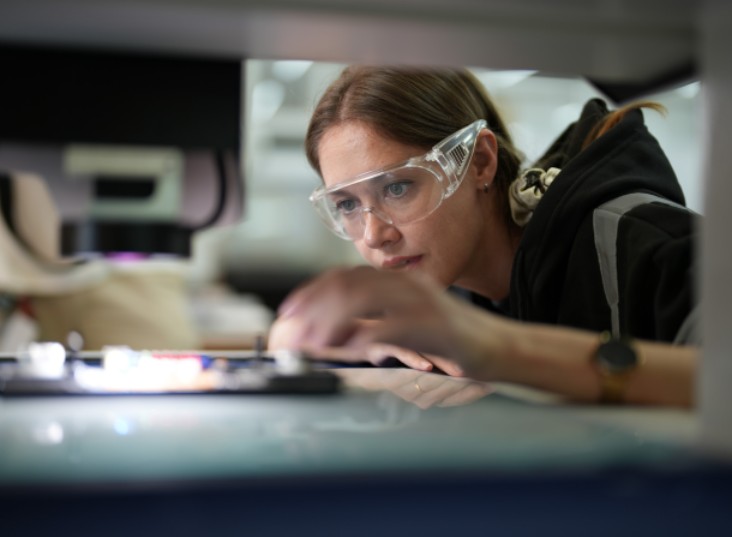
Adaptiv AI’s goal seems simple: automate the work of operators on the factory floor so that they can focus on maximizing capabilities or what they do best. It refocuses the debate on the importance of AI agents in a manufacturing environment where supply chains continue to experience volatility, customer demands are shifting rapidly, and legacy systems are struggling to keep up.
“I used to say, “We don’t sell parts; we sell process.” Customers expected complete visibility into how their parts were made, with full traceability. At Adaptiv AI, I’ve carried that mindset forward. With AI, it’s often unclear how a solution is reached, but we’ve built in traceability so users can see exactly what steps our system took and retain that history for audits. This tool is grounded in decades of manufacturing and process expertise. Software alone isn’t enough; you have to understand how the manufacturing business works”, Madera concludes.
By embedding intelligence into daily operations, Adaptiv AI aims to help manufacturers adapt, and optimize operations in real-time.
While I trust Madera’s vision, I look forward to seeing more concrete steps. Beyond the teaser, the industry will want to see how his technology actually works in practice, because, in the end, the proof of the pudding is in the eating.
This interview has first been shared in the 2025 May/June edition of 3D ADEPT Mag. Discover the entire issue here.