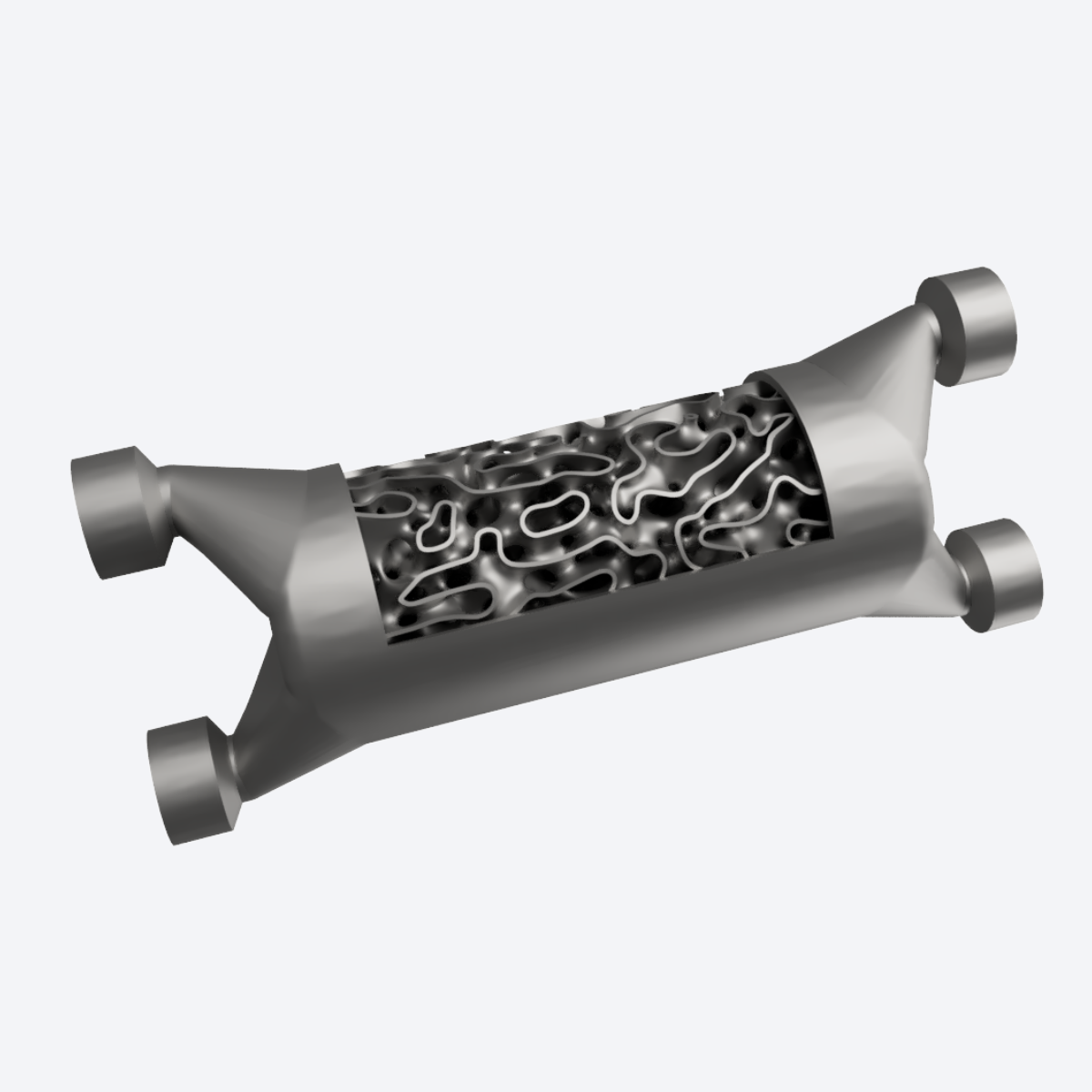
Remember Spherene, the Swiss company operating at the intersection of software design and material development? The company behind the patented Adaptive Density Minimal Surfaces (ADMS) technology, recently released Spherene V3.
This version of its core geometry technology introduces advanced geometry controls and a new flow-optimized ADMS type, expanding the functional capabilities of ADMS for mechanical, thermal, and fluid applications.
Since its inception, ADMS has distinguished itself through continuous local adaptation of cell size and wall thickness, surface-conformal fitting to complex shapes, near-isotropic mechanical behavior, and progressive layer-by-layer failure. These capabilities allow engineers to design lightweight, mechanically reliable structures that perform predictably under load, a press release reads.
The three key features of Spherene V3
The main versions of Spherene V3 include Scatter Vector, Flow ADMS and Flow Direction.
Scatter Vector: This feature gives engineers a way to gently “guide” the shape of a structure in specific directions. Instead of changing the whole design, they can stretch or influence the geometry only where needed.
Think of it like pulling soft clay slightly in one direction without breaking it. The structure stays continuous and intact, but its internal shape can be tuned to behave differently depending on the direction, which is useful when strength, flexibility, or performance needs to vary locally.
Flow ADMS: This is a new type of internal structure created specifically for parts that fluids need to pass through, such as cooling systems or heat exchangers. Traditional minimal-surface structures often make fluids work harder than necessary, causing uneven flow or too much resistance.
Flow ADMS solves this by using a geometry that is optimized to let fluids move more smoothly and evenly. The result is better balance between channels and less effort required to push the fluid through, which means lower energy consumption for pumps.
Flow Direction: This feature takes Flow ADMS one step further by allowing engineers to tell the geometry exactly how the fluid should flow. Using directional guidance, the internal structure automatically adapts to support preferred flow paths, like lanes on a highway.
This reduces obstacles inside the part and helps fluids move more efficiently. In practical tests, such as heat exchangers, this approach reduced pressure loss by about 20% compared to more conventional internal structures, while keeping the same cooling performance.
These advancements enable application-specific implementations such as SphereneHEX, where the evolved ADMS geometry is used for controlled internal flow and heat dissipation within a single, additively manufacturable structure, the company says.
“SphereneV3 empowers users with full control over geometric anisotropy and enables the generation of flow-adapted ADMS, unlocking significant potential for fluid applications,” Dr Jian Tang, Computational Engineer at Spherene and member of the SphereneV3 core development team.
*We curate insights that matter to help you grow in your AM journey. Receive them once a week, straight to your inbox. Subscribe to our weekly newsletter.