They use the same materials. Often the same machines. They are both building a future in which additive manufacturing produces parts that fly, withstand extreme conditions, and are trusted with human lives.
And yet, when it comes to how they certify those parts, civil aviation and defense manufacturing have largely gone their separate ways, developing qualification frameworks in parallel, with limited cross-pollination, and limited incentive to change that.
Two systems, two logics
Civil aviation operates under a publicly legible, internationally coordinated framework. The FAA and EASA have been running joint workshops on AM qualification and certification since 2015.
EASA’s Certification Memorandum CM-S-008, now in its fourth issue, sets the standard for AM aerospace parts. SAE, ASTM, and the Aerospace Industries Association have all published AM-specific guidance. It is a system built on consensus, traceability, and proportionality to risk, designed to produce auditable decisions that can withstand regulatory scrutiny.
Defense works differently. There is no single equivalent of EASA or the FAA. Qualification frameworks are often platform-specific, program-specific, or kept internal to the prime contractor. Where civil certification demands that every deviation be documented and justified, defense qualification can afford to be faster and more iterative when operational urgency demands it.
Both logics exist for good reasons. The question is whether each has anything to learn from the other and who is doing that learning today.
What’s been built and what it costs
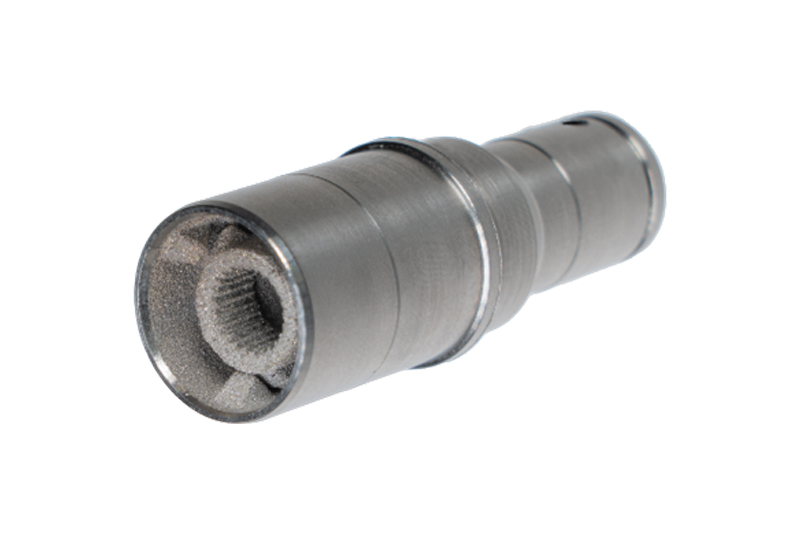
The civil world’s achievements are real, and hard-won. When Liebherr-Aerospace integrated a 3D-printed titanium flex shaft into the Airbus A350, replacing seven conventional parts with one printed component, the part carried full EASA approval for serial production. Satair, the Airbus services company, has certified more than 300 part numbers for AM across every Airbus aircraft family. Airbus Helicopters has been producing titanium locking shafts by AM since 2017, with more than 13,500 produced to date.
But those milestones came at a cost that the civil world is still reckoning with. When Premium AEROTEC qualified a multi-laser system for titanium components on the A320 family, they ran into a structural problem: a process qualified on a two-laser machine cannot simply transfer to a four-laser machine, even with the same manufacturer, same material, same geometry. The constraint lives in the documentation. And that documentation is the qualification. Process lock-in is a real barrier, and it slows the civil world’s ability to adopt improvements as they emerge.
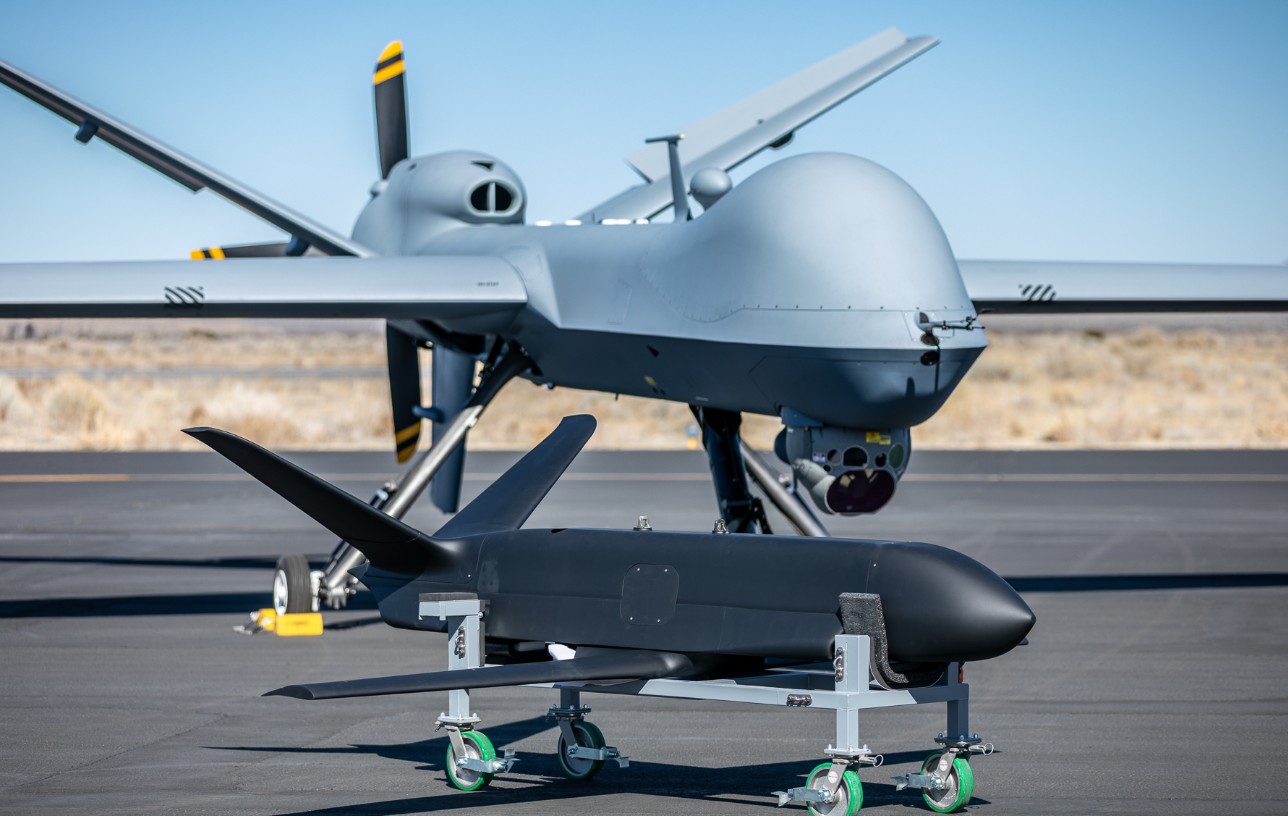
Defense has moved faster, and more visibly in recent years. GA-ASI flew its first metal-printed component in 2019, and has since reached a point where AM is present in more than 75% of the parts in some of its platforms.
L3Harris has cut production lead times on certain propulsion components by a factor of ten using large-format AM, and is building toward an end-to-end scramjet manufacturing capability that does not depend on an extended supply chain. The implicit promise behind both cases: if you control the qualification internally, you can move at the speed the mission requires.
Where the gap really shows up
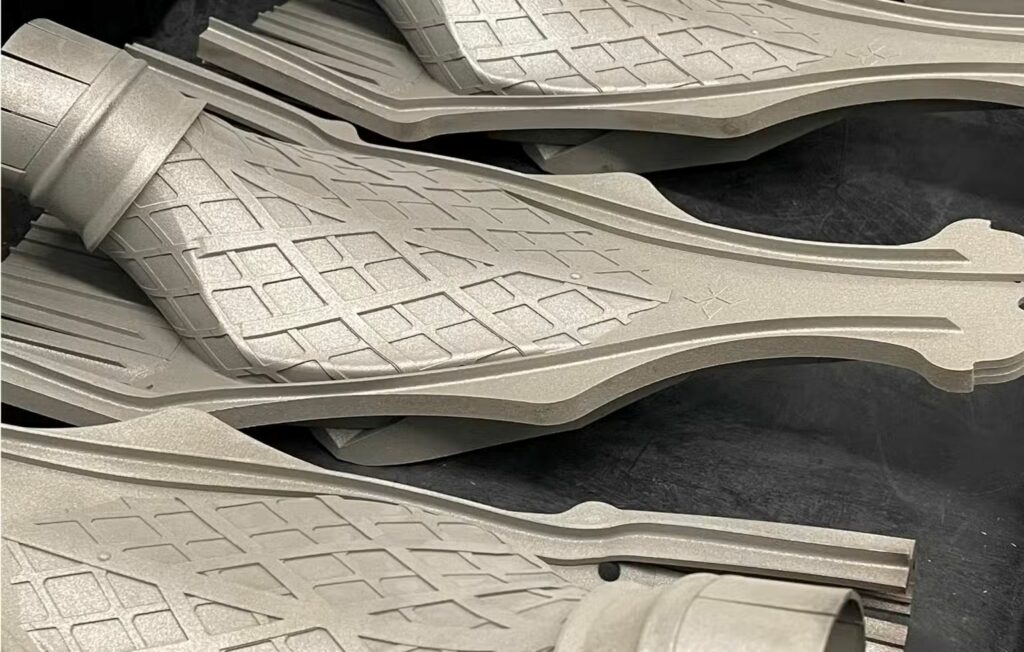
Courtesy of GA-ASI
There could be more, but so far, we have identified three fault lines define the divide.
Part-to-part variability is a challenge in both worlds, but managed differently. Civil certification requires statistically based material and process data at the time of qualification a large body of evidence, built systematically. Defense programs can sometimes accept a narrower dataset, particularly for lower-criticality applications, with the expectation that qualification will be revisited if the part migrates to a more demanding platform.
Process lock-in cuts deeper in civil aviation. Because commercial certification ties qualification to specific documented parameters, upgrading a machine or switching a material supplier can restart the clock. Defense programs, operating under internal design authority, adapt more quickly, at the cost of a less transparent audit trail.
Speed to field remains the starkest divergence. Civil certification timelines for safety-critical AM parts are measured in years. Defense qualification, under operational pressure, can compress dramatically. Whether the resulting part is equally trustworthy, and by whose definition, is a question the industry has not yet answered openly.
The convergence nobody is quite ready to name
There are signals, still tentative, that the two worlds are beginning to look at each other.
The US National Defense Authorization Act, signed in late 2025, introduced formal requirements around security, software control, data sovereignty, and qualification for AM in defense manufacturing.
The ASTM AMQ certification program, developed with Boeing, Lockheed Martin, Safran, and others, is an attempt to create a shared quality assurance baseline that spans civil and defense contexts. EASA‘s own certification memorandum flags explicitly that inconsistencies exist between civil and military standards on fatigue and vibration, and that dual-use parts need those differences resolved.
The infrastructure for convergence is being built. But the hard part — sharing real operational knowledge across cultures that don’t naturally communicate — hasn’t happened yet.
The conversation that needs to happen
The certification question in AM is often framed as a technical problem. At 3D ADEPT media, we believe it is also a cultural one: two industries with genuinely different risk tolerances and accountability structures have been developing their approaches to a shared technology in largely separate rooms.
What does the civil world offer that defense increasingly needs? Auditable, scalable qualification frameworks that can survive regulatory scrutiny and travel across supply chains. What does defense offer that civil aviation hasn’t built? The ability to iterate fast, qualify under pressure, and deploy AM where the logistics chain ends.
What each can learn from the other and whether anyone is actually doing that learning is the question this conversation requires.
On April 22, Hauke Schulz, AM Roadmap Leader at Airbus, and Steve Fournier, Technical Director of the Additive Design & Manufacturing Center of Excellence at GA-ASI, will address these questions directly in the first episode of Additive Talks, Season 6.
One has spent years building qualification frameworks across three Airbus business units with fundamentally different certification pressures. The other has led a defense prime through one of the most operationally ambitious AM deployments in the industry. Both have had to make real calls in real programs.
Wednesday, April 22 | 15:30–16:30 CEST | 09:30–10:30 EDT
Additive Talks is a panel series produced by 3D ADEPT Media, bringing together industry experts, technology providers, and decision-makers to discuss concrete applications, market trends, and real industrial use cases in additive manufacturing.