

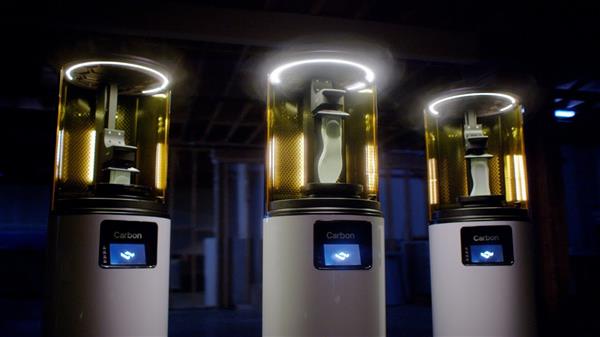
Carbon expands its portfolio with two new materials: Epoxy (EPX) 82 and Elastomeric Polyurethane (EPU) 41. Both materials that join the materials program of the company enable it to offer services in new applications.
EPX 82 is an engineering material with long-term durability, while EPU 41 is an elastomeric material which provides higher resilience for making durable, elastic lattices. What can you expect from each of these materials? EPX 82
The main characteristic of this material is that it is very resistant. It integrates a heat-deflection temperature of 125°C and is ideal for applications where strength, toughness, and thermal-cycling durability are necessary.
Connectors, brackets, and housings in the automotive and industrial sectors are a few examples of these sectors. Its mechanical properties can be compared to lightly glass-filled thermoplastics (e.g., 20% GF-PBT, 15% GF-Nylon) and meet the USCAR-2 fluid compatibility standards. The challenging aspect in the choice of this material relies on the fact that its mechanical properties must be maintained as the connector withstands harsh environmental conditions, including temperature-humidity cycling and exposure to caustic chemicals.
EPU 41
As part of Carbon’s elastomeric materials families (SIL 30, EPU 40, and EPU 41), the EPU 41 will be used to manufacture lattice geometries. In addition to its resilience at room and low temperatures, it is also a resistant material and which integrates energy return. Furthermore, with its elongation, it is ideal for cushioning, impact absorption, and comfort.
According to the company, the material will provide very good results in functional testing, including fatigue, hydrolysis, UV-stability, and plastic deformation tests. Advice to customers: “You can combine the performance of EPU 41 with Carbon’s exhaustive library of tunable elastomer lattices and software tools to rethink old benchmarks for comfort, safety and performance that were previously set by foam products. Carbon’s software tools also eliminate the conventional trial-and-error process of creating lattices, enabling designers and engineers to test load requirements, confirm it can be manufactured using Carbon’s technology, and create multiple functional zones within the same part.”
Last, it requires an MMD (meter, mix, and dispense) device for proper dispensing of the material in bulk quantities.
For further information about 3D Printing, follow us on our social networks and subscribe to our newsletter!
Would you like to be featured in the next issue of our digital magazine? Send us an email at contact@3dadept.com
THE 3D ADEPT WEEKLY NEWSLETTER
The industry moves fast. Stay ahead.
Every week, the latest additive manufacturing news, in-depth features and real-world applications, straight to your inbox. Plus, be the first to know when a new issue of 3D ADEPT Mag is out.
Free · One email a week · Unsubscribe anytime
Clicking loads our email provider’s sign-up form, including its analytics and Google’s anti-bot protection. You’re only subscribed if you complete the sign-up. Read our privacy policy.