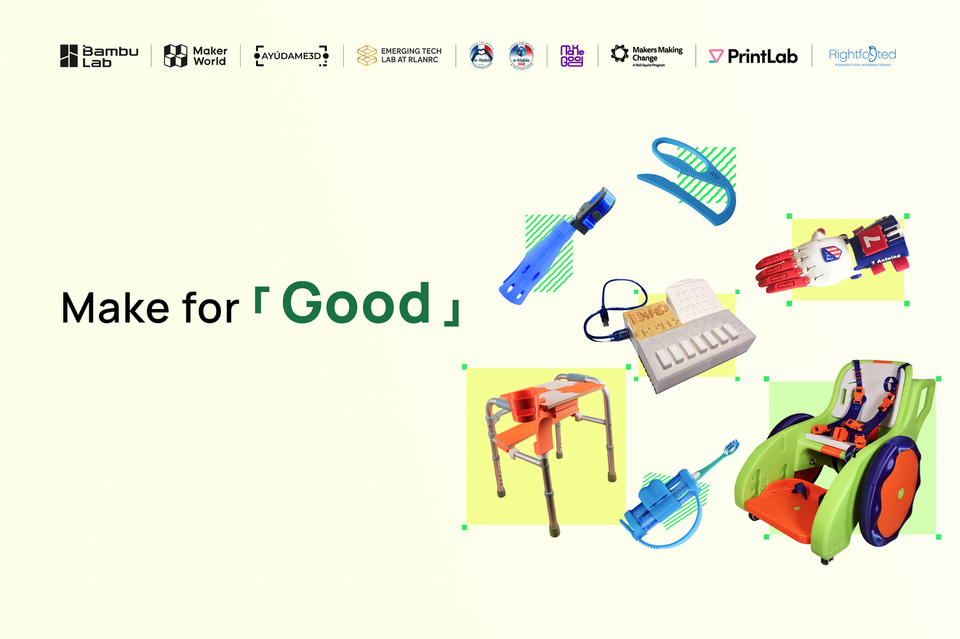
“From prints to people”. If this was a reality show, this is the title we would have given but it is not, yet we are talking about real people. 3D printer manufacturer Bambu Lab has launched Make for Good: Accessibility Design Contest, an accessibility challenge on MakerWorld built on 24 design briefs from seven organizations.
The organizations include:
- Ayúdame3D (Spain)
- e-NABLE France
- the Emerging Tech Lab at Rancho Los Amigos National Rehabilitation Center (US)
- MakeGood (US)
- Makers Making Change, run by the Neil Squire Society (Canada)
- PrintLab (UK)
- Rightfooted Foundation International (US)
Submissions run from September 24 to December.
The problem with many community-led accessibility projects is that oftentimes, there is no guarantee the solutions created would fit specific end-users. In this specific case, makers will have to design assistive devices about specific everyday tasks, such as putting on socks, carrying objects or playing sports.
The same partners will also handle distribution. Winning designs go into open libraries maintained by volunteer networks that operate in more than 70 countries. Makers Making Change alone has 40,000 volunteers and more than 30,000 devices delivered. e-NABLE France counts over 450 volunteers.
While Bambu Lab’s audience (over two million models on MakerWorld) will be put to work, the final judgment remains in the hands of partners.
What others did in the past
In 2013, MakerBot backed the Robohand project with printers, which helped spark the e-NABLE movement. Since then, the best-known effort has been PrintLab’s Make:able challenge. It is run with Autodesk and draws on a network of partners and sponsors that includes Prusa Research, MatterHackers and Makers Making Change. Today, Make:able is mostly an education program: it asks students and young makers to design for real people, and it sees design thinking as its main outcome.
What will define success
Running the contest is the easy part. Three questions will decide whether it matters:
- Will winning designs be maintained once the prizes are handed out?
- Can quality be controlled for devices that people rely on every day?
- Will Bambu Lab return to this subject, or will it stay a one-time effort?
I strongly believe that assistive technology is one of the clearest cases for local, personalized production. Consumer 3D printing brands like to say their machines “empower makers”. Bambu Lab is now embodying that during a challenge where the end user is not the maker.
*We curate insights that matter to help you grow in your AM journey. Receive them once a week, straight to your inbox. Subscribe to our weekly newsletter.