

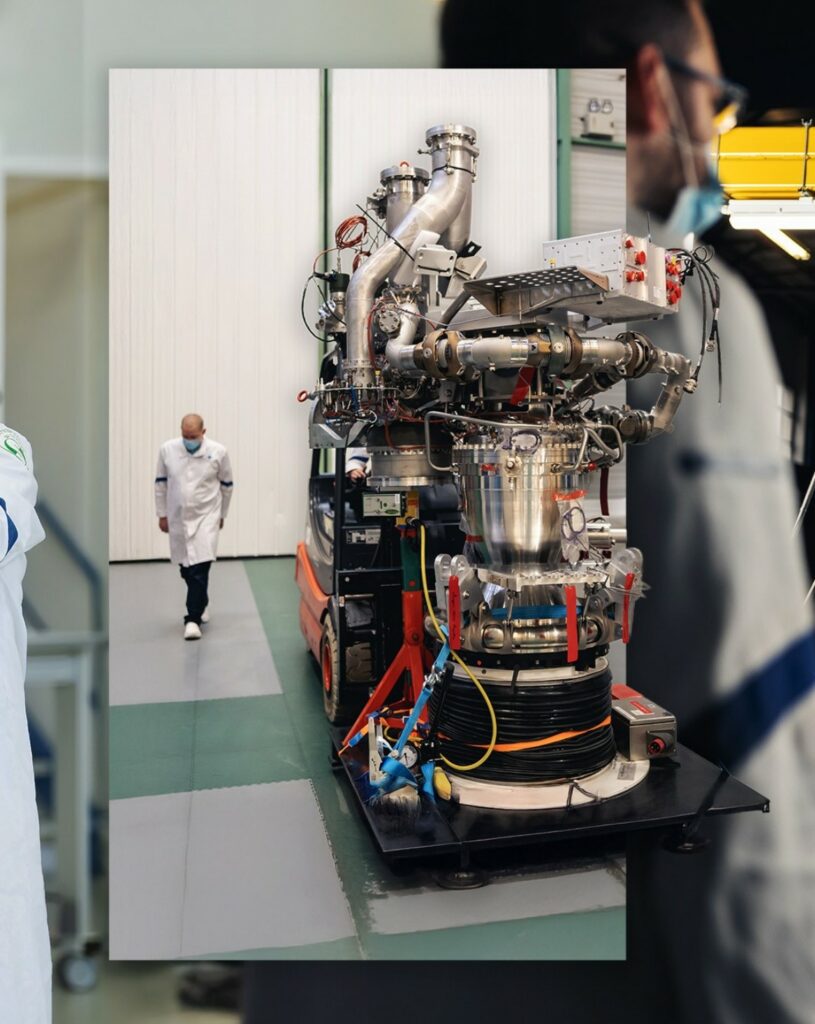
For decades, most rockets have worked like disposable cameras, used once and thrown away. Reusable rockets are more like airliners. They land, get checked, are refuelled, and fly again. With its rocket engine Prometheus, aerospace company ArianeGroup makes us believe it will probably give Europe its version of that model.
The Prometheus project started in 2015 with the French space agency CNES and has been backed by the European Space Agency (ESA) since 2017. It aims to produce a reusable engine that costs about one tenth of the Vulcain 2 engine that powered Ariane 5.
Two features set it apart: First, it runs on liquid oxygen and liquid methane, which burns cleaner than kerosene and leaves fewer residues, making reuse easier. Second, its power can be adjusted between 30 and 100%, like the accelerator pedal of a car.
While a health-monitoring system checks the engine, this control is crucial to land the rocket.
“An engine written in layers”
ArianeGroup describes the rocket engine of around 100 tons of thrust as being written in layers. Unlike conventional manufacturing processes that require the assembly of hundreds of parts, each machined, welded or bolted to the next (adding time, weight and a potential weak spot), many parts of the Prometheus engine are built as a single piece using additive manufacturing.
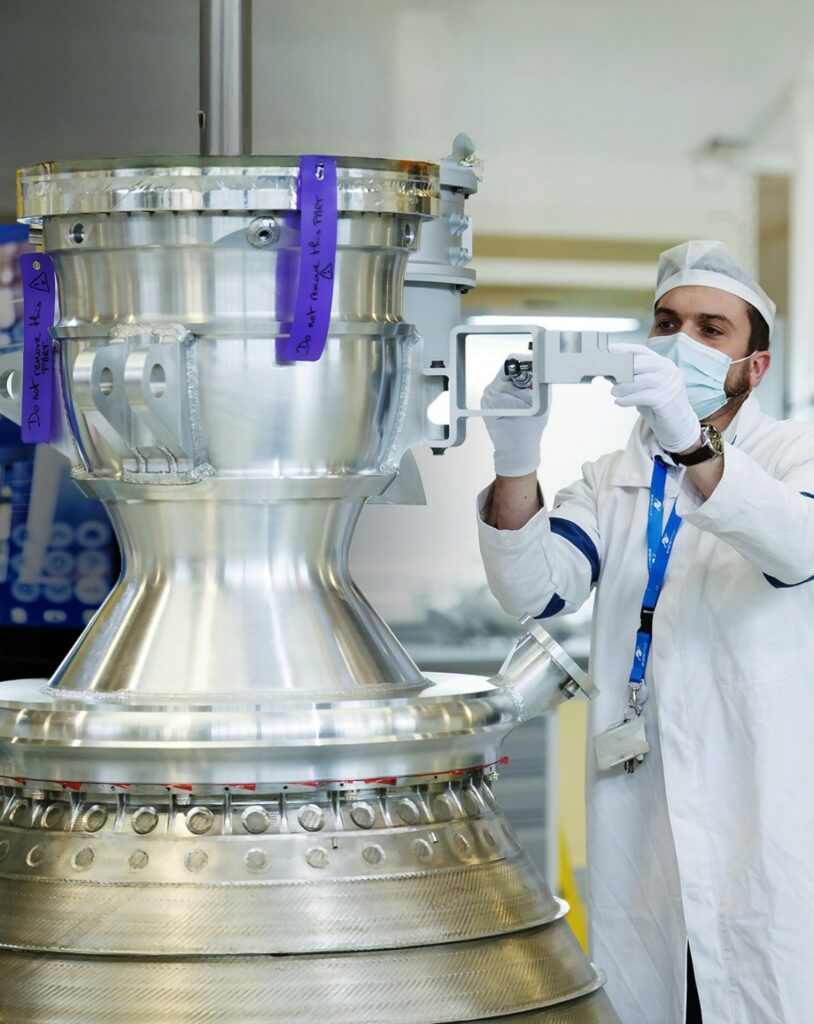
According to ArianeGroup, printed parts now account for 70% of Prometheus’ total mass, including the combustion chamber where fuel burns. That chamber is printed entirely at the company’s Ottobrunn site in Germany.
“By printing complex components as single pieces, additive manufacturing reduces material consumption, simplifies assembly, and enables lighter, highly integrated structures, while maintaining the performance required for reusable flight,” ArianeGroup explains.
The company already built up a rich experience in additive manufacturing. In 2018 for example, the team produced a 3D printed gas generator on the Vulcain 2.1 engine for Ariane 6. In 2020, they tested the company’s first 3D printed combustion chamber on a demonstrator.
More recently, its partnership with Nikon SLM Solutions on components over one cubic metre shows how far it intends to go. Prometheus is where these steps come together in one engine.
As discussed during one of our Additive Talks on low-cost propulsion, cost is now as important as performance. ArianeGroup says this approach enables serial production at a planned rate of 50 engines per year. This means Prometheus is being manufactured as a true industrial product.
What should we expect next?
All eyes are now on Themis, ESA’s reusable stage demonstrator, powered by a single Prometheus engine. Installed at the Esrange Space Center in Sweden, it completed a second full countdown rehearsal at the end of September 2026. The next milestone is its first “hop”: a short vertical take-off and landing. The EU-funded project behind these tests now runs until the end of 2026.
If the hop succeeds, Europe will have shown that a largely printed engine can fly, land and be prepared to fly again.
THE 3D ADEPT WEEKLY NEWSLETTER
The industry moves fast. Stay ahead.
Every week, the latest additive manufacturing news, in-depth features and real-world applications, straight to your inbox. Plus, be the first to know when a new issue of 3D ADEPT Mag is out.
Free · One email a week · Unsubscribe anytime
Clicking loads our email provider’s sign-up form, including its analytics and Google’s anti-bot protection. You’re only subscribed if you complete the sign-up. Read our privacy policy.