

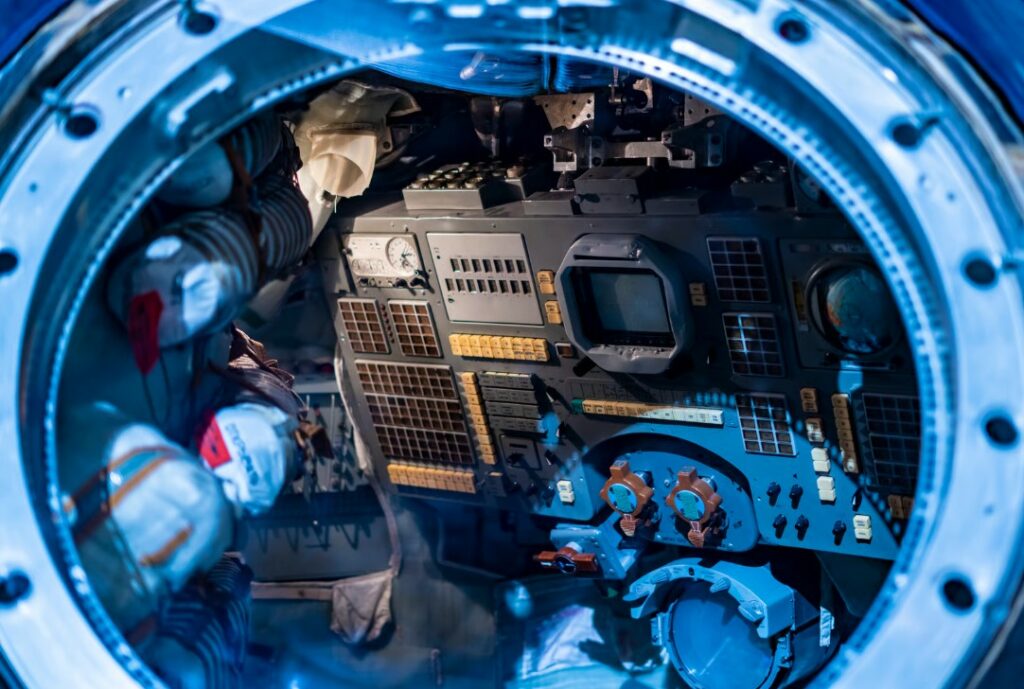
On January 12, the Institute of Mechanics from the Chinese Academy of Sciences (CAS) conducted an experiment with a recoverable scientific payload it developed.
The payload flew aboard the Lihong-1 Y1, a reusable commercial suborbital vehicle developed by CAS Space for space tourism. The vehicle conducted its first test flight on January 12 from the Jiuquan Satellite Launch Center in northwestern China.
According to CAS, once the Lihong-1 Y1 crossed the Kármán line—the 100-kilometer boundary between Earth’s atmosphere and outer space—and reached an altitude of around 120 kilometers, the experimental equipment autonomously 3D printed metal parts under microgravity conditions.
“This success marks China’s transition from ‘ground-based research’ to a new phase of ‘space engineering verification’ in metal additive manufacturing technology,” CAS said. “Our overall technical capabilities have reached world-leading levels.”
While this achievement is a key driver for future space infrastructure development, it is not without challenges. The engineering team in China faced challenges already observed in similar projects across the world: stable material transfer and shaping in microgravity, closed-loop control throughout the entire process, and highly reliable coordination between the payload and launch vehicle.
The mission further demonstrated the Lihong-1 Y1’s potential as a reliable experimental platform, combining relatively low launch costs with a high degree of flexibility. Beyond the onboard metal 3D printing equipment, the flight also carried rose seeds as part of agricultural research experiments, highlighting the vehicle’s ability to support a wide range of scientific payloads.
Developed as a multipurpose reusable spacecraft, the platform is undergoing extensive testing to integrate crew life-support systems and reliable escape technologies, said Wang Yingcheng, deputy chief designer. These efforts aim to boost low-cost suborbital research capabilities and pave the way for commercial space tourism.
Source: Institute of Mechanics, Chinese Academy of Sciences, 22 January 2026.
THE 3D ADEPT WEEKLY NEWSLETTER
The industry moves fast. Stay ahead.
Every week, the latest additive manufacturing news, in-depth features and real-world applications, straight to your inbox. Plus, be the first to know when a new issue of 3D ADEPT Mag is out.
Free · One email a week · Unsubscribe anytime
Clicking loads our email provider’s sign-up form, including its analytics and Google’s anti-bot protection. You’re only subscribed if you complete the sign-up. Read our privacy policy.