

Feature based on interviews from July/August 2023, published online in February 2024. Roles, product ranges and projects refer to that period.
Depowdering polymer parts raises specific questions about throughput, handling and safety. This feature brings together explanations from Solukon and DyeMansion, comparing them with operations used for some metal parts.
Parts produced in a powder bed need to be unpacked and cleaned before use. Further operations depend on the material, surface condition and application requirements. For Andreas Hartmann, founder and CEO/CTO of Solukon, these post-processing steps can “be divided into four categories: unpacking, cleaning (= depowdering / removing residual powder sticking (sintered) on the part surface), surface finishing (chemical or mechanical smoothing, polishing, blasting, infiltrating or milling, [coating and spray painting]) and coloring/dyeing.”
“Compared to Metal AM, there are even more processes for surface treatment and finishing in the post-processing of polymer components. This is because often the main goal of post-processing for polymer parts is a perfect resolution, look and color (automotive interior, glasses etc.) in addition to optimal functionality,” Hartmann adds.
Unpacking, depowdering and cleaning do not describe identical stages for every manufacturer. Unpacking frees parts from the powder cake. Cleaning then removes adhering residues, for example through brushing or media blasting appropriate to the material. A system may combine these functions, so comparisons should focus on the operation performed rather than its name alone.
Interestingly, the depowdering of plastic 3D printed parts can easily be understood by comparing the same process performed with metal 3D printed parts. That’s why, we have identified 4 key considerations that may help part manufacturers to better understand this process.
1. Relevant AM processes
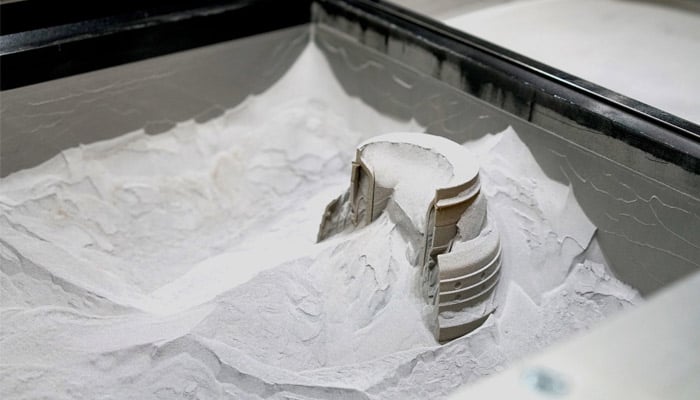
For Philipp Kramer, DyeMansion’s CTO and co-founder at the time of the interview, polymer powder-bed processes such as SLS, MJF, SAF and HSS require parts to be unpacked and cleaned. The process, powder and geometry determine depowdering requirements.
2. Part handling and cleaning
Here again, the depowdering technique is quite different from what one uses to see with metals. Two differentiating factors shared by Hartmann and Kramer are quantity and weight:
A polymer build box may contain many parts nested within the powder cake. Metal builds can also contain many parts: the distinction here is primarily between polymer parts lying freely in the powder bed and metal parts generally attached to a plate in laser powder-bed fusion. This comparison does not cover every metal AM process.
One challenge highlighted by the contributors is releasing parts without damaging thin features and then removing residues with an appropriate cleaning process. Removing powder from internal cavities and channels remains important for polymers too. Fragility depends on geometry and material, not simply on the label “plastic”.
In the polymer powder-bed applications discussed here, parts are not attached to a build plate by support structures. Batch treatment in a basket or on a belt may be suitable if the parts tolerate the handling and blasting media. For some metal parts still attached to the plate, depowdering may instead involve rotating the assembly.
Another challenge may come with the use of glass beads. Solukon’s spokesperson warns that during the depowdering process, the glass beads get statically charged and adhere to the component. These adhesions must be released again with ionized air. Furthermore, during the process, more and more powder gets into the blasting material which can result in an undesirable discoloration of the parts due to thermal processes (the surface gets hot when plastic particles hit the surface). Therefore, when depowdering polymers, special care must be taken to ensure that the glass bead quality remains high (as little powder residue as possible in the blasting material). To keep glass beads quality high and refreshing rates low, some systems like the Solukon system use ultrasonic screening.
In any cases, one should keep in mind that “depowdering in the polymer sector is normally the final cleaning process in postprocessing, whereas in metal processes the part may be contaminated again during support removal, for example, and must be fine-cleaned again at the end,” Hartmann outlines.
This comparison describes the workflows Hartmann discusses; it does not mean that polymer depowdering can never be followed by another operation or cleaning stage.
3. Selecting a machine

This is probably the most difficult consideration as there are a lot of options on the market and this article does not aim to study the unique features that set them apart. If each solution comes with its share of strengths and limitations, it’s important to keep in mind that applications, volume production, and costs are the key factors that may drive your choice for one solution or another.
“Some basic manual blasters might be suitable for both metal and plastic parts. Once you use automated solutions, there are major differences in the machine setup and the process as well. So, it is recommended for users to [rely on] systems that have been designed and dedicated to either metal or plastic. Handling metal or plastic powder requires quite different technological setups,” DyeMansion CTO outlines.
4. Risk prevention
Automation aims, among other things, to limit operators’ exposure to powder. It does not eliminate every risk: polymer dust, as well as metal dust, may present health, fire or explosion hazards depending on its properties and handling conditions.
Such hazardous dust can also be a risk for the operator’s health during the unpacking of plastic 3D printed parts due to the fact that they often manually uncover the parts from the powder cake.

“The creation of clouds of powder that could be inhaled is unavoidable [hence the need of] respiratory protections or dust-extraction units. Since the dimensions of the build job can be very large, manual unpacking in protected gloveboxes is difficult or impossible due to the limited accessibility.
Since a high throughput of components is required in large production facilities, a lot of powder is also processed. Reducing human contact with hazardous powder is an even more pressing concern in the polymer field than in the metal field. The dust-free production must be the goal with regard to occupational safety and health protection. This calls for automated, sealed and consistent postprocessing of polymers without any manual intervention,” Hartmann alerts.
Handling under an inert atmosphere may be required for particular metal powders and operations. The polymer installations discussed in this interview use other preventive measures. However, neither the polymer classification nor cooling alone establishes that a powder is safe.
“Gentle cleaning processes with a low risk of dust formation and charging of the powder, a system design free of ignition sources and suitable dust extraction can sufficiently reduce the explosion hazard of polymer powders. Unpacking and depowdering only take place when the polymer parts have cooled down and therefore no inert gas is required. Oxidative processes only play a role in the build process and cooling, not in unpacking or depowdering,” Hartmann concludes.
These comments describe Solukon’s approach for the equipment discussed. They are not a universal exemption from inerting or a guarantee against explosion. OSHA notes that plastic dust can be explosible under certain conditions. Appropriate measures must be based on the powder, its safety data sheet, the equipment and a risk assessment.
This article has first been published in the July/August 2023 edition of 3D ADEPT Mag.
A few words on the contributing companies
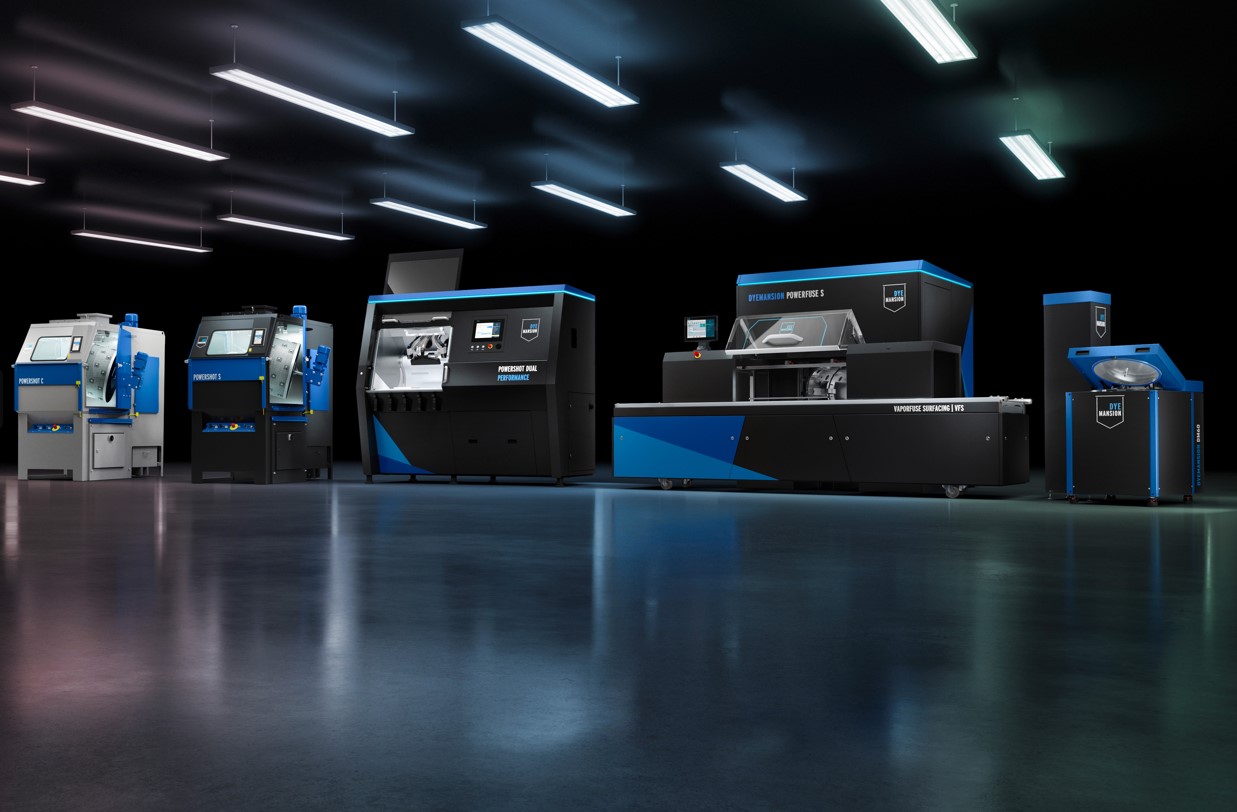
At the time of the interview, DyeMansion described the following range. DyeMansion GmbH provides connected & fully integrated end-to-end solutions for all finishing steps for 3D-printed polymer parts. They specifically offer two different systems for the depowdering step. The classic Powershot C, which is an automated solution for handling small to medium batches, and the Powershot Performance C/Dual, which is dedicated to larger batches, digitally and physically integrated production setups. The latter comes with all digital interfaces and process control that is required for a full traceable manufacturing and can combine the cleaning and surfacing in one system. Both systems can also work with the PolyShot Cleaning process, which offers several advantages over traditional depowdering with glass and has been developed specifically for 3D printed plastic parts. The company believes that the right gentle depowdering plays a vital role in achieving reproducible results in surface smoothing and coloring.
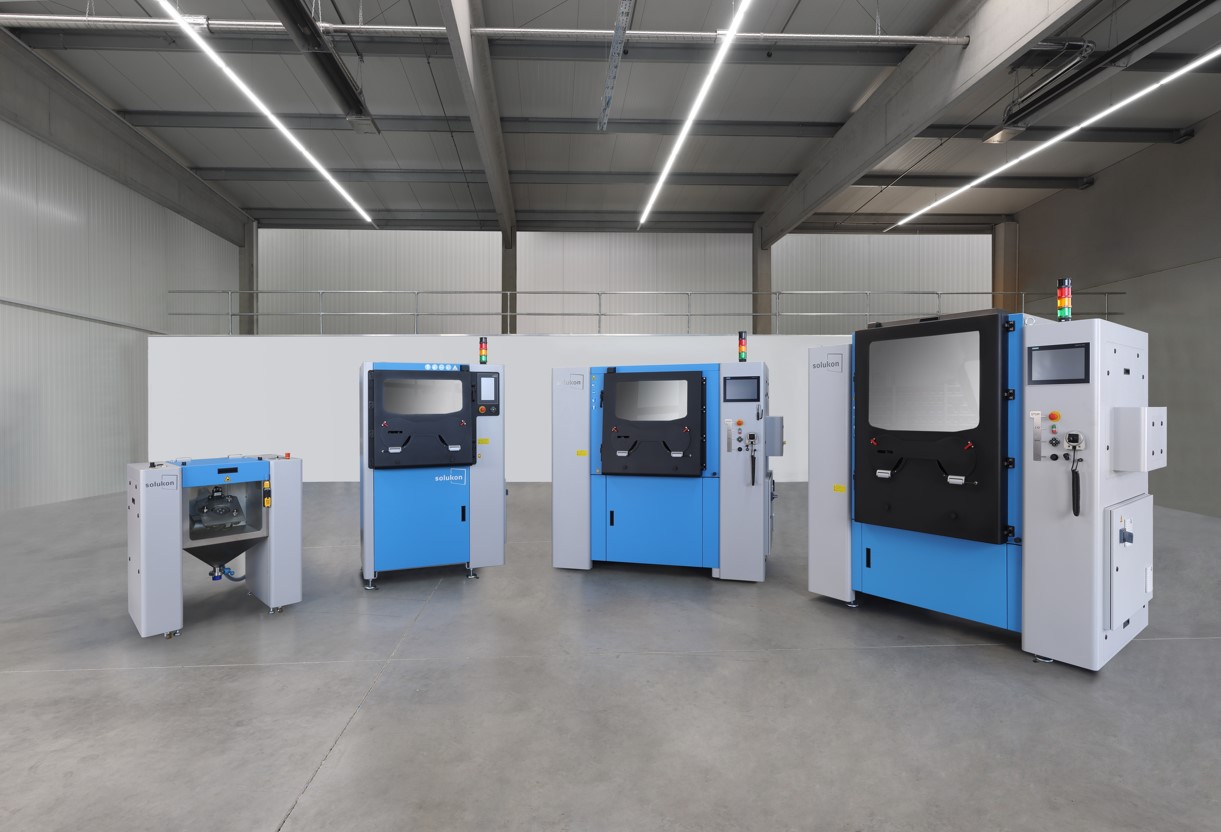
Solukon presents the SFP770 as a system combining automated unpacking and cleaning of SLS parts. Its product documentation specifies compatibility with the EOS P 770 and, with adapters, the FORMIGA P 110 and EOS P 500. The workflow comprises loading, unpacking, transfer and cleaning. According to the company, an ultrasonic sieve separates powder residues from the glass beads to support their reuse. Performance benefits and the claim of uniqueness remain manufacturer claims; this feature is not an exhaustive market comparison.
Solukon describes the enclosed workflow as a way to reduce dust dispersion and handling. Productivity and safety benefits need to be assessed under the actual conditions of each installation.
THE 3D ADEPT WEEKLY NEWSLETTER
The industry moves fast. Stay ahead.
Every week, the latest additive manufacturing news, in-depth features and real-world applications, straight to your inbox. Plus, be the first to know when a new issue of 3D ADEPT Mag is out.
Free · One email a week · Unsubscribe anytime
Clicking loads our email provider’s sign-up form, including its analytics and Google’s anti-bot protection. You’re only subscribed if you complete the sign-up. Read our privacy policy.