

According to Z2I, the manufacturing of the Rocket engine will include the use of artificial intelligence (AI) and neural networks to improve the cooling of the thrust chamber via structures that cannot be manufactured conventionally.
Zero 2 Infinity is a Barcelona-based company specialized in Near Space transportation of components requiring testing and certification in Space conditions. The company is also working on small satellites into orbit with the Bloostar launcher project.
As for FADA, it is a NGO that wants to promote and develop technological knowledge and its transfer to the aerospace industry. CATEC, the Advanced Center for Aerospace Technology is managed by FADA hence the name FADA CATEC. The organization develops application for Space and aeronautics, including hardware for critical and secondary structures using additive manufacturing.
Why 3D printing and AI for the manufacturing of TEIDE?
Jose Mariano Lopez-Urdiales, founder and CEO of Zero 2 Infinity explains us that traditional rockets have had straight cooling channels because that’s all that could be manufactured. 3D printing and AI have enabled to the manufacturing to evolve and to achieve things that were not possible before.
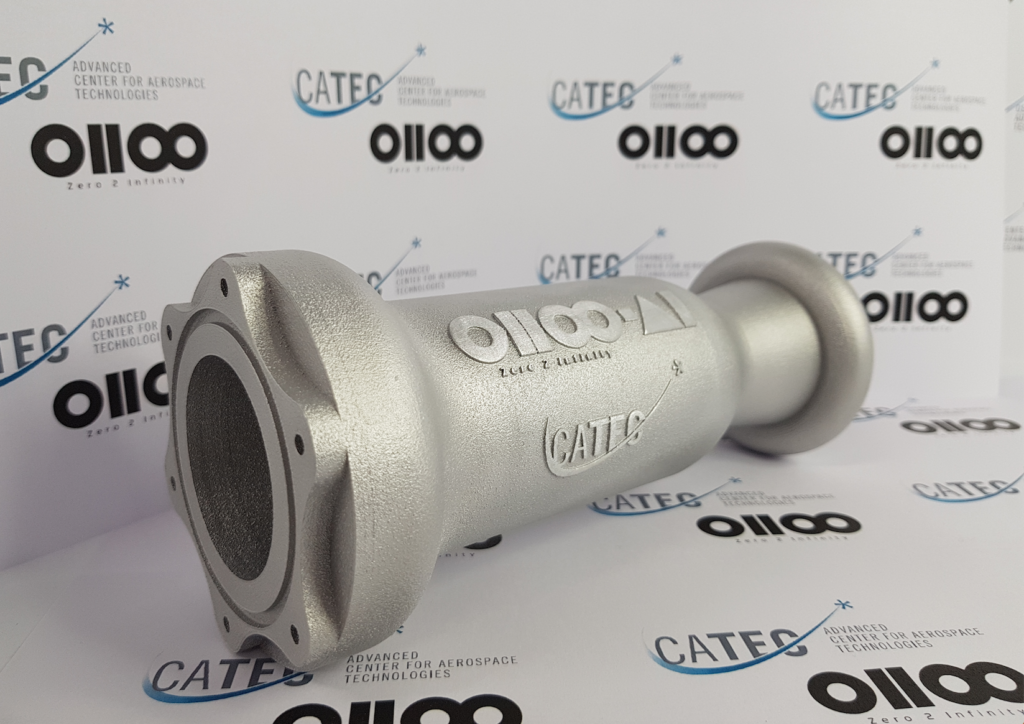
Combustion chamber of Bloostar’s engine named Teide I. 3D printed in FADA-CATEC. Bloostar is Zero 2 Infinity’s small satellite launcher.
Furthermore, the company has been able to save time and cost during the production, as well as to manufacture while respecting the environment.
It should be noted that Teide (Bloostar’s engine) comes from the Spanish highest mountain, a volcano that is no longer active. The volcano is located in Tenerife where the rocket will be launched from.
“Bloostar first stage is a balloon that brings the rocket above 99% of the mass of the atmosphere, where the aerodynamic resistance is almost non-existent. This method yields significant advantages compared to ground or aircraft-based launchers. A clear advantage is that the engines work more efficiently in near vacuum. Thus, Teide has a unique design to be specifically launched from a high altitude and is the most eco-friendly engine designed up to date.”
For further information, follow us on our social media and subscribe to our newsletter!
Would you like to be featured in the next issue of our digital magazine? Send us an email at contact@3dadept.com
//pagead2.googlesyndication.com/pagead/js/adsbygoogle.js
(adsbygoogle = window.adsbygoogle || []).push({});
THE 3D ADEPT WEEKLY NEWSLETTER
The industry moves fast. Stay ahead.
Every week, the latest additive manufacturing news, in-depth features and real-world applications, straight to your inbox. Plus, be the first to know when a new issue of 3D ADEPT Mag is out.
Free · One email a week · Unsubscribe anytime
Clicking loads our email provider’s sign-up form, including its analytics and Google’s anti-bot protection. You’re only subscribed if you complete the sign-up. Read our privacy policy.