

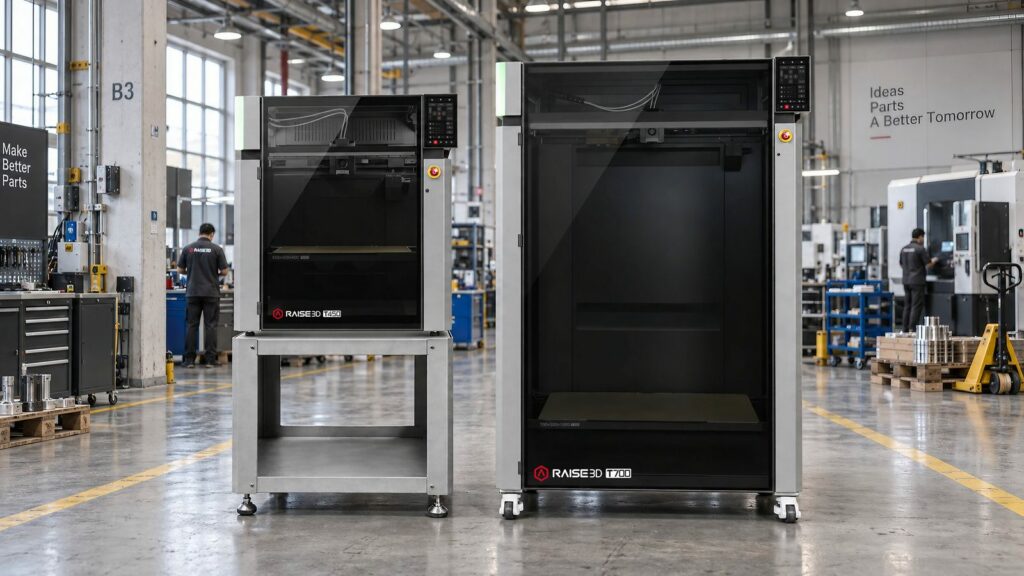
3D printer manufacturer Raise3D has unveiled T450 and T700, two large-format fused filament fabrication 3D printers with an actively heated chamber. Both will make their public debut at Formnext 2026. Described as the most affordable industrial machines of this size to offer such a chamber,the 3D printers are available at US$4,999 and US$15,999 respectively.
When a large part doesn’t fit on the printer’s build plate, manufacturers have to split it into smaller sections and assemble them afterward, creating extra labor and cost. To address this issue, the T450 prints parts up to 450 × 350 × 400 mm (63 L), in a chamber that can reach 70°C whereas the T700 goes up to 700 × 500 × 1,000 mm (350 L), with a chamber limited to 60°C.
According to Raise3D, the smaller model targets fixtures, casting patterns, big prototypes and production aids; The larger one is meant for large tooling and patterns.
Similarities between the two large-format 3D printers
Both machines are built on the same platform. Their motion system, called 4MD CoreXY, relies on four motors fixed to the frame, which would limit vibrations and layer shifts over long distances.
The TwinFlow™ extrusion pushes two filaments into a single nozzle and would reach 600 mm/s and 80 mm³/s. It should be noted that the flow figure was measured by Raise3D with its own Hyper Speed ABS V2 filament and a 0.4 mm nozzle.
The hot end climbs to 420°C and the bed to 120°C, enough for carbon fiber-filled PET, PPA and PPS. As far as the chamber is concerned, a system named Air Flow Manager 2 sets the temperature according to the material, and cools the part instead when printing PLA.
Speed has long been a priority for the manufacturer, which upgraded its Hyper FFF technology for the Pro2 Series in 2023.
To illustrate why size matters, CEO Edward Feng chooses a medical example: “Larger build areas open up applications that were previously limited by size. A scoliosis brace is one of them. […] On the T450, an adolescent brace fits inside the 450 × 350 mm build area with room to spare, so it comes off the machine as a single part.”
On the industrial side, the company printed battery cell transport trays on both machines. Lead time would have gone down from around 40 days to 10, and each tray would weigh about 2 kg instead of 8 kg.
Update on its SLS 3D printing portfolio
Through software update, owners of the RMS220 selective laser sintering (SLS) printer gain 100 mm in height, for a build envelope of 220 × 220 × 450 mm (about 21.8 L), with no change to the hardware.
In April, Raise3D teamed up with AMT to offer end-to-end SLS post-processing in Europe around the RMS220. Not surprisingly, it now launches its own sandblasting station, the B520, which can also clean parts coming from third-party SLS, MJF, SAF and HSS machines.
Last but not least, Raise3D reports a US$15 million funding round completed this month, to finance development in FFF, SLS and DLP and the move into new applications.
T450 deliveries start by the end of December 2026; the T700 should follow by the end of January 2027. Prices do not include configuration, taxes, shipping or service.
Visitors can see both printers in Frankfurt from November 17 to 20, in Hall 12.1, Stand D21.
At this price, a heated chamber and a fiber-ready nozzle bring large engineering-material parts within reach of workshops that have mostly used FFF for prototypes so far.
THE 3D ADEPT WEEKLY NEWSLETTER
The industry moves fast. Stay ahead.
Every week, the latest additive manufacturing news, in-depth features and real-world applications, straight to your inbox. Plus, be the first to know when a new issue of 3D ADEPT Mag is out.
Free · One email a week · Unsubscribe anytime
Clicking loads our email provider’s sign-up form, including its analytics and Google’s anti-bot protection. You’re only subscribed if you complete the sign-up. Read our privacy policy.