

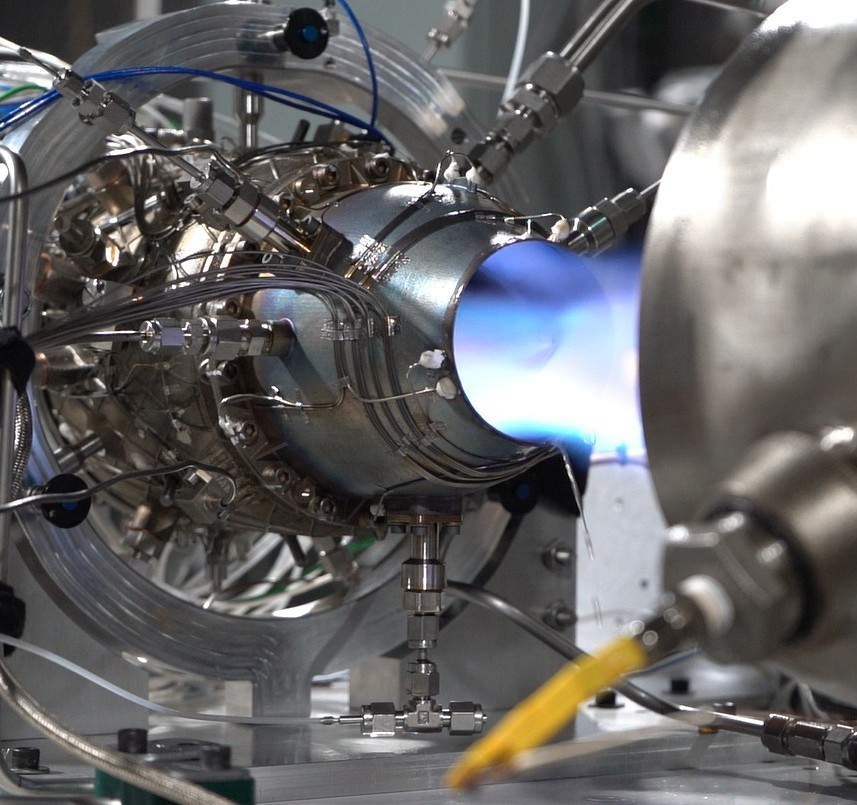
Four months. That is how long Beehive Industries needed to take its Frenzy 6 engine from finalized requirements to a prototype on the test stand.
The Colorado-based manufacturer of additively manufactured jet engines for uncrewed aerial defense aimed to achieve three main objectives during the testing of its 100 lbf Frenzy 6 prototype: reliability, engine performance and operability.
The engine was first test-fired on September 23 at Beehive’s headquarters, four months after the company finalized requirements with its U.S. Air Force customer. In an early run that same month, the prototype, referred to as the Zero Engine to Test (ZETT), ramped up to 80,000 RPM.
The Frenzy 6 engine
Frenzy 6 is the second member of the Frenzy engine family, after the 200 lbf Frenzy 8. To design it, Beehive’s engineers reused the design principles and lessons learned from the larger engine. Frenzy 8’s development is supported by the $29.7 million U.S. Air Force contract announced in April.
“Frenzy 8 validated how we design and scale a concept at unprecedented speed,” said David Kimball, Chief Technology Officer at Beehive. According to him, those lessons allowed the team to iterate faster on Frenzy 6, and the four-month leap from requirements to test shows what an additively enabled approach can deliver.
According to Gordie Follin, Chief Product Officer, Frenzy 6 is a compact version of Frenzy 8 designed for smaller munitions, drones and UAVs. In these segments, defense customers increasingly look for “affordable mass”: systems that can be produced in large numbers at a cost low enough to make them expendable.
The key role of additive manufacturing here
When Beehive completed the first fire tests of its demonstrator in 2024, it shared that hundreds of conventional parts had been consolidated into 15 primary components, for a price the company estimated at roughly half that of traditionally developed engines. This part consolidation’s approach to manufacturing was applied to Frenzy 6: Fewer parts mean fewer interfaces to design, fewer suppliers to qualify and fewer assembly steps to validate.
In practice, this shortens the print-test-redesign loop that Beehive credits for Frenzy 6’s timeline. The U.S. Army also recently applied this approach during the flight-test of the 3D printed heavy-fuel rotary engine on its VICTOR drone.
Following its investments in Southwest Ohio, the acquisition of two Cincinnati-area machine shops, and its recent acquisition of EOS 3D printers, we can’t wait to see how Beehive Industries will reach its goal of manufacturing more than 8,000 jet engines per year.
THE 3D ADEPT WEEKLY NEWSLETTER
The industry moves fast. Stay ahead.
Every week, the latest additive manufacturing news, in-depth features and real-world applications, straight to your inbox. Plus, be the first to know when a new issue of 3D ADEPT Mag is out.
Free · One email a week · Unsubscribe anytime
Clicking loads our email provider’s sign-up form, including its analytics and Google’s anti-bot protection. You’re only subscribed if you complete the sign-up. Read our privacy policy.